IX.8.8 Pompeii. House of Primigenia. Excavated 1880.
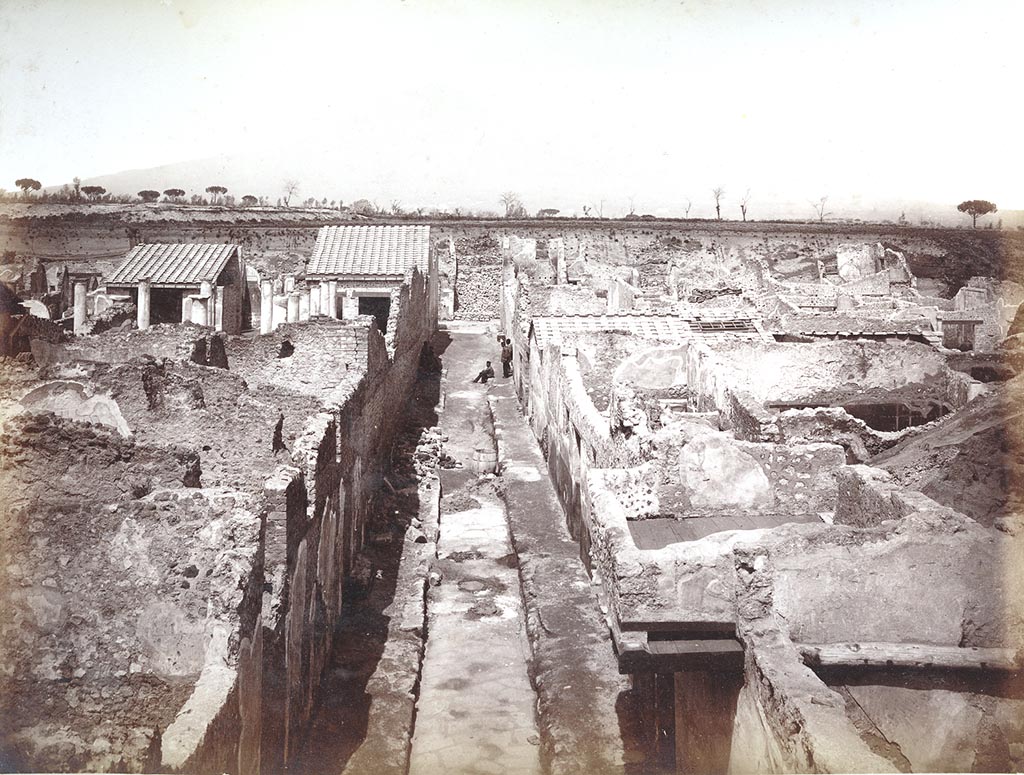
IX.8.8 Pompeii, on left. Undated photo by Sommer numbered 1298.
Looking north along unnamed vicolo between IX.8 on left and IX.9 on right, with ongoing work taking place in the vicolo.
Photo courtesy of Espen B. Andersson.
![IX.8.8 Pompeii. May 2005. Entrance.
According to NdS, on the east side of the insula called “of the Centenary” written in red but nearly vanished was the recommendation -
C……STIVM BALBVm
/
priMIGENIA ROgat
/
…AFRA… [CIL IV, 3773]
See Notizie degli Scavi, 1888, p.521-2
According to Epigraphik-Datenbank Clauss/Slaby (See www.manfredclauss.de), this read -
Q(uintum) B[ru]ttium Balbu[m]
[6]
Iul[ia Pri]migenia ro[gat]
[3]a et
M[3]aera [CIL IV, 3773]](9%2008%2008_files/image004.jpg)
IX.8.8 Pompeii. May 2005. Entrance.
According to NdS, 1888, on the east side of the insula called “of the Centenary” written in red but nearly vanished was the recommendation -
C……STIVM BALBVm
/
priMIGENIA ROgat
/
…AFRA… [CIL IV, 3773]
See Notizie degli Scavi di Antichità, 1888, p.521-2
According to Epigraphik-Datenbank Clauss/Slaby (See www.manfredclauss.de), this read as -
Q(uintum)
B[ru]ttium Balbu[m]
[6]
Iul[ia
Pri]migenia ro[gat]
[3]a et
M[3]aera [CIL IV, 3773]
![IX.8.8 Pompeii. According to NdS 1888, on the same wall, in large red letters on a large “tabella ansata” was the above recommendation. Although the name of the candidate L. Statius Receptus, was new to Sogliano in 1888, the writer of the electoral programme, Aemilius Celer, called him a “neighbour”. As Aemilius Celer was thought to have lived opposite this recommendation, it was thought L. Statius Receptus possibly also lived somewhere in this small vicolo. Remarkable is the expletive “Invidiose qui deles aegrotes” addressed to the envious that might have defaced or crossed out the programme.
See Notizie degli Scavi, 1888, p.521-2
Della Corte described CIL IV 3775 as coming from the house “opposite the entrance” of the house of Aemilius Celer, which would be IX.8.8 -
L. Statium Receptum
Il vir(um) i(ure) d(icundo) o(ro) v(os) f(aciatis. Vicini dig(num) (civem) (rogant)
Scr(ipsit) Aemilius Celer vic(inus) Invidiose qui deles aegrote [CIL IV 3775]
See Della Corte, M., 1965. Case ed Abitanti di Pompei. Napoli: Fausto Fiorentino. (p.166)
According to Cooley this translated as –
Neighbours beg you to elect Lucius Statius Receptus, duumvir, with judicial power, a worthy man.
Aemilius Celer wrote this, a neighbour.
You jealous one who destroys this, may you fall ill. [CIL IV 3775]
See Cooley, A. and M.G.L., 2004. Pompeii : A Sourcebook. London : Routledge. (p.126, F79).](9%2008%2008_files/image006.jpg)
IX.8.8 Pompeii. According to NdS 1888, on the same wall, in large red letters on a large “tabella ansata” was the above recommendation.
Although the name of the candidate L. Statius Receptus, was new to Sogliano in 1888, the writer of the electoral programme, Aemilius Celer, called him a “neighbour”.
As Aemilius Celer was thought to have lived opposite this recommendation, it was thought L. Statius Receptus possibly also lived somewhere in this small vicolo.
Remarkable is the expletive “Invidiose qui deles aegrotes” addressed to the envious that might have defaced or crossed out the programme.
See Notizie degli Scavi di Antichità, 1888, p.521-2
Della Corte described CIL IV 3775 as coming from the house “opposite the entrance” of the house of Aemilius Celer, which would be IX.8.8 -
L. Statium Receptum
Il vir(um) i(ure)
d(icundo) o(ro) v(os)
f(aciatis. Vicini dig(num)
(civem) (rogant)
Scr(ipsit) Aemilius
Celer vic(inus) Invidiose
qui deles aegrote [CIL IV 3775]
See Della Corte, M., 1965. Case ed Abitanti di Pompei. Napoli: Fausto Fiorentino. (p.166)
According to Cooley this translated as –
Neighbours beg you to elect Lucius Statius Receptus, duumvir, with judicial power, a worthy man.
Aemilius Celer wrote this, a neighbour.
You jealous one who destroys this, may you fall ill. [CIL IV 3775]
See Cooley, A. and M.G.L., 2004. Pompeii: A Sourcebook. London: Routledge. (p.126, F79).
![IX.8.8 Pompeii. March 2009. Street Altar on north side of entrance doorway. According to Della Corte, this street altar was dedicated to the god Salus, as shown by the painted epigraph – Salutis e Salutei sacrum [CIL IV 3774 a,b] Also found on the right (north) of the entrance, was a recommendation – Primigenia rog(at) [CIL IV 3773]
See Della Corte, M., 1965. Case ed Abitanti di Pompei. Napoli: Fausto Fiorentino. (p.165)
According to Epigraphik-Datenbank Clauss/Slaby (See www.manfredclauss.de), these read –
Salutis
/Salutei
sacrum [CIL IV 3774 ]
Q(uintum) B[ru]ttium Balbu[m]
[6]
Iul[ia Pri]migenia ro(gat)
[3]a et
M[3] aera [CIL IV 3773]
According to Cooley, this translates to – “Sacred to the Well-being” [CIL IV 3774]. Above the street altar was a painting of two horns-of-plenty and a garland. See Cooley, A. and M.G.L., 2004. Pompeii : A Sourcebook. London : Routledge. (p.109)
According to Helbig, this was the only altar found that was not dedicated to the street gods. On the wall above two cornucopias, the words “Salutei Sacrum” (Sacred to Salus) were painted – the Goddess of Health was worshipped here. See Helbig, W., 1868. Wandgemälde der vom Vesuv verschütteten Städte Campaniens. Leipzig: Breitkopf und Härtel. (p.235)](9%2008%2008_files/image008.jpg)
IX.8.8 Pompeii. March 2009. Street Altar on north side of entrance doorway.
According to Della Corte, this street altar was dedicated to the god Salus, as shown by the painted epigraph –
Salutis e Salutei
sacrum
[CIL IV 3774 a,b]
Also found on the right (north) of the entrance, was a recommendation – Primigenia rog(at) [CIL IV 3773]
See Della Corte, M., 1965. Case ed Abitanti di Pompei. Napoli: Fausto Fiorentino. (p.165)
According to Epigraphik-Datenbank Clauss/Slaby (See www.manfredclauss.de), these read –
Salutis
/Salutei
sacrum [CIL IV 3774 ]
Q(uintum) B[ru]ttium Balbu[m]
[6]
Iul[ia Pri]migenia ro(gat)
[3]a et
M[3] aera
[CIL IV 3773]
According to Cooley, this translates to – “Sacred to the Well-being” [CIL IV 3774].
Above the street altar was a painting of two horns-of-plenty and a garland.
See Cooley, A. and M.G.L., 2004. Pompeii: A Sourcebook. London: Routledge. (p. 109)
According to Helbig, this was the only altar found that was not dedicated to the street gods.
On the wall above two cornucopias, the words “Salutei Sacrum” (Sacred to Salus) were painted – the Goddess of Health was worshipped here.
See Helbig, W., 1868. Wandgemälde der vom Vesuv verschütteten Städte Campaniens. Leipzig: Breitkopf und Härtel. (p. 235)
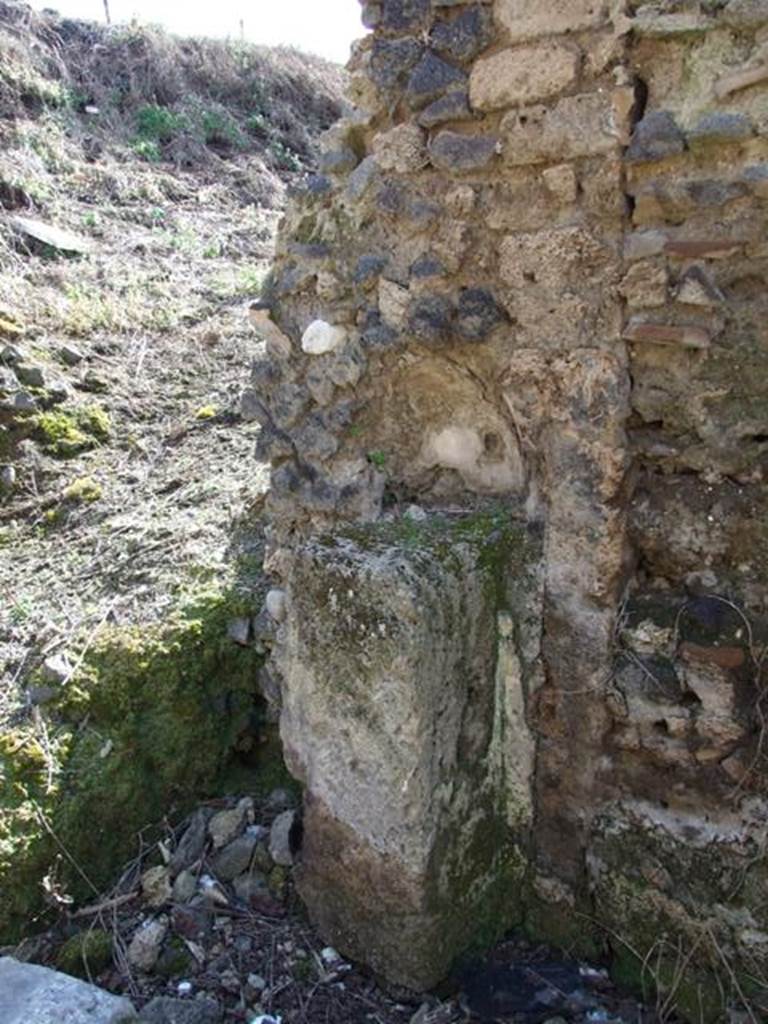
IX.8.8 Pompeii. March 2009. Street altar on north side of entrance doorway.
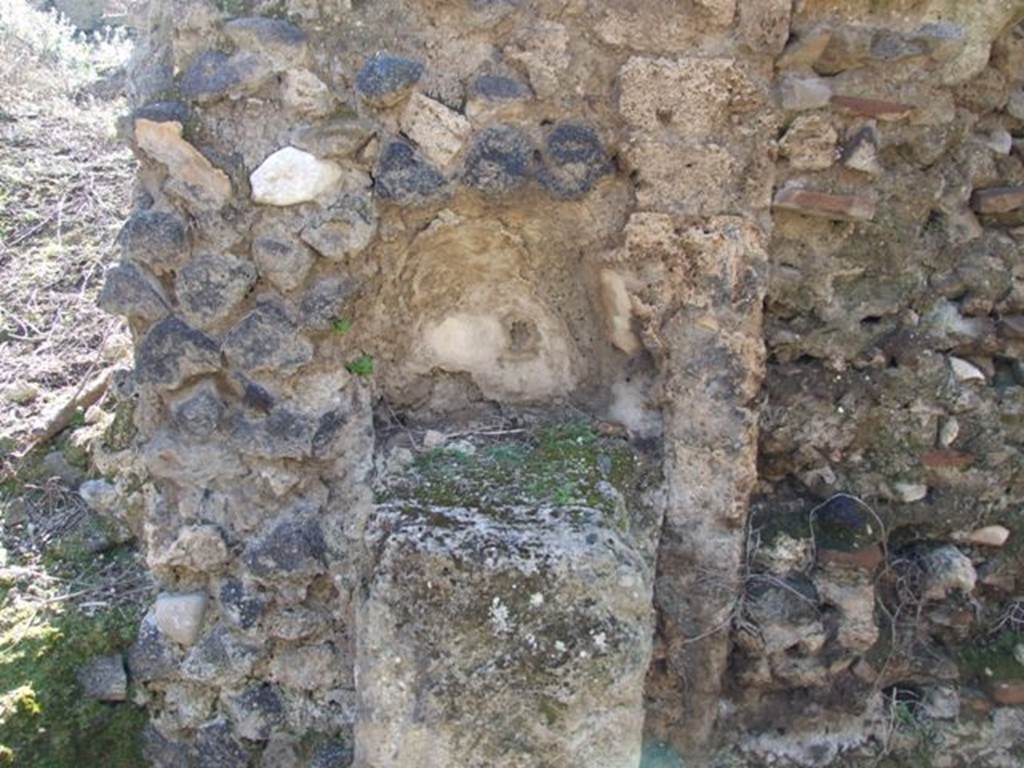
IX.8.8 Pompeii. March 2009.
Street altar with small semicircular niche built into the wall above, on north side of entrance doorway.
According to NdS -
on the left above the niche on a layer of flaked lime but hardly visible, were the painted remains of the upper part of a Genius (?) with cornucopia.
On this was written in black letters SALV…..
In the centre was a large cornucopia surrounded by garlands.
At the top, the layer of lime had fallen, and on an underneath layer written in black lettering, more wording was visible -
SALVTEI
C
See Notizie degli Scavi di Antichità, 1888, p.521-2
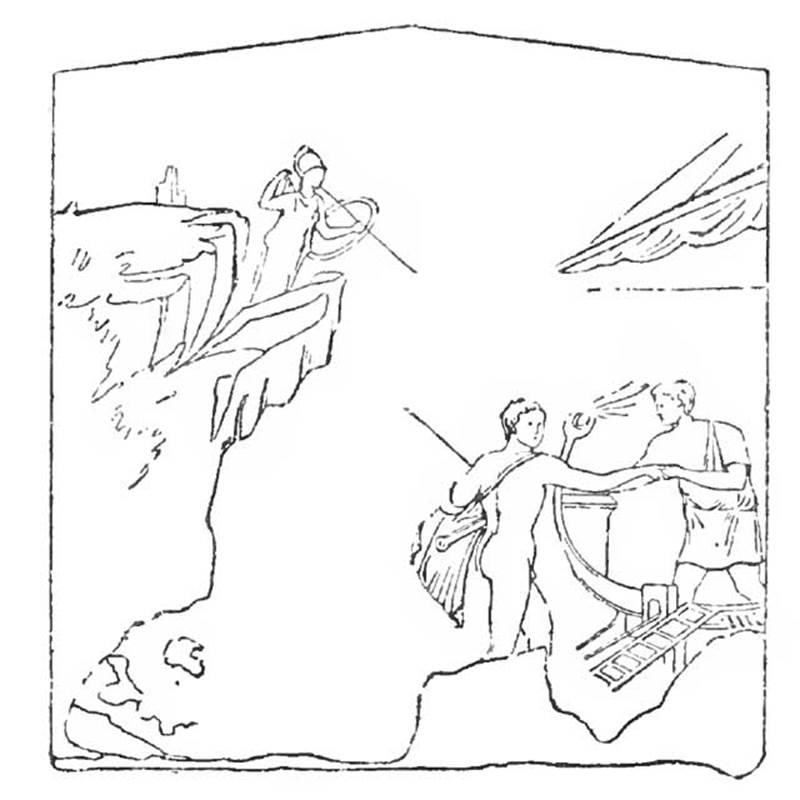
IX.8.8 Pompeii. 1890 sketch of painting of Theseus abandoning Ariadne.
According to NdS, in a room, not yet entirely excavated in 1891, of a small house to the south of the House of the Centenary, a badly conserved painting was found on the west wall.
It showed Theseus abandoning Ariadne. It was 1.09m high by 1m wide.
The sleeping Ariadne was on the left but was completely destroyed.
On the right is a ladder which acts as a bridge resting on the prow of the ship.
On the bridge is the naked Theseus giving his right hand to a bearded sailor who helps him climb aboard.
In the background is a cliff, behind which Pallas descends from above, armed with helmet shield and spear.
See Bullettino dell’Instituto di Corrispondenza
Archeologica (DAIR), 1890. p. 277.
See Notizie degli Scavi di Antichità, 1891,
p. 265.
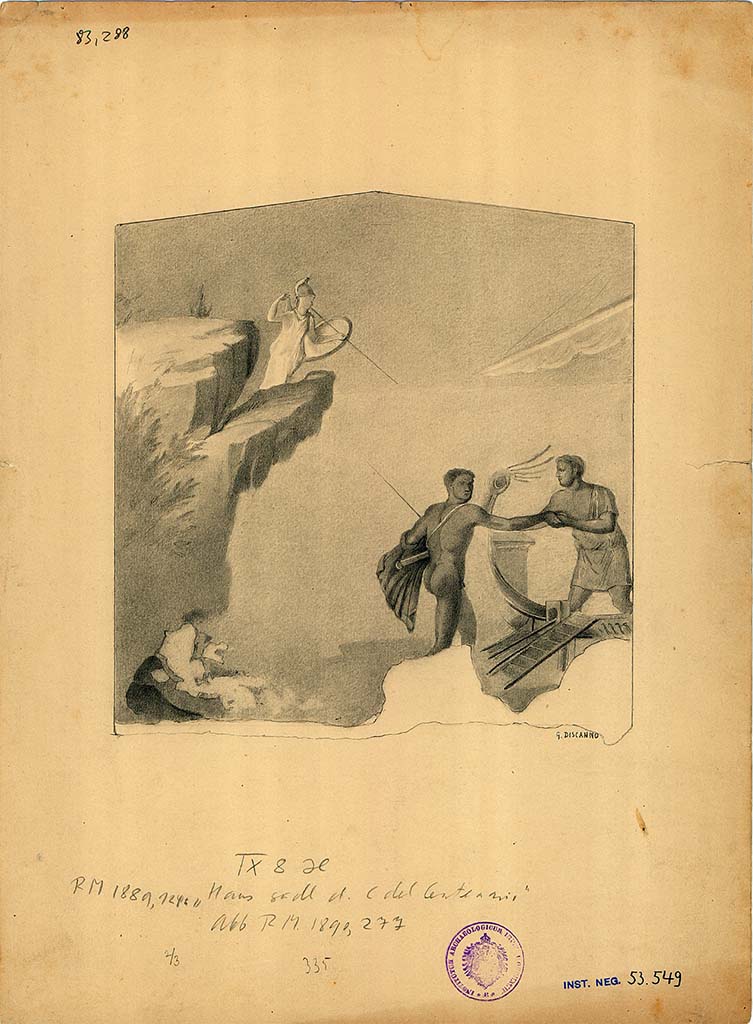
IX.8.8 Pompeii. Painting by G. Discanno of painting of Theseus abandoning Ariadne.
DAIR
83.288 and 53.549. Photo © Deutsches Archäologisches Institut, Abteilung Rom,
Arkiv.
Similar but differing in several details to one by Sikkard from IX.6.d which shows Theseus fully clothed, several sailors and oars under the boat where Discanno shows the plaster missing.
According to NdS, in a room, not yet entirely excavated in 1891, of a small house to the south of the House of the Centenary, a badly conserved painting was found on the west wall.
This could be IX.8.8 or perhaps IX.6.d, where the two similar paintings are recorded.
PPP shows both the Sikkard and Discanno paintings as from the north wall of the atrium of IX.6.d.
Schefold shows the Sikkard painting (DAIR 53.505) as from IX.6.d and the Discanno painting (DAIR 53.549) as from an unidentified location in IX.8.
The DAIR web site (See Arachne) shows it as "Wandmalerei aus der
Casa IX 8, 8? Theseus verlässt Ariadne".
See Bragantini, de Vos, Badoni, 1986. Pitture e Pavimenti di Pompei, Parte 3. Rome: ICCD, p.
490.
See
Schefold, K., 1957. Die Wände Pompejis.
Berlin: De Gruyter, p. 266.
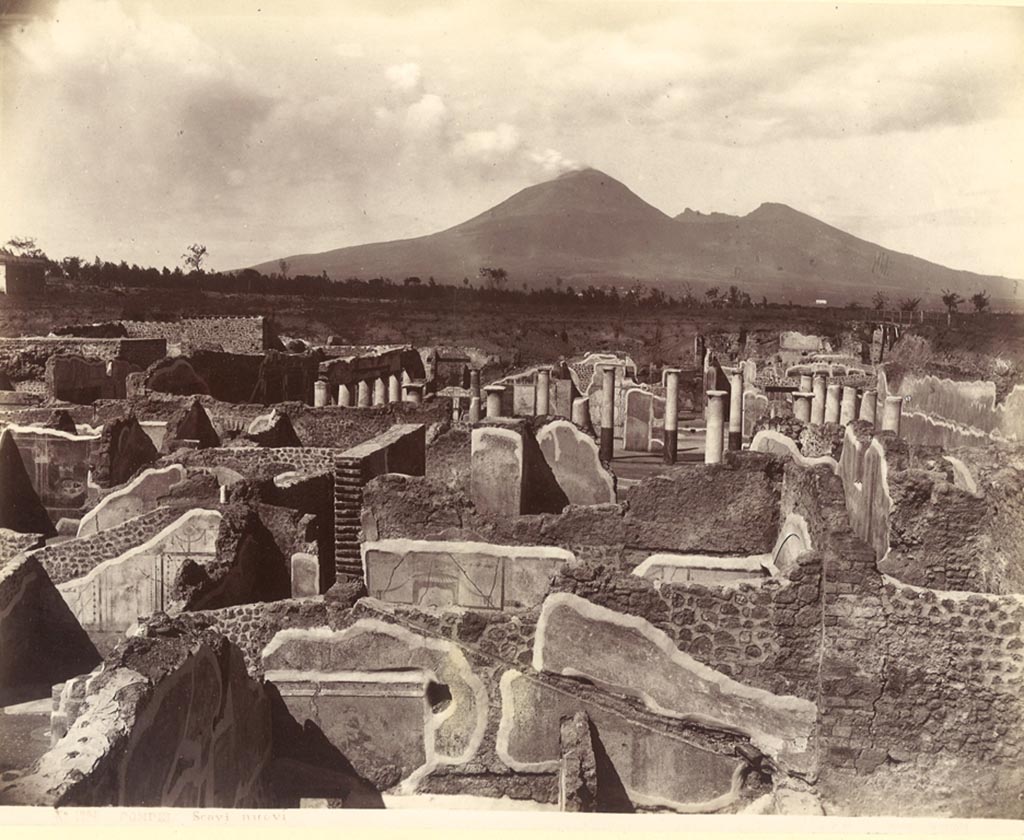
IX.8.6 Pompeii.
c.1880-1890. G. Sommer no. 1291.
Looking north from IX.8.8/IX.8.c, towards rear of triclinium with nymphaeum and peristyle of IX.8.6. Photo courtesy of Rick Bauer.