IX.7.16 Pompeii. House of A. Virnius
Modestus or Casa del Cavallo Troiano.
Partly excavated in 1867, 1880.
Part 2 Part 1
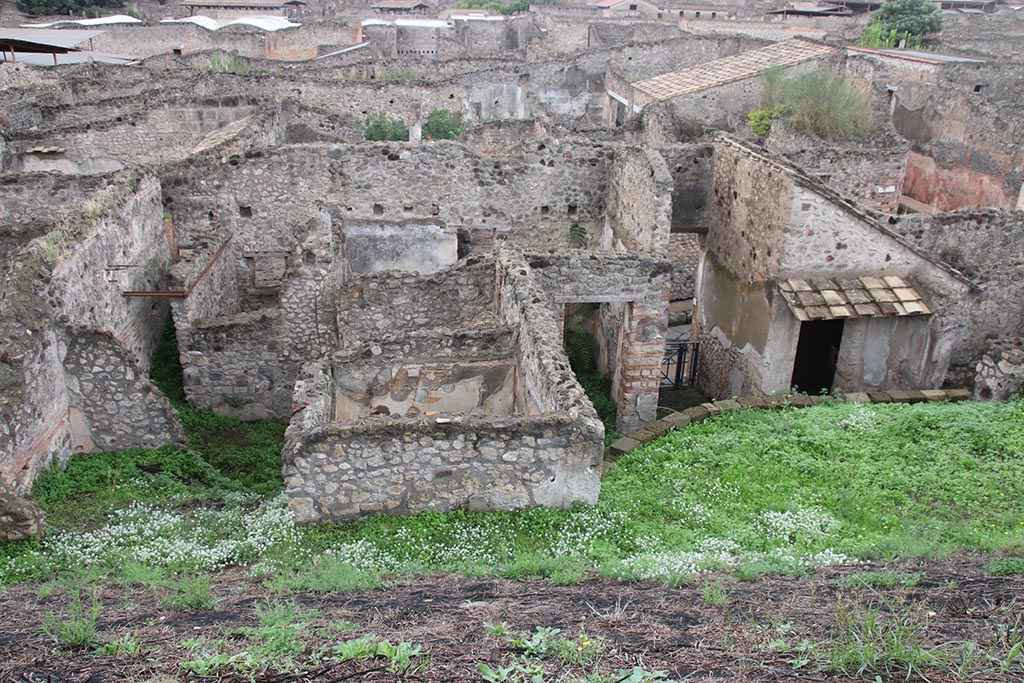
IX.7.16 Pompeii. October 2024.
Looking west towards rear of house from Casina dell’Aquila, with entrance doorway, on right. Photo courtesy of Klaus Heese.
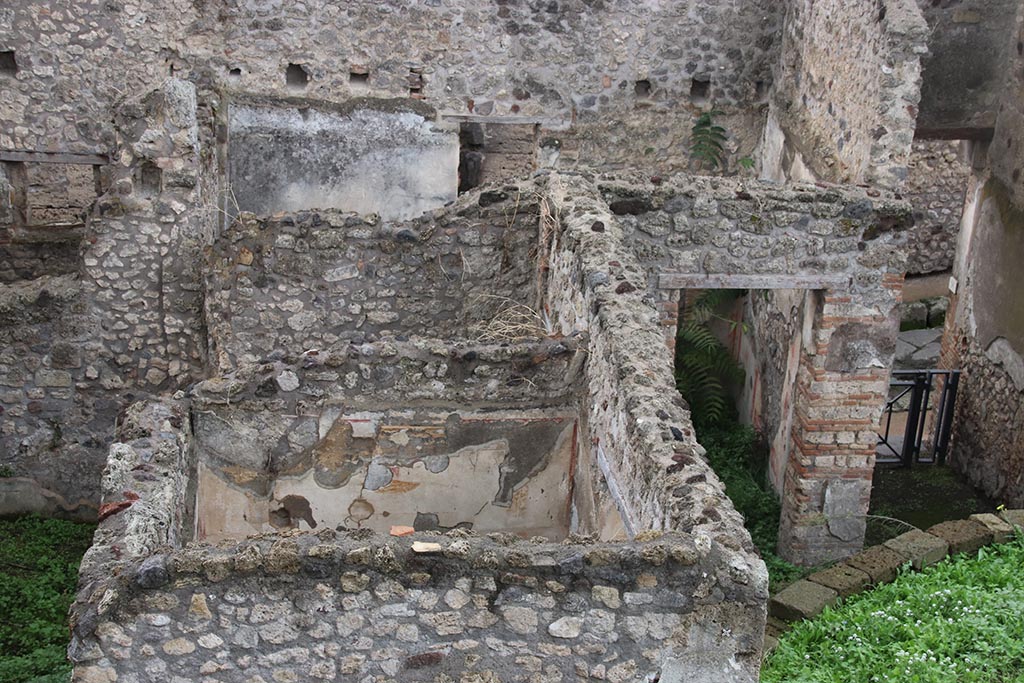
IX.7.16 Pompeii. October 2024. Looking west from Casina dell’Aquila, with room “c” (lower centre).
At its rear is room 3, leading into kitchen “d” on left, with doorway to triclinium “b” on right next to entrance doorway.
Photo courtesy of Klaus Heese.
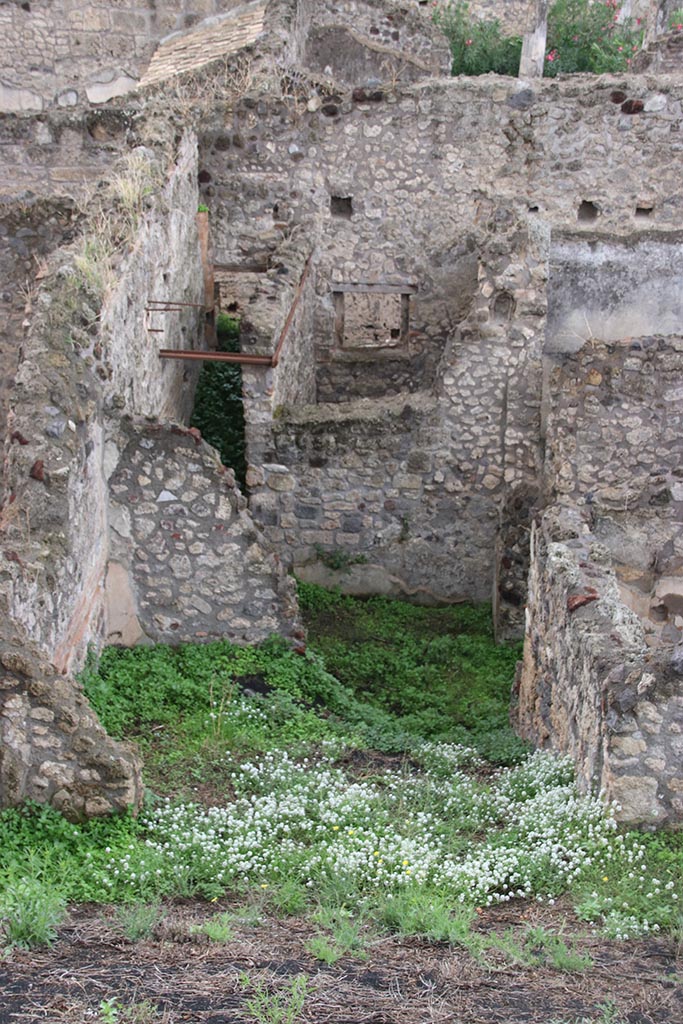
IX.7.16 Pompeii. October 2024.
Looking west from room 6, across room 5, into kitchen “d”. Photo courtesy of Klaus Heese.
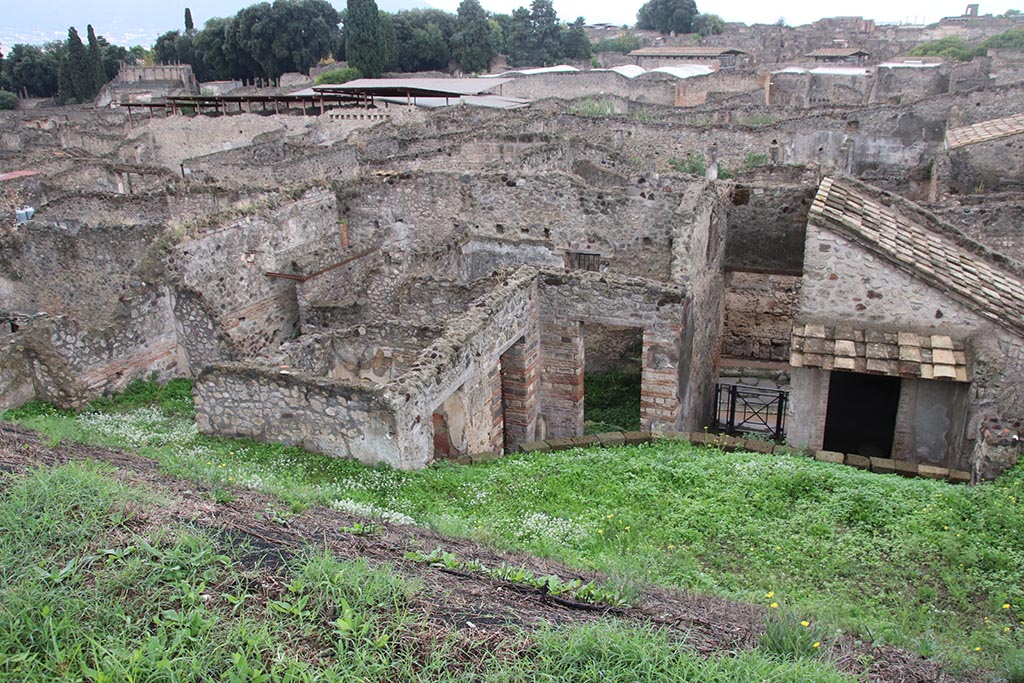
IX.7.16 Pompeii. October 2024.
Looking south-west from Casina dell’Aquila across atrium 2, lower right, towards doorways to rooms “c” and 3, on south side.
On the west side of the atrium 2, are doorways to rooms “b”, entrance corridor 1, and room “a”, centre right. Photo courtesy of Klaus Heese.
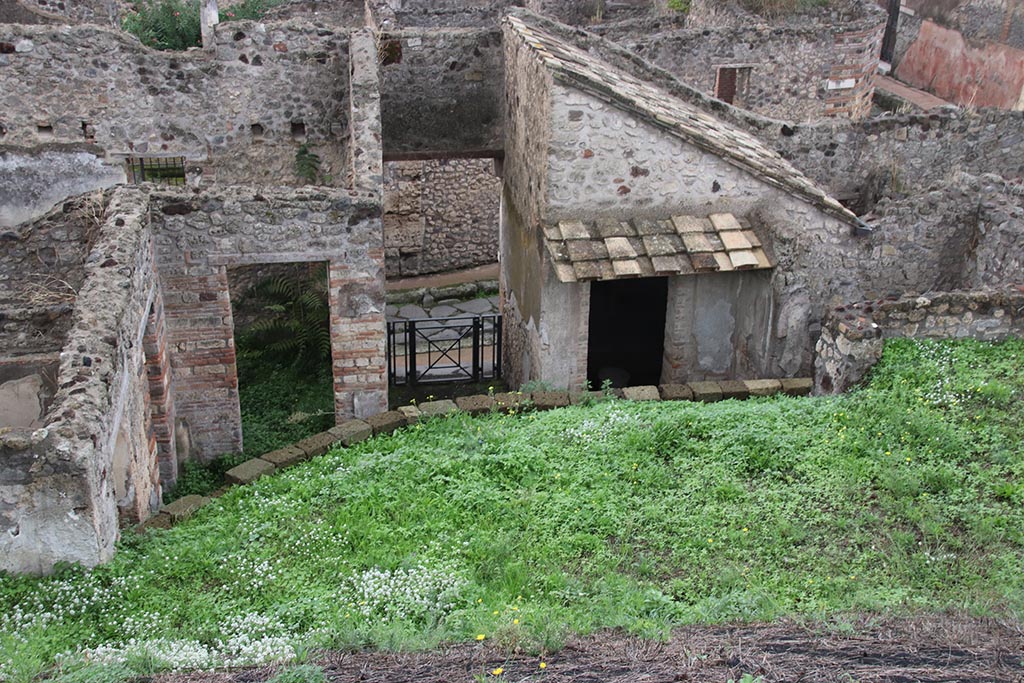
IX.7.16 Pompeii. October 2024.
Looking west across atrium 2, towards doorway to triclinium “b”, entrance corridor 1, and room “a”. Photo courtesy of Klaus Heese.
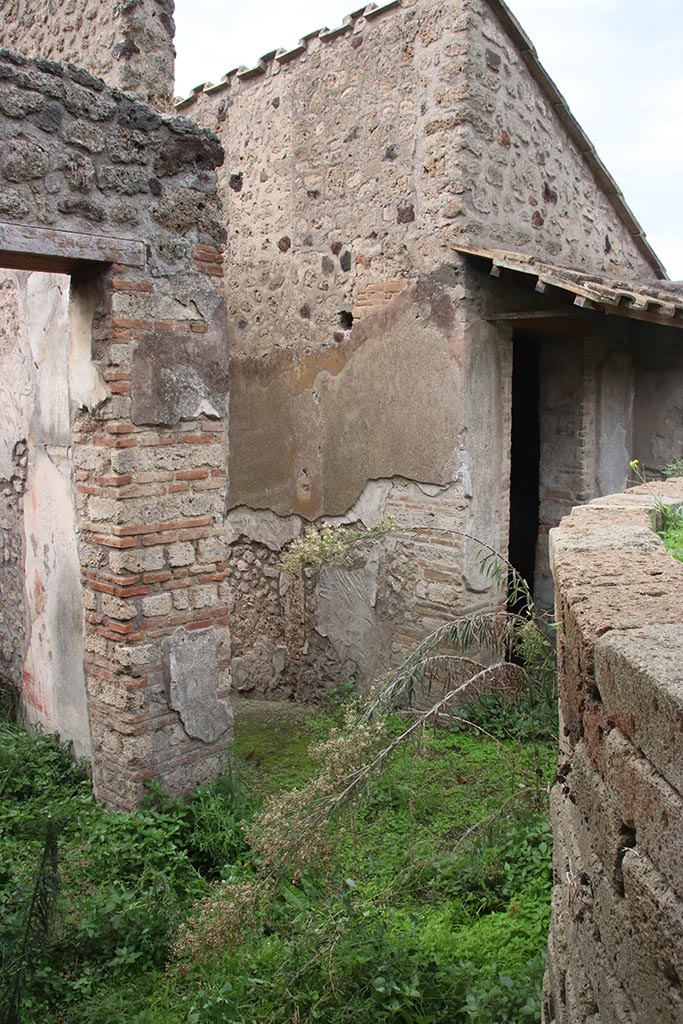
IX.7.16 Pompeii. October 2024.
Looking towards west side of atrium 2 towards entrance corridor/fauces 1, in centre, between rooms “a” and “b”.
Photo courtesy of Klaus Heese.
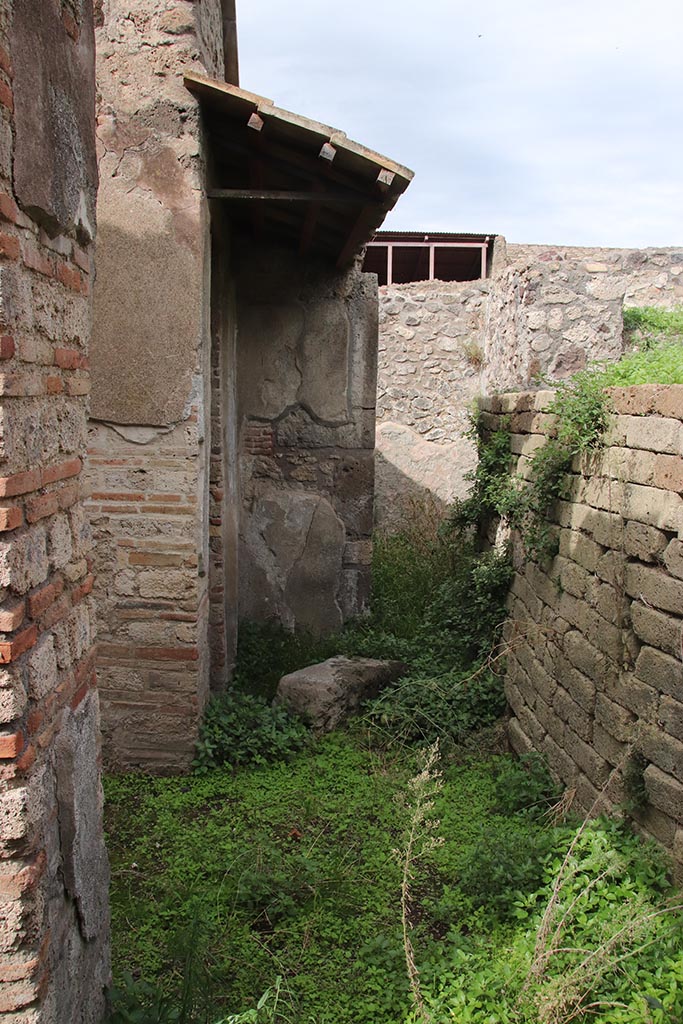
IX.7.16 Pompeii. October 2024.
Looking north across atrium 2, towards north-west corner, with doorway to room “a”, under roof, and doorway into room 7.
The entrance corridor 1 is on left. Photo courtesy of Klaus Heese.
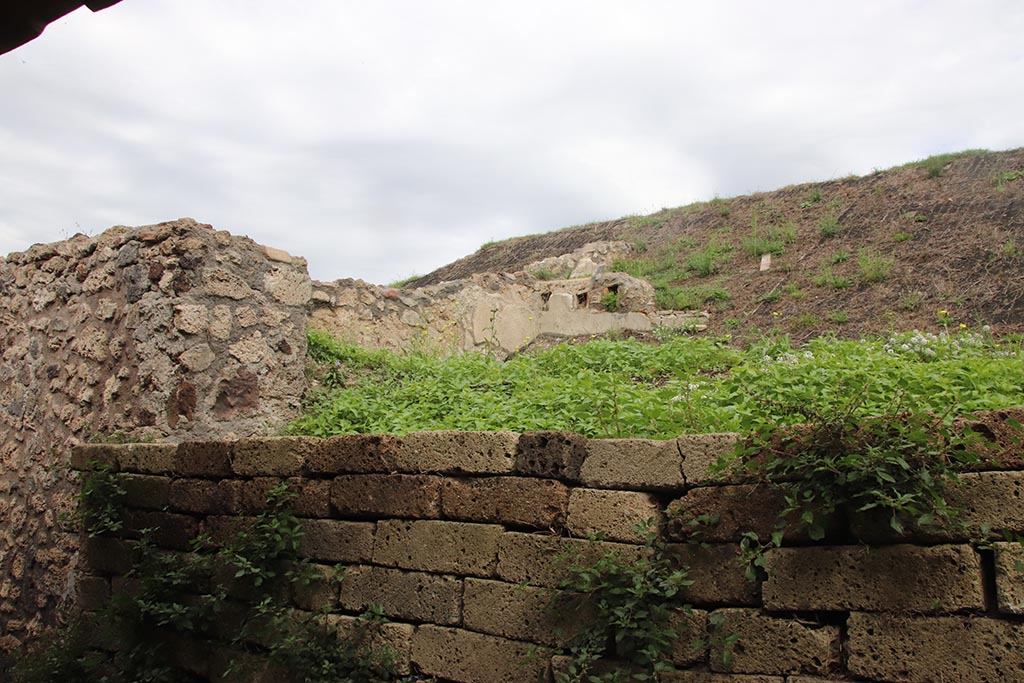
IX.7.16 Pompeii. October 2024. Looking north-east across atrium 2. Photo courtesy of Klaus Heese.
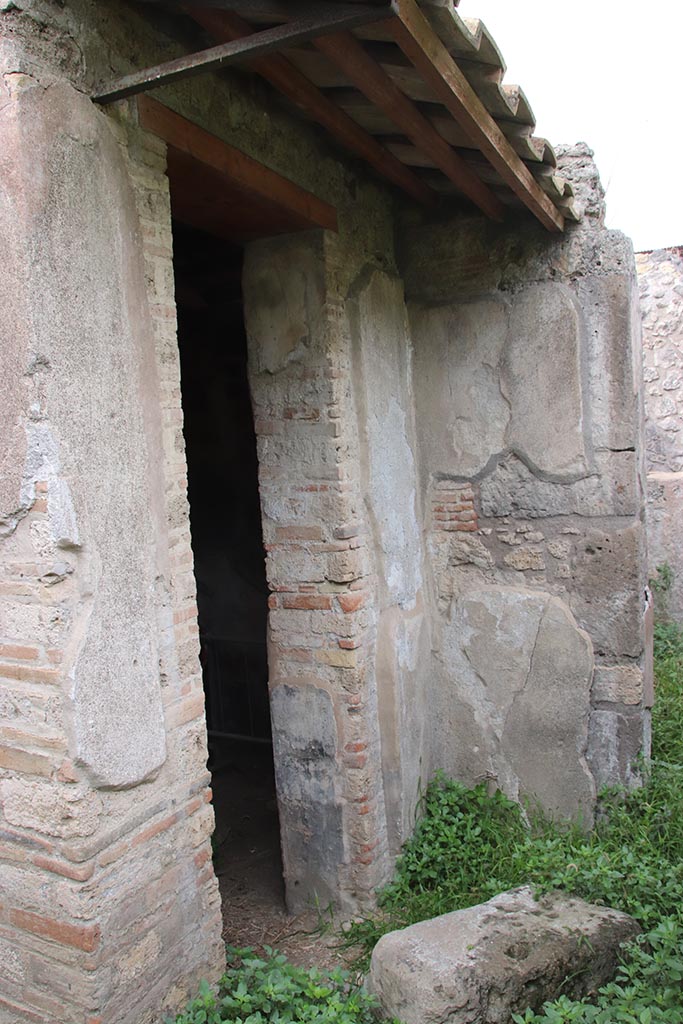
IX.7.16 Pompeii. October 2024.
Doorway into room “a” in north-west corner of atrium. Photo courtesy of Klaus Heese.
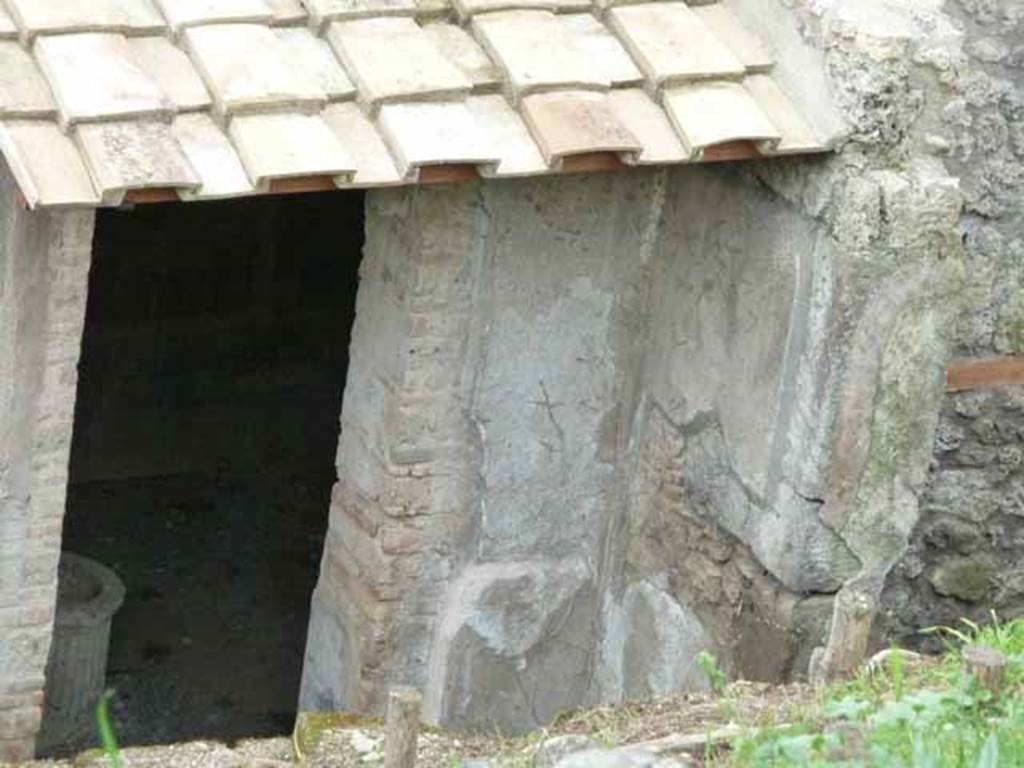
IX.7.16 Pompeii. May 2010. Room “a”, cubiculum on north side of entrance.
Jashemski says that this room, according to Mau, had a garden scene in the centre of the side panels on each wall, other than on the north, which had been painted later.
Mau did not describe the paintings, and they are no longer visible.
See Mau, Bullettino dell’Instituto di Corrispondenza
Archeologica (DAIR), 1883, (p.126-133)
See Jashemski, W. F., 1993. The Gardens of Pompeii, Volume II: Appendices. New York: Caratzas. (p.401)
According to Dawson, -
On the entrance (east) wall, right of doorway was - Perseus & Andromeda, p. 84, pl. IV.
On the left (south) wall was - Rape of Hylas, p. 85, pl. III.
On the rear (west) wall was - Trojan Horse, p. 85, pl. IV.
On the right (north) wall was – a sacred landscape, p. 86.
See Dawson, C. 1944. Romano-Campanian
Mythological Landscape Painting, p. 84-6, pls. III, IV.
See Schefold, K.,
1962. Vergessenes Pompeji. Bern:
Francke. (Fig.11, 2).
See Catalogue, 1989. Italienische Reise: Pompejanische Bilder in den deutschen archäologischen Sammlungen. Napoli: Bibliopolis. p. 241-244, fig 81.
See Peters, W.J.T. (1963): Landscape in Romano-Campanian Mural Paintings. The Netherland, Van Gorcum & Comp. (p. 77-78, figs. 61, 62 & 63)
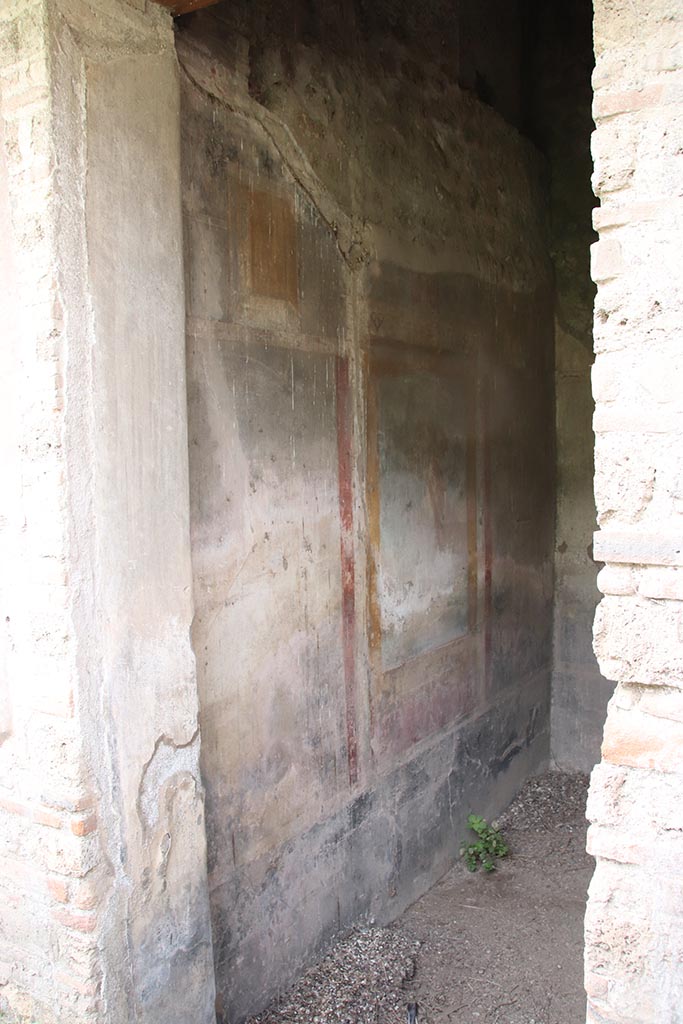
IX.7.16 Pompeii. October 2024.
Room “a”, south wall from entrance doorway. Photo courtesy of Klaus Heese.
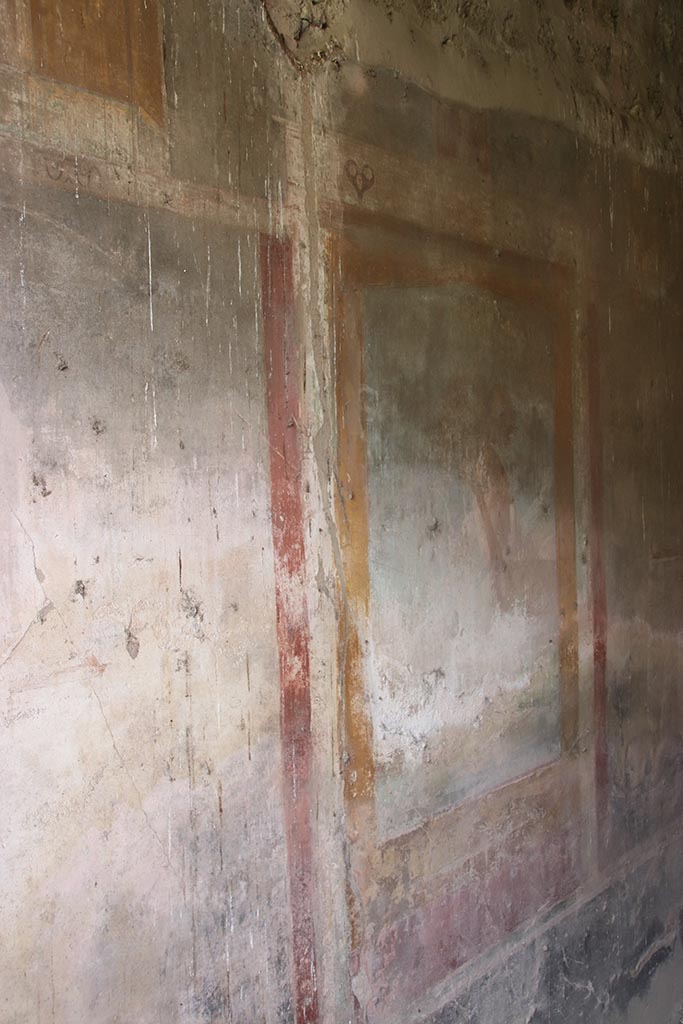
IX.7.16 Pompeii. October 2024.
Room “a”, central painting on south wall. Photo courtesy of Klaus Heese.
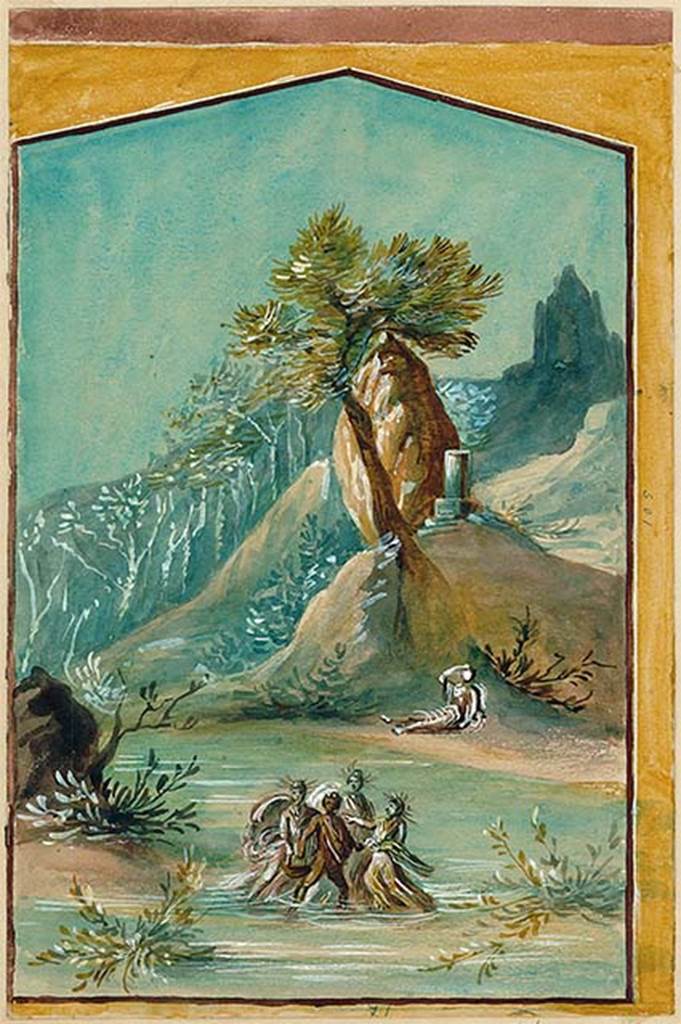
IX.7.16 Pompeii. Found on the south wall of the cubiculum on north side of entrance.
Water-colour copy of the painting of Hylas and the nymphs.
DAIR 83.299.
Photo © Deutsches Archäologisches Institut, Abteilung Rom, Arkiv.
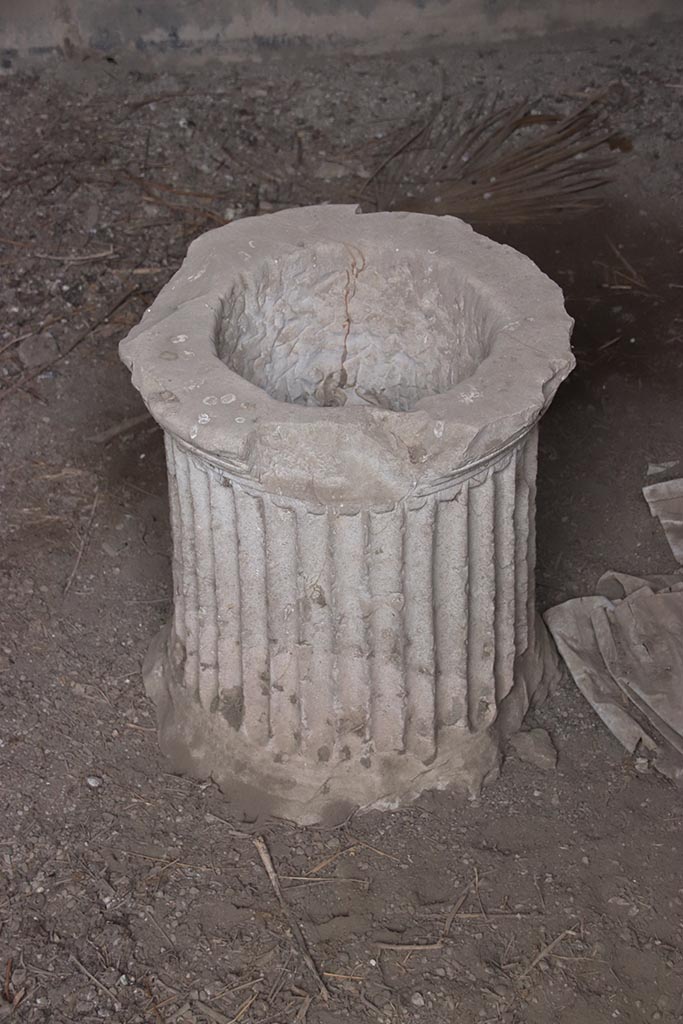
IX.7.16 Pompeii. October 2024. Room “a”, puteal. Photo courtesy of Klaus Heese.
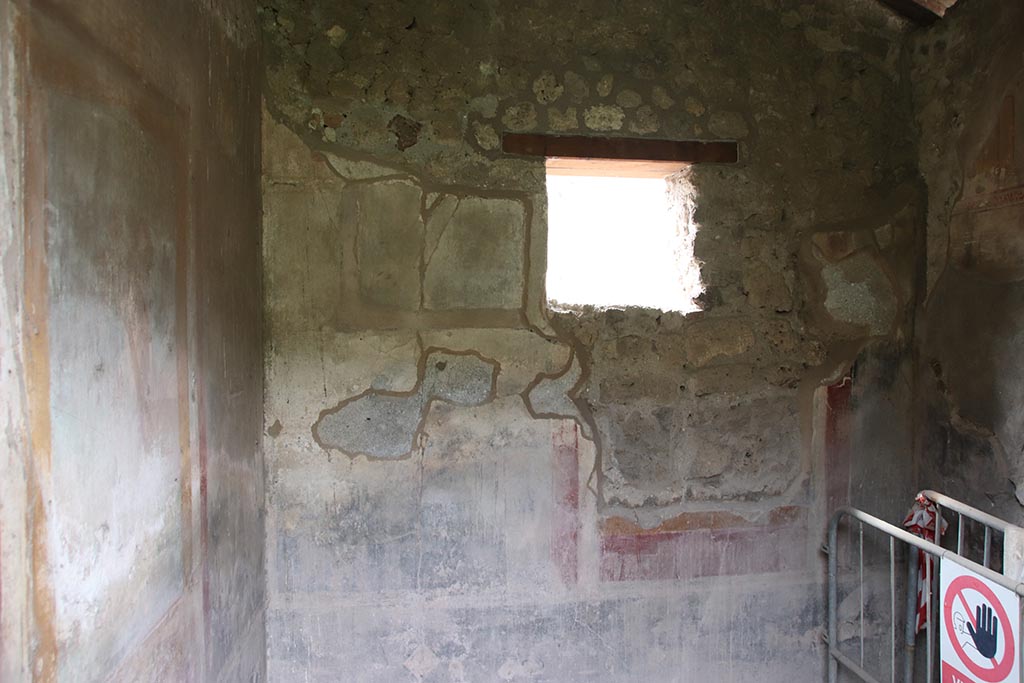
IX.7.16 Pompeii. October 2024. Room “a”, looking towards west wall. Photo courtesy of Klaus Heese.
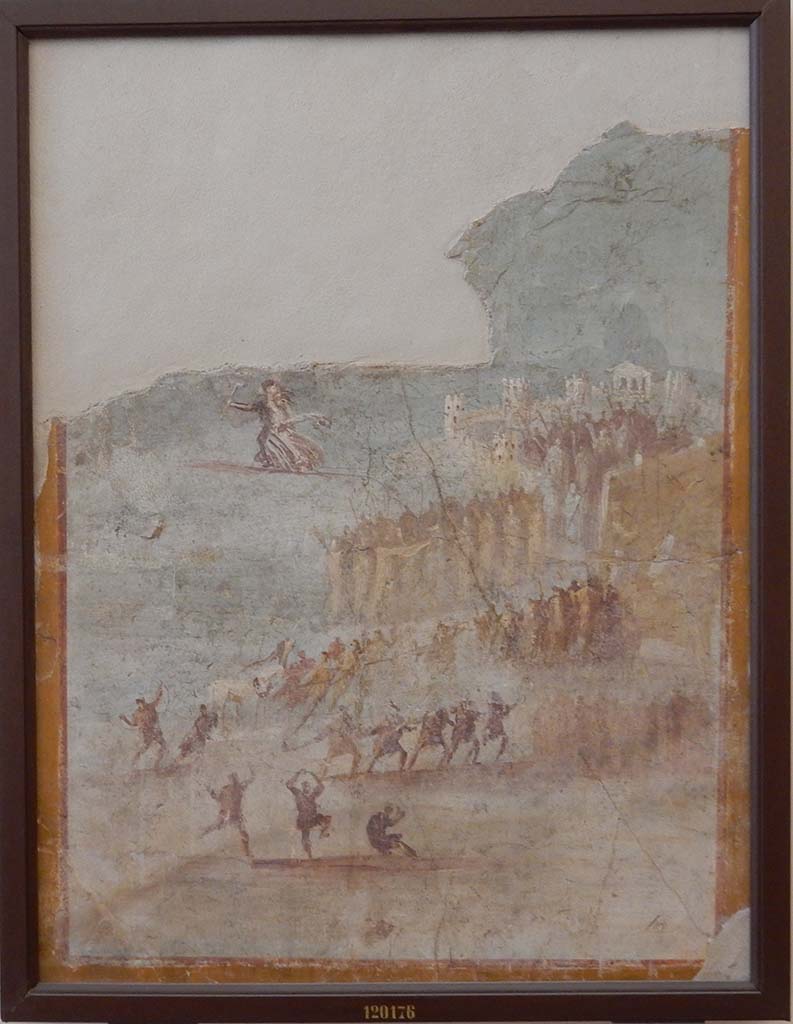
IX.7.16 Pompeii. Found on the west wall of the cubiculum on north side of entrance.
Painting of the Trojan Horse. The Trojans dance happily and drag the wooden horse to the walls of Troy.
They ignore the warnings of Cassandra who is seen withdrawing, carrying lighted torches.
Now in Naples Archaeological Museum. Inventory number 120176.
See Sampaolo V.
and Bragantini I., Eds, 2009. La Pittura
Pompeiana. Electa:
Verona. (Page 345, Scheda 158).
See Schefold, K., 1957. Die Wände Pompejis. Berlin: De Gruyter. (page 268).
Photo courtesy of Buzz Ferebee.
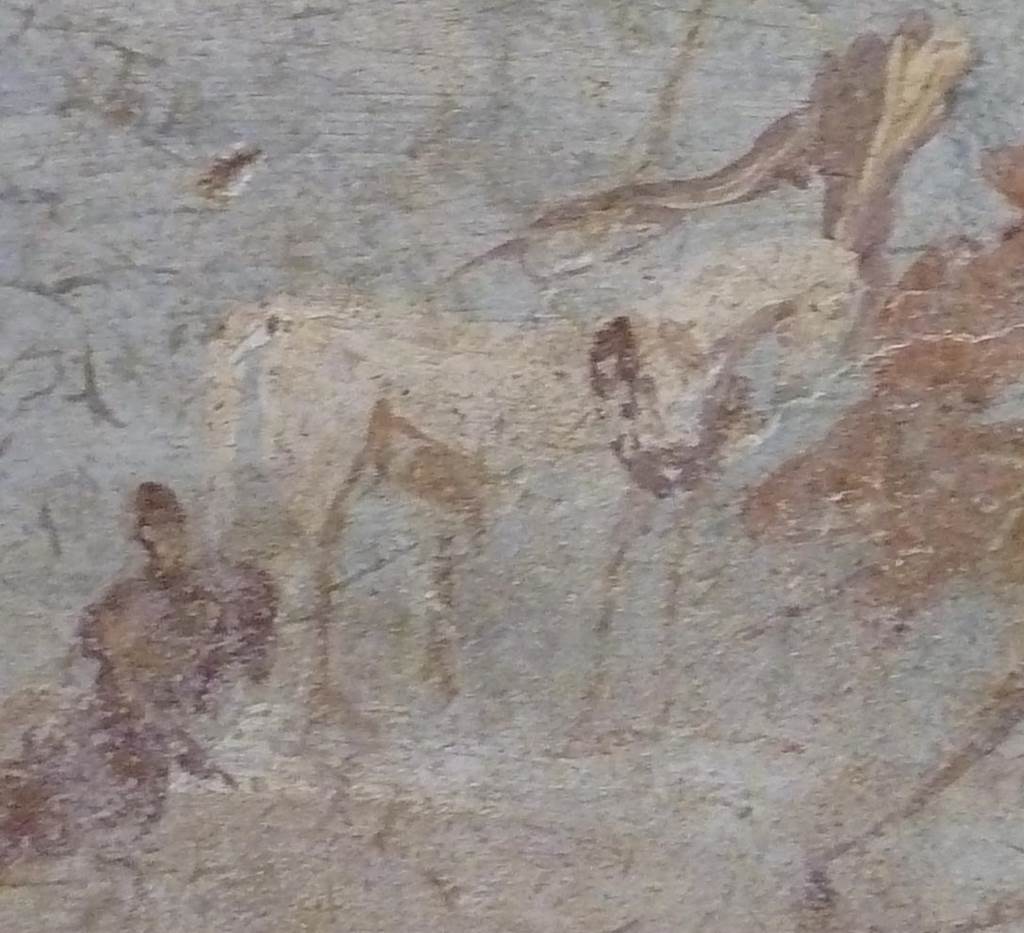
IX.7.16 Pompeii. Found on the west wall of the cubiculum on north side of entrance.
Detail of painting of the Trojan Horse. Detail of the horse left outside the city by the Greeks.
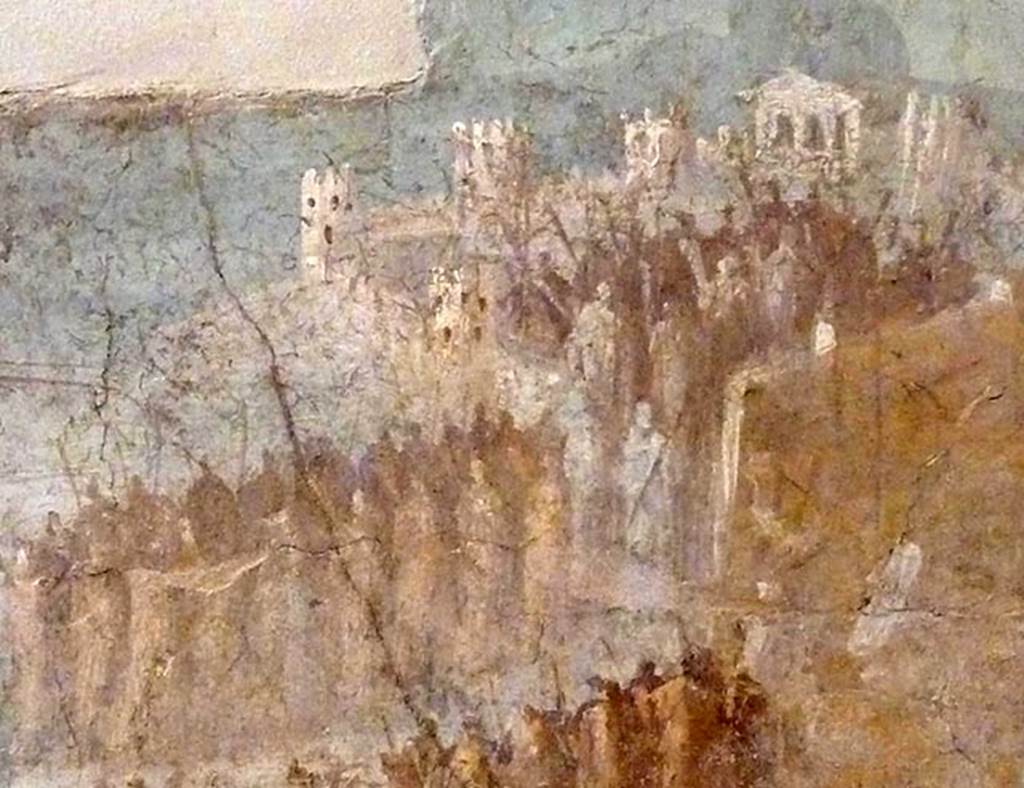
IX.7.16 Pompeii. Found on the west wall of the cubiculum on north side of entrance.
Detail of painting of the Trojan Horse. The city of Troy.
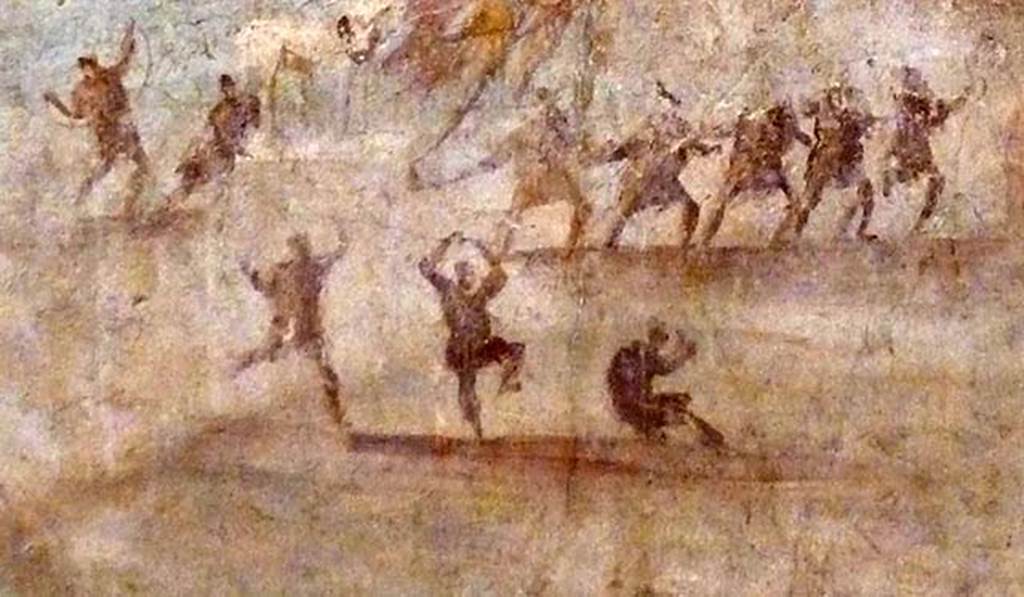
IX.7.16 Pompeii. Found on the west wall of the cubiculum on north side of entrance.
Detail of painting of the Trojan Horse. The Trojans dance happily.
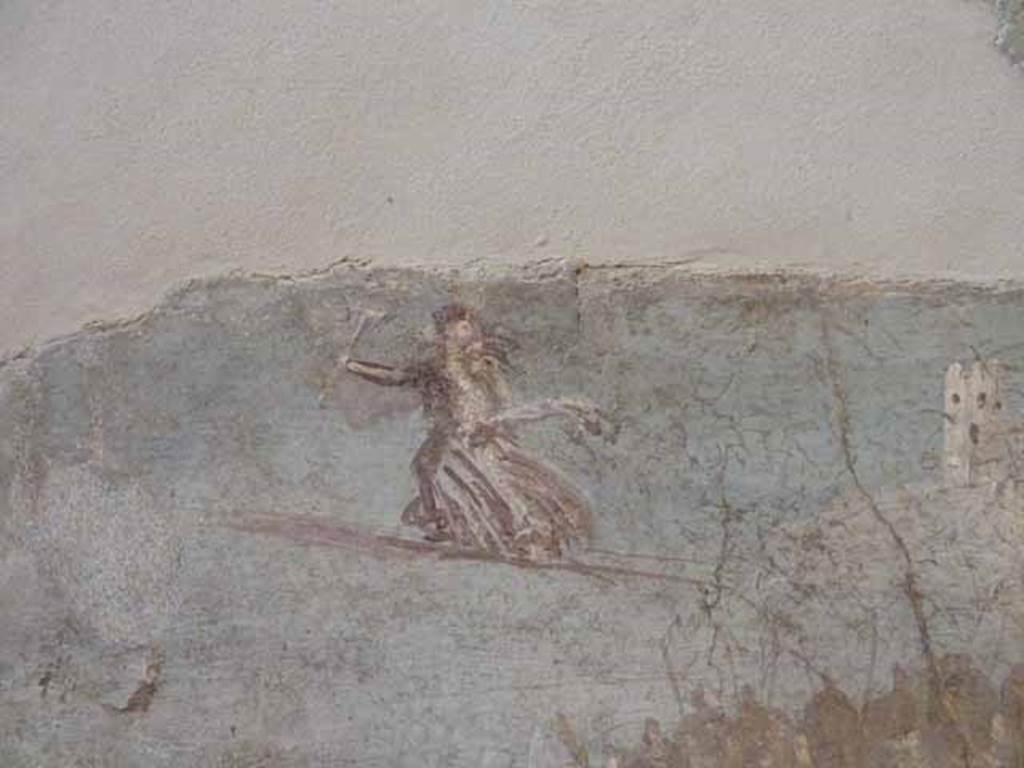
IX.7.16 Pompeii. Found on west wall of cubiculum on north side of entrance.
Detail of painting of the Trojan horse. The Trojans ignore the warnings of Cassandra who is seen withdrawing, carrying lighted torches.
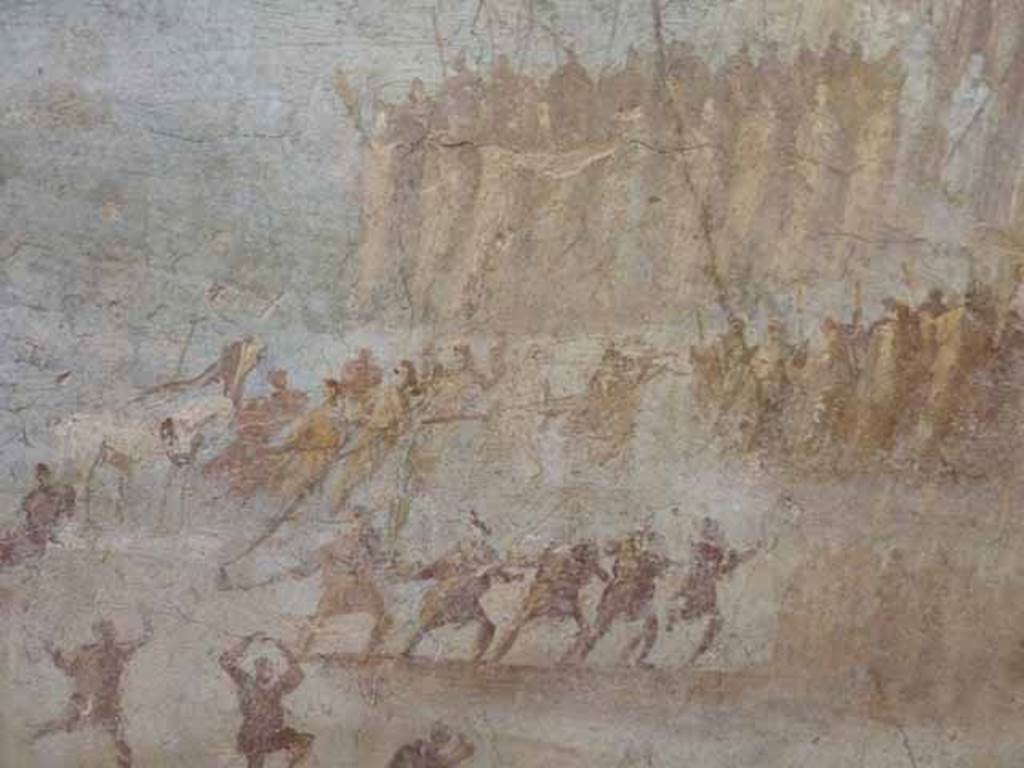
IX.7.16 Pompeii. Found on west wall of cubiculum on north side of entrance.
Detail of painting of the Trojan horse. The Trojans drag the wooden horse to the walls of Troy.
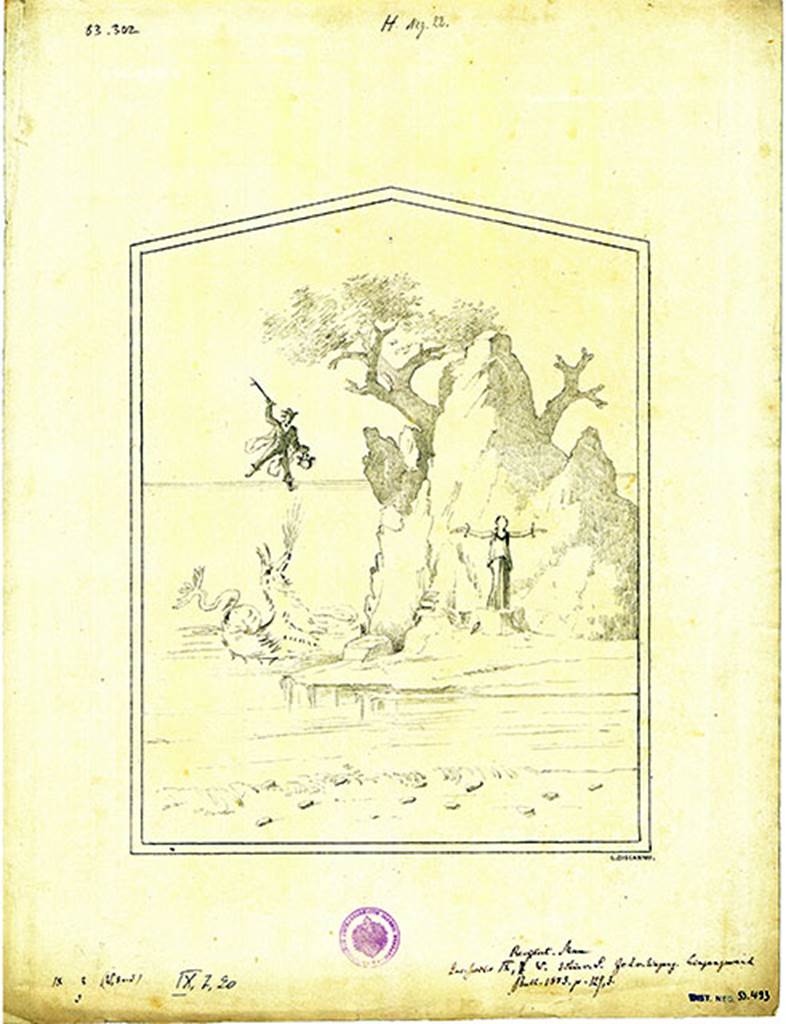
IX.7.16 Pompeii. Cubiculum on north side of entrance. East wall, right of doorway.
Copy of painting of Perseus rescuing Andromeda.
DAIR 83.302. Photo
© Deutsches Archäologisches Institut, Abteilung Rom, Arkiv.
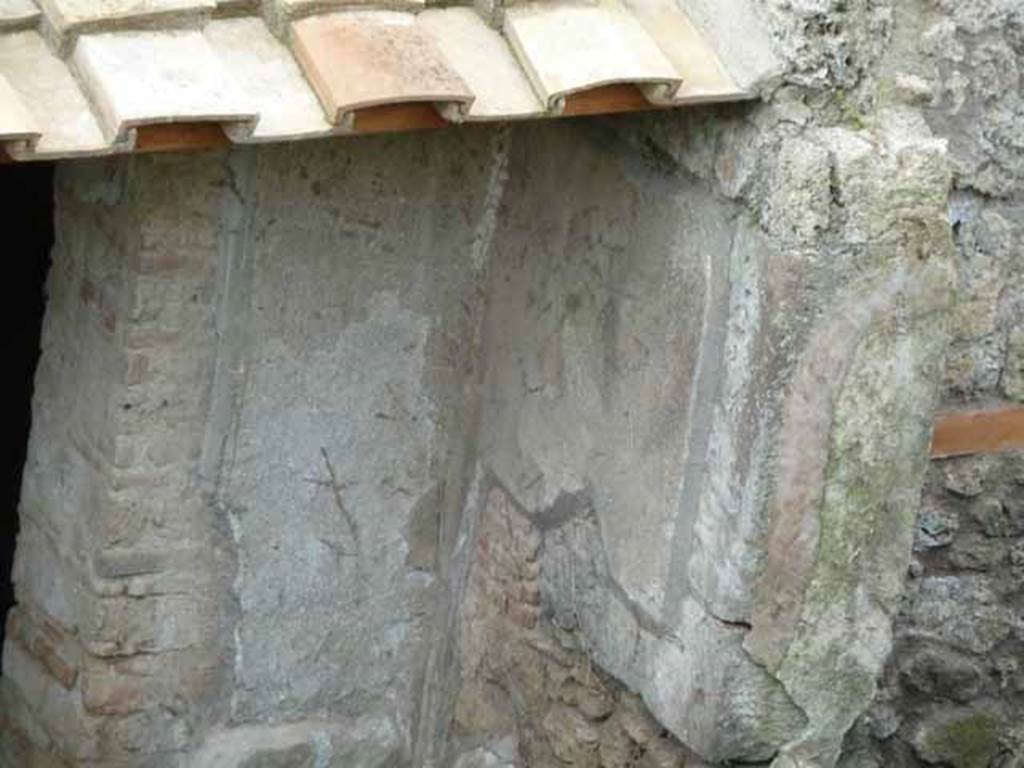
IX.7.16 Pompeii. May 2010. Wall plaster outside cubiculum “a”, in north-west corner of atrium 2.
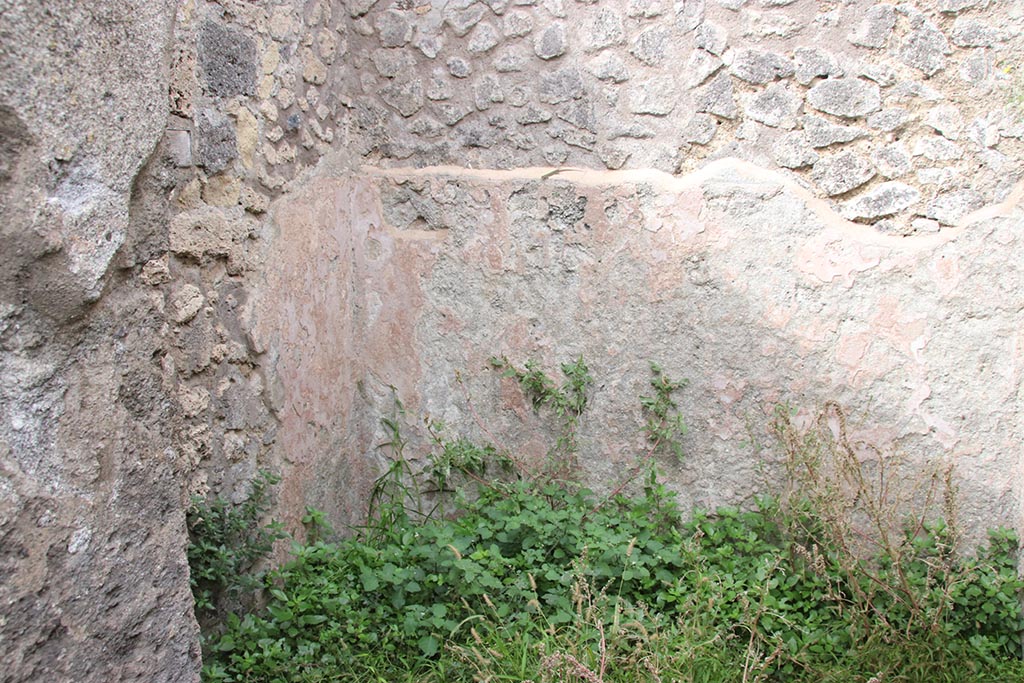
IX.7.16 Pompeii. October 2024. Room 7, looking through doorway towards north-west corner. Photo courtesy of Klaus Heese.
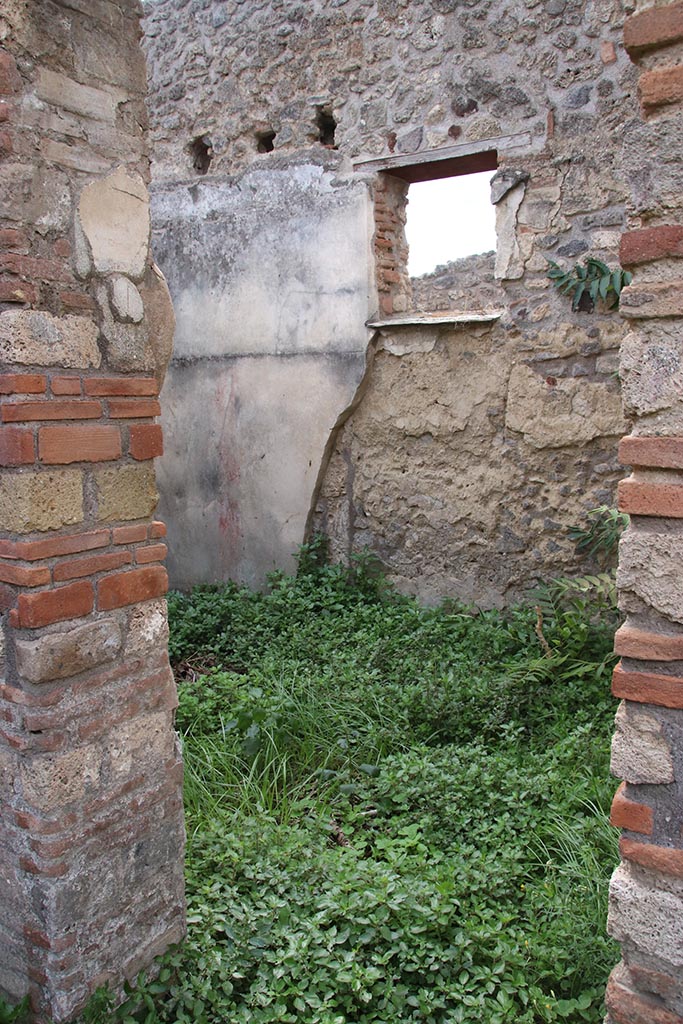
IX.7.16 Pompeii. October 2024.
Looking through doorway into room “b”, on west side of atrium. Photo courtesy of Klaus Heese.
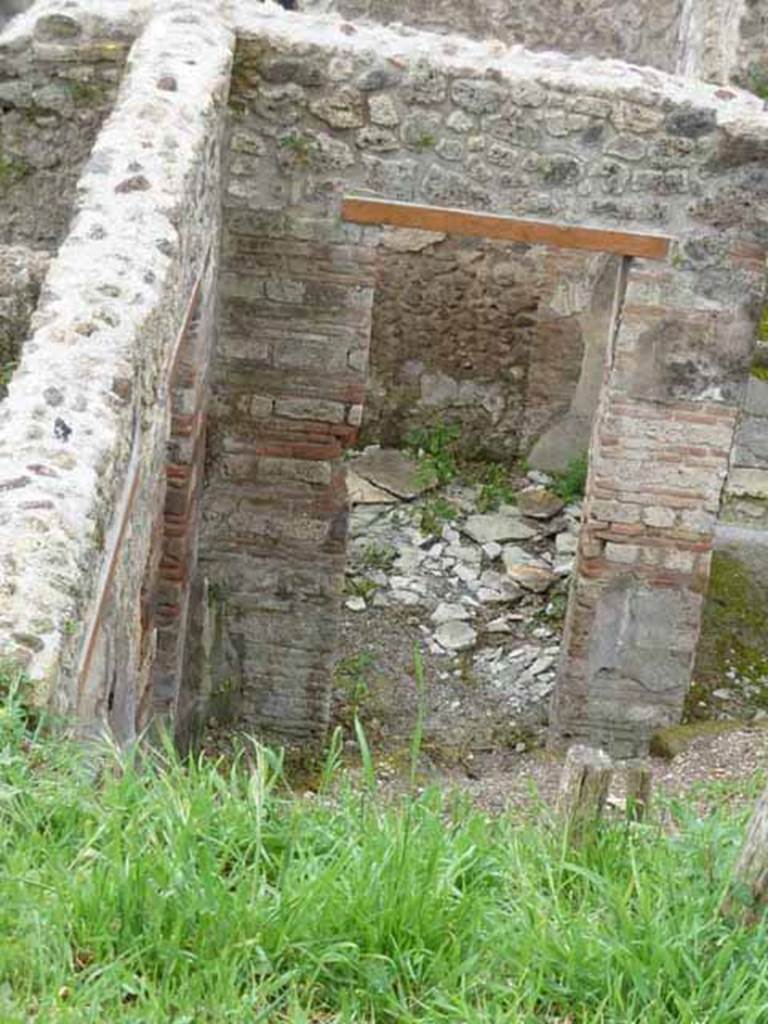
IX.7.16 Pompeii. May 2010. Doorway to triclinium “b”, on
south side of entrance.
Found on the east wall of the triclinium, according to Schefold was Bellerophon
and Pegasus.
According to Peters (1963), in situ practically nothing remained of the painting.
See Schefold, K., 1957. Die Wande Pompejis. Berlin: De Gruyter. (p.269)
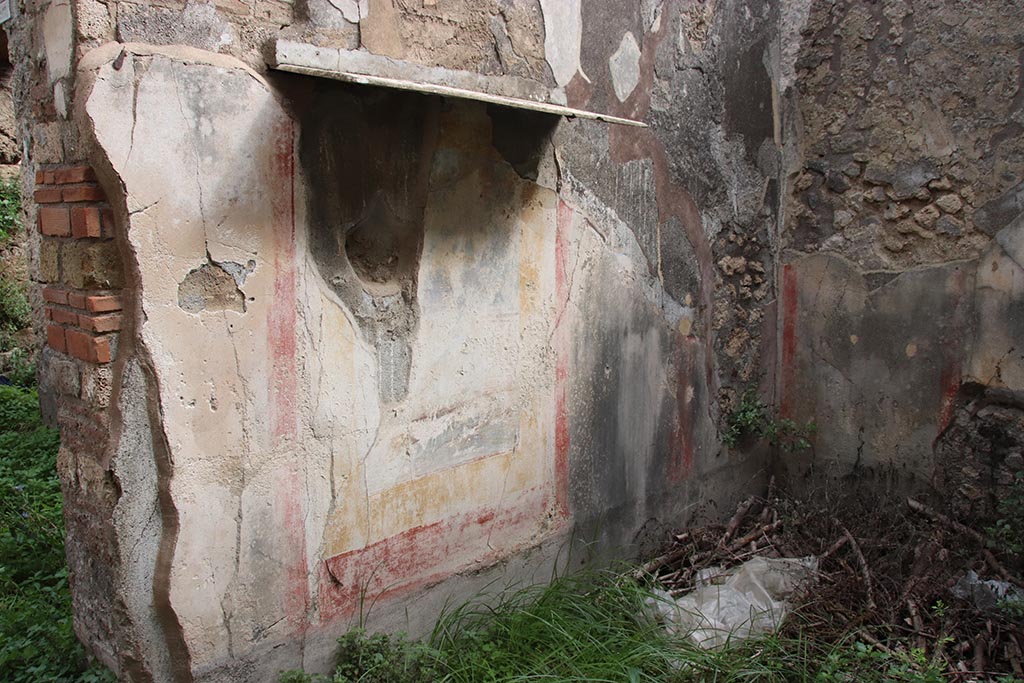
IX.7.16 Pompeii. October 2024. Room “b”, east wall with remains of wall painting. Photo courtesy of Klaus Heese.
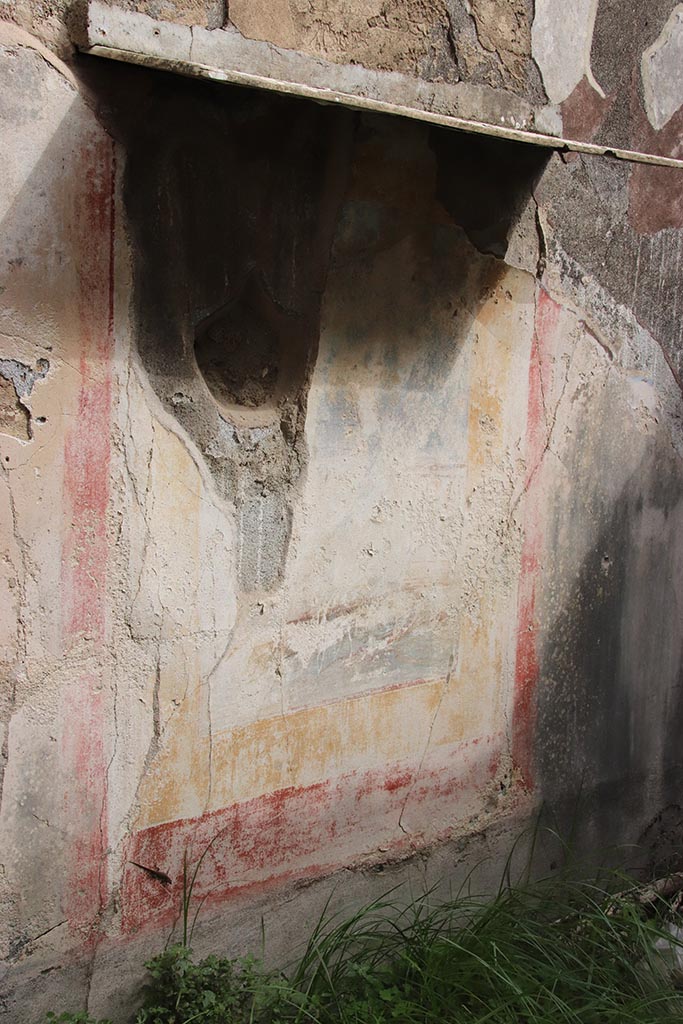
IX.7.16 Pompeii. October 2024.
Room “b”, detail of remains of wall painting on east wall. Photo courtesy of Klaus Heese.
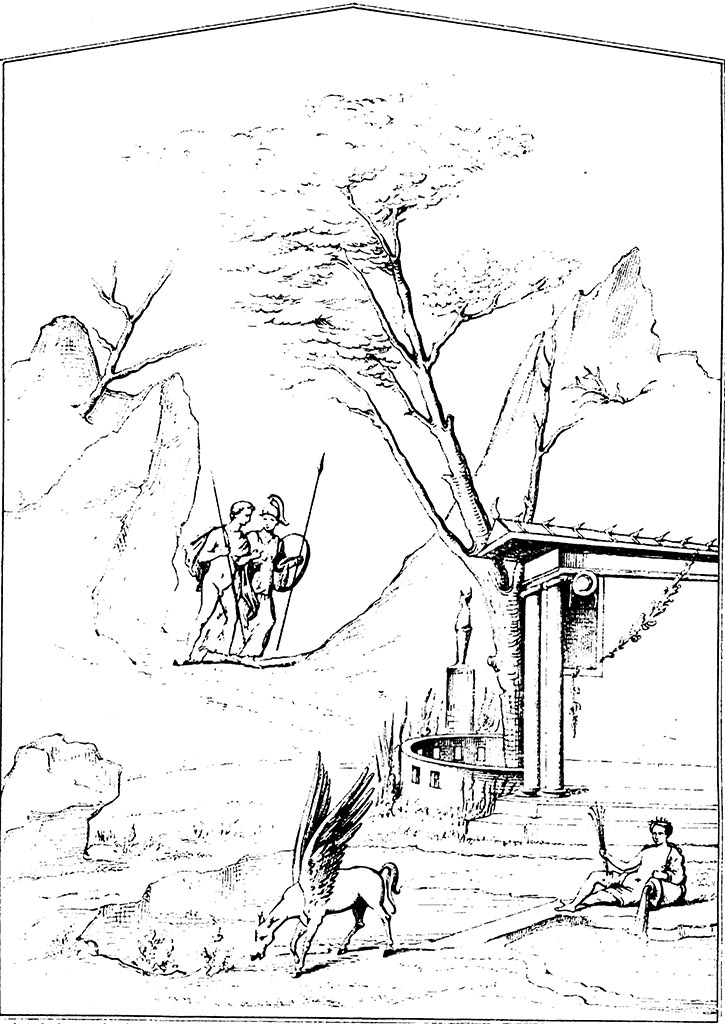
IX.7.16 Pompeii. May 2010. Triclinium, “b” on south side of
entrance, on the east wall.
Outline drawing of the painting of Bellerophon and Pegasus.
See Giornale degli Scavi, NS1, 1868 No 5, p. 117, Tav. VII,1.
See Reinach S.,
1922. Répertoire de peintures grecques et
romaines. Paris: Leroux.
(p. 181, 5).
See Catalogue, 1989. Italienische Reise: Pompejanische Bilder in den deutschen archäologischen Sammlungen. Napoli: Bibliopolis. (p. 241-244, fig 83).
See Peters, W.J.T. (1963): Landscape in Romano-Campanian Mural Paintings. The Netherlands, Van Gorcum & Comp. (p.80 fig.66)
According to Mau, there were
on the entrance wall: Bellerophon going to find Pegasus: (Sogliano 520).
on the left wall: Daedalus and Icarus: (Sogliano 523).
on the rear wall: nearly destroyed: Selene and Endymion:
Landscape with trees and to the left – a temple. (Sogliano 457: Helbig 942,).
See Mau, in Bullettino dell’Instituto di Corrispondenza
Archeologica (DAIR), 1883, (p.130-1)
See Sogliano, A.,
1879. Le pitture murali campane scoverte
negli anni 1867-79. Napoli: Giannini. (nos. 520, 523 and 457).
See Helbig, W., 1868. Wandgemälde der vom Vesuv verschütteten Städte Campaniens. Leipzig: Breitkopf und Härtel. (no. 952).
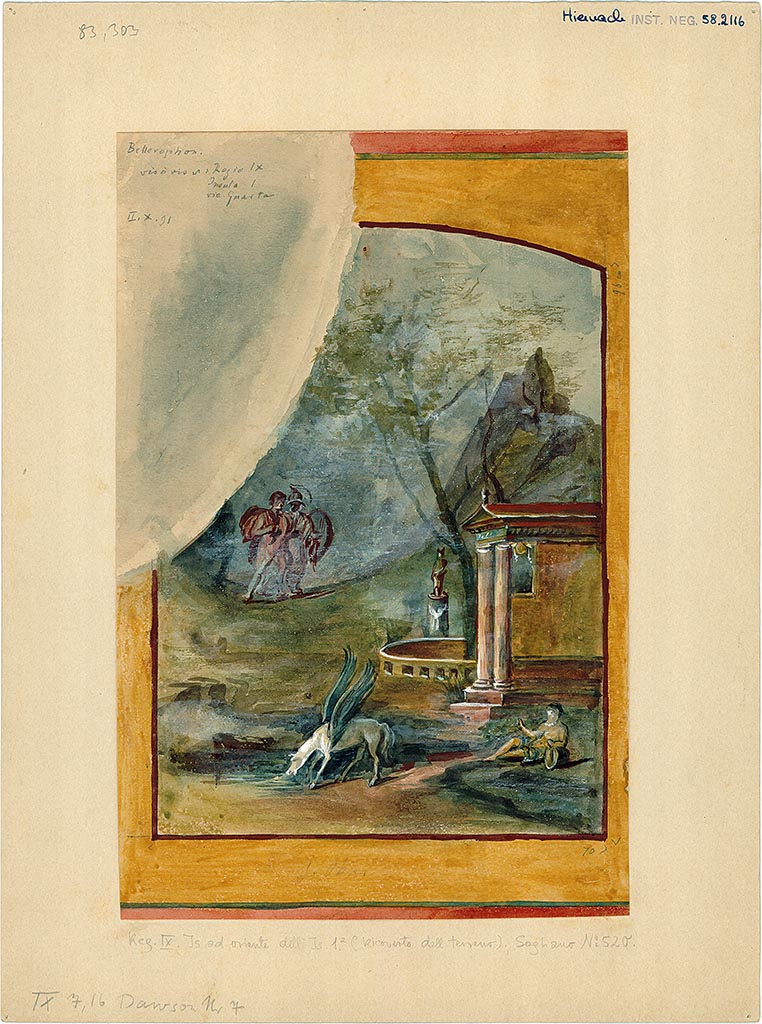
IX.7.16 Pompeii. Triclinium, “b”, on south side of entrance,
on the east wall.
Copy of the painting of Bellerophon and Pegasus.
DAIR 83.303. Photo © Deutsches Archäologisches Institut, Abteilung Rom, Arkiv.
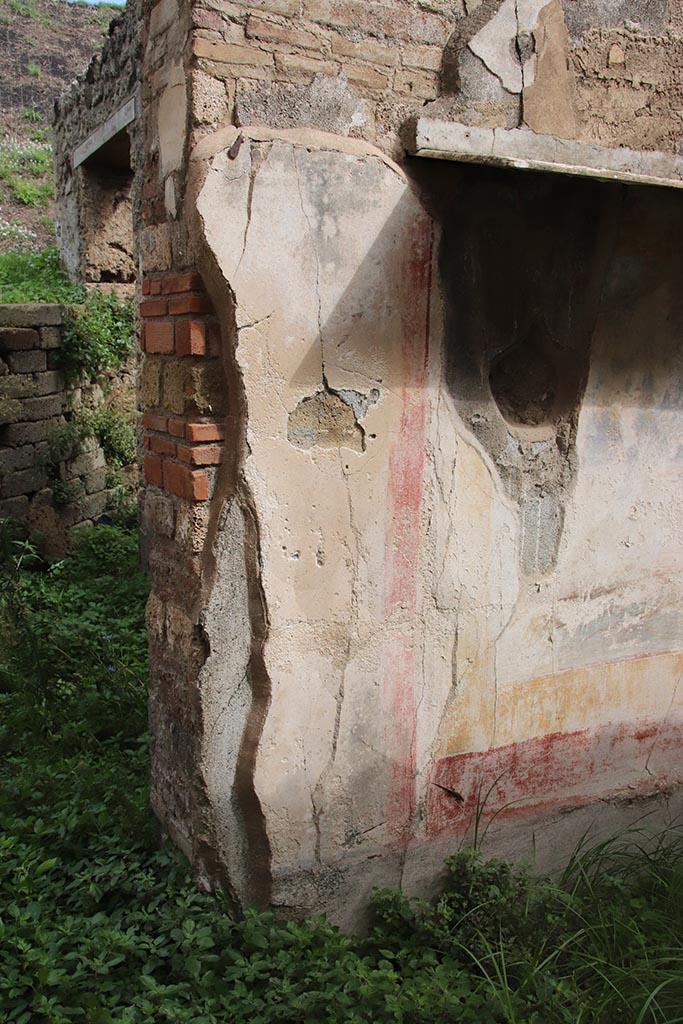
IX.7.16 Pompeii. October 2024.
Room “b”, looking east from doorway into atrium, with doorway into room “c” visible. Photo courtesy of Klaus Heese.
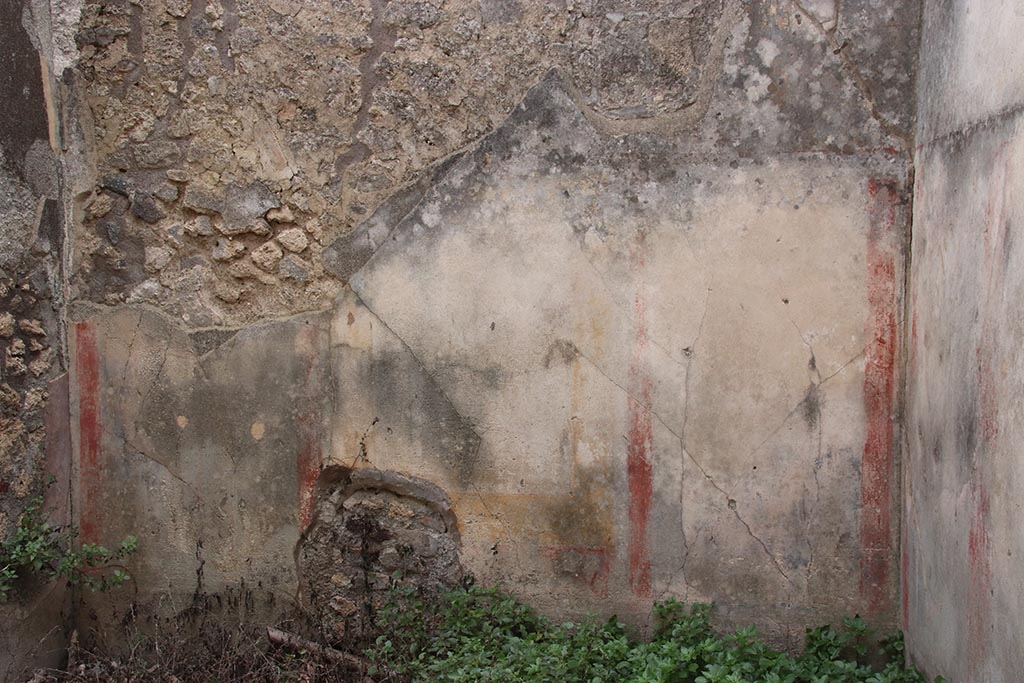
IX.7.16 Pompeii. October 2024. Room “b”, south wall with remains of painted decoration. Photo courtesy of Klaus Heese.
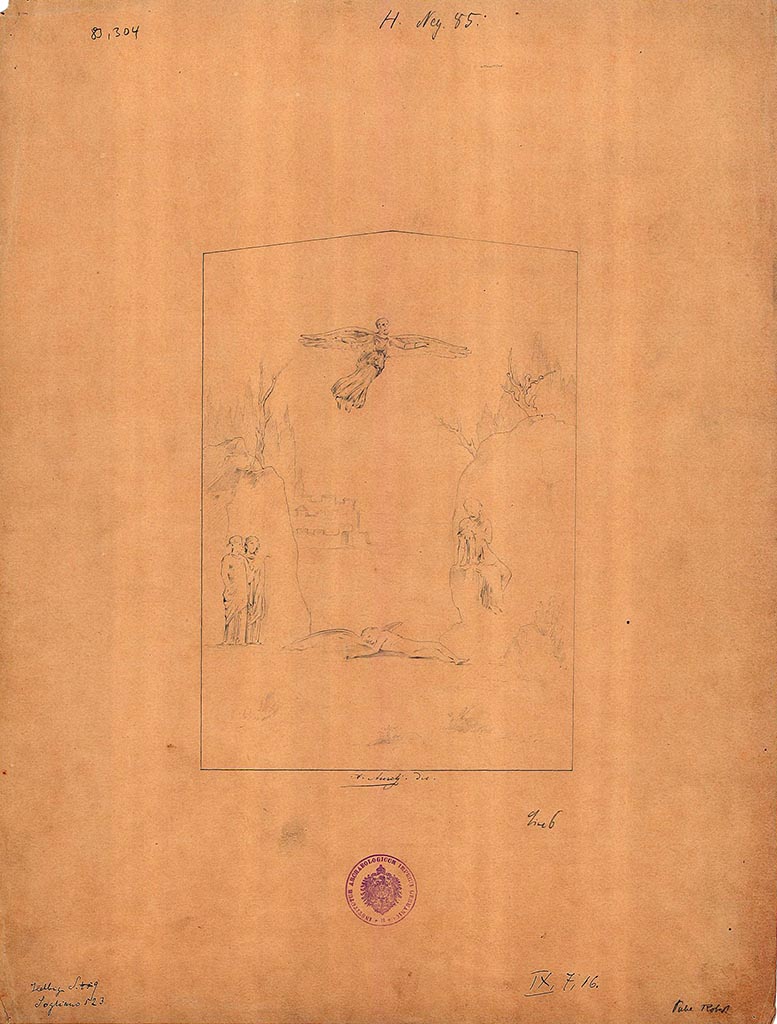
IX.7.16 Pompeii. Triclinium “b”. Drawing by A. Aurelj of Daedalus and Icarus, found in 1867 on the south wall.
DAIR 83.304.
Photo © Deutsches Archäologisches Institut, Abteilung Rom, Arkiv.
See Sogliano, A., 1879. Le pitture murali campane scoverte negli anni 1867-79. Napoli: Giannini. (no: 523).
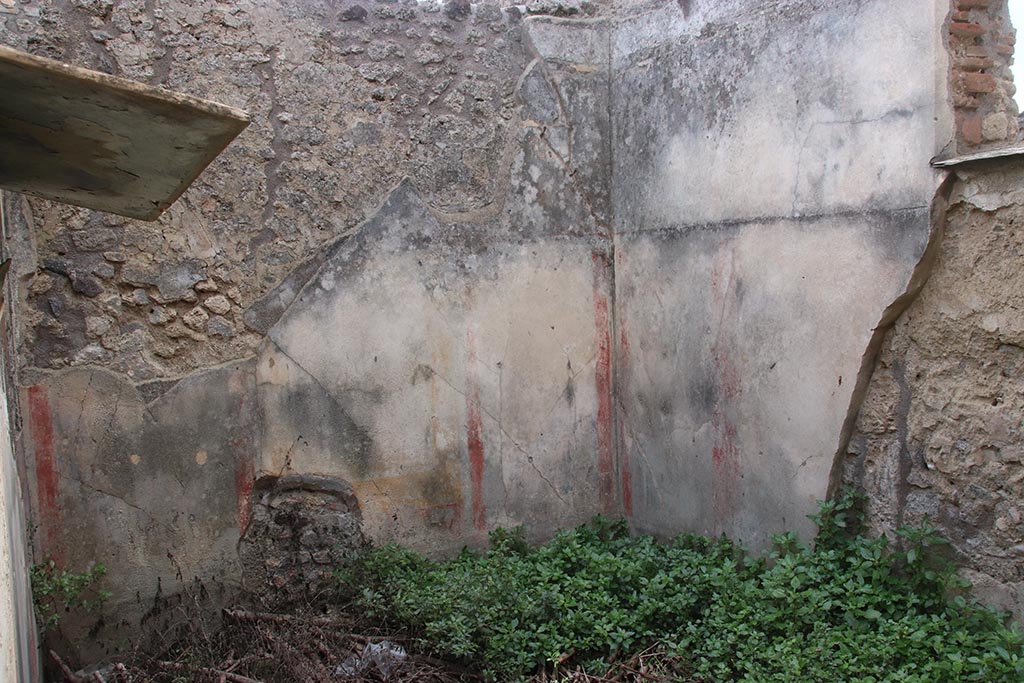
IX.7.16 Pompeii. October 2024.
Room “b”, looking towards south wall, south-west corner, and window in west wall. Photo courtesy of Klaus Heese.
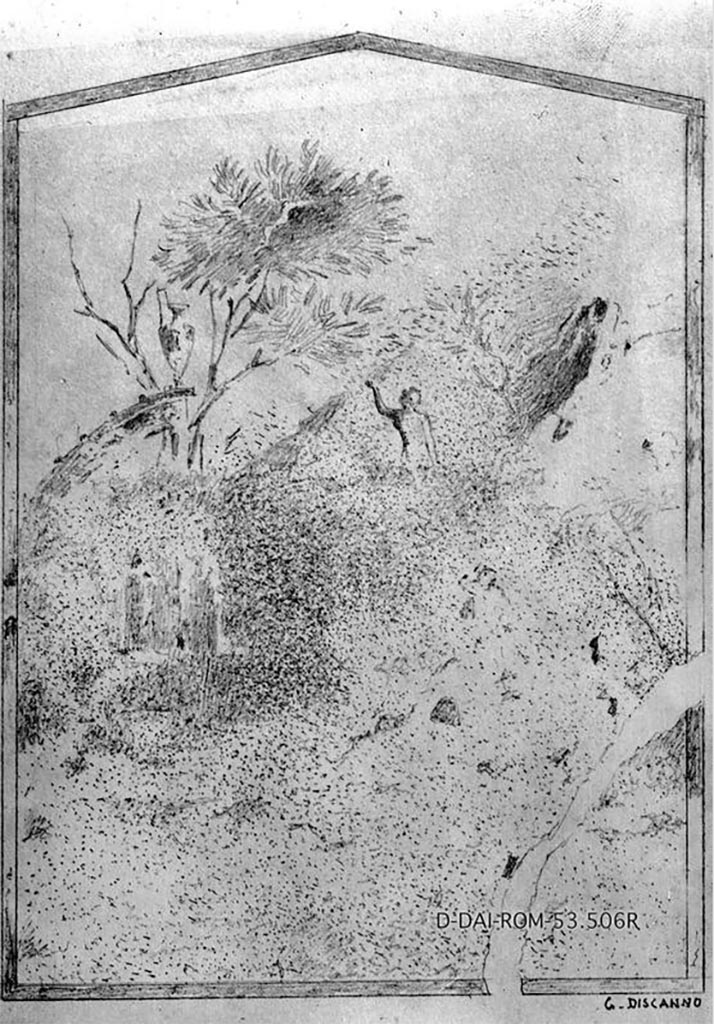
IX.7.16 Pompeii. Triclinium, “b”, found on the west wall in 1867, and then reburied.
Due to the bad state of the painting when found, it was recognised originally by Mau as Selene and Endymion (but most probably Diana and Acteon).
DAIR 83.305.
Photo © Deutsches Archäologisches Institut, Abteilung Rom, Arkiv.
See Sogliano, A.,
1879. Le pitture murali campane scoverte
negli anni 1867-79. Napoli: Giannini. (no: 457).
See Helbig, W., 1868. Wandgemälde der vom Vesuv verschütteten Städte Campaniens. Leipzig: Breitkopf und Härtel. (no: 952).
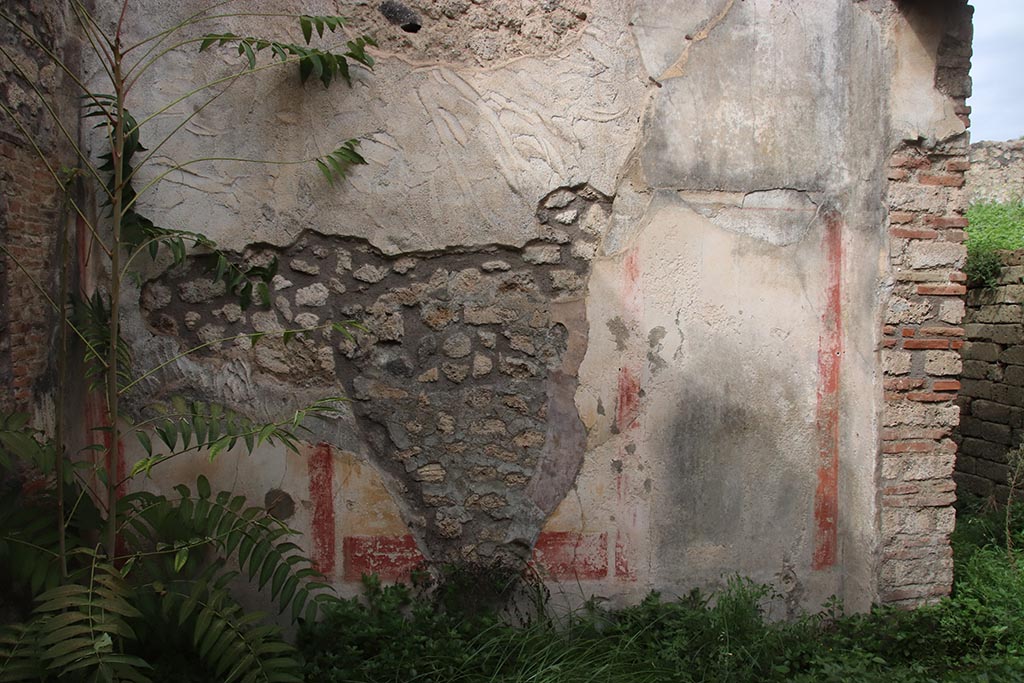
IX.7.16 Pompeii. October 2024. Room “b”, north wall, with doorway to atrium, on right. Photo courtesy of Klaus Heese.
According to PPM –
“The middle zone of the north wall showed, in the centre an aedicula with a yellow background but the central painting had been destroyed by a hole made in antiquity, and narrow red vertical bands which separated it from the black side panels.”
See Carratelli,
G. P., 1990-2003. Pompei: Pitture e
Mosaici. IX (9). Roma: Istituto della enciclopedia italiana, p. 793.
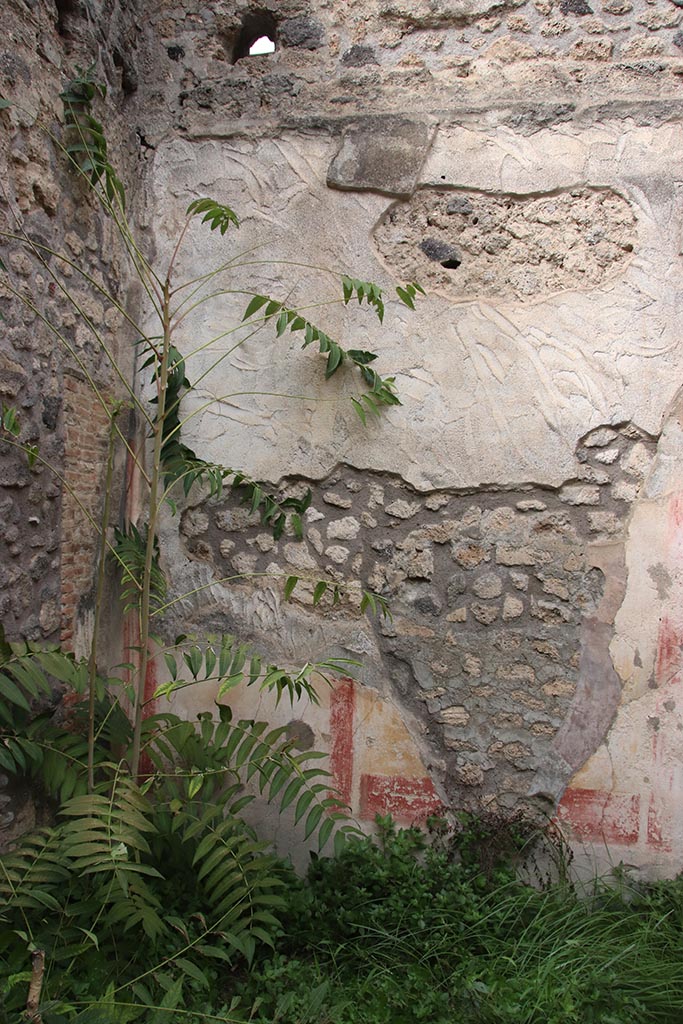
IX.7.16 Pompeii. October 2024.
Room “b”, detail of north wall at west end. Photo courtesy of Klaus Heese.
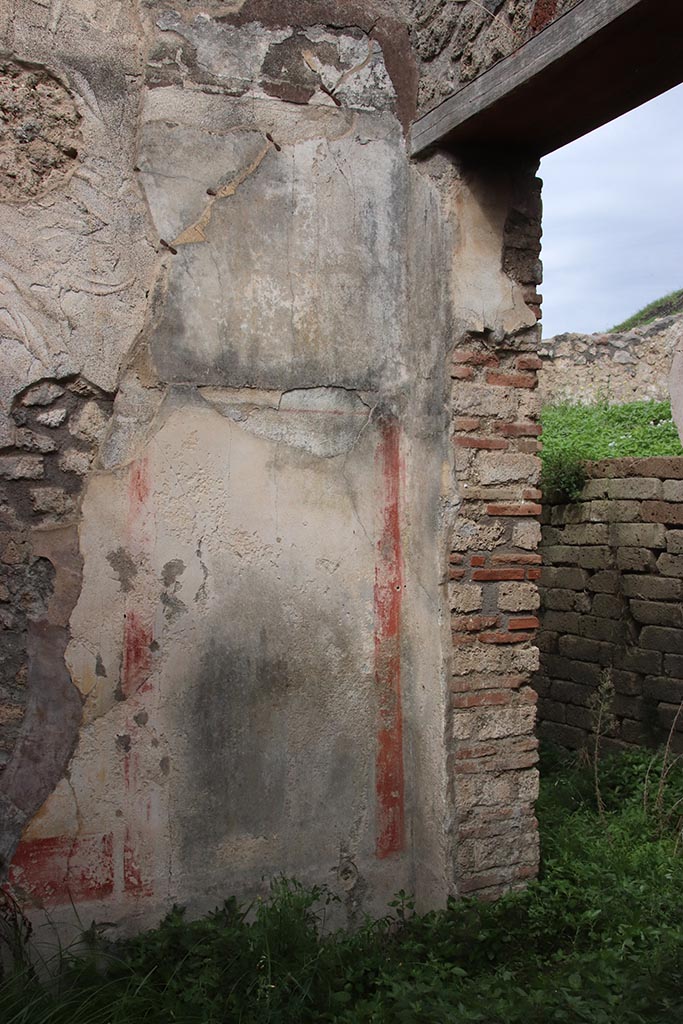
IX.7.16 Pompeii. October 2024.
Room “b”, detail of north wall at east end, with doorway into atrium. Photo courtesy of Klaus Heese.
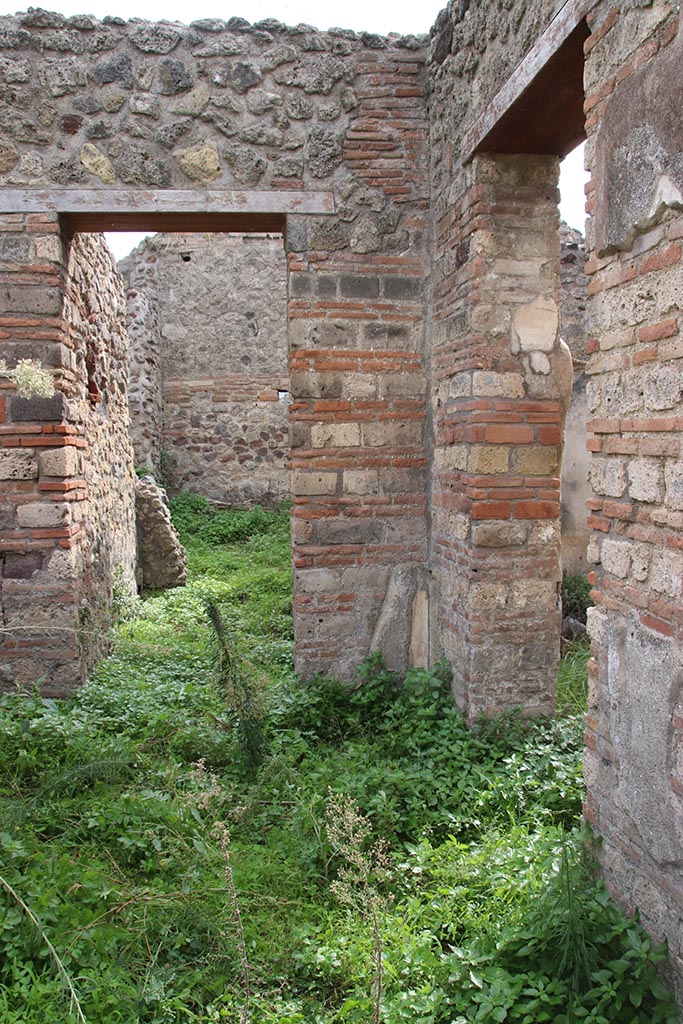
IX.7.16 Pompeii. October 2024.
Looking towards south-west corner of atrium 2, with doorway to room 3, on left, and into room “b”, on right.
Photo courtesy of Klaus Heese.
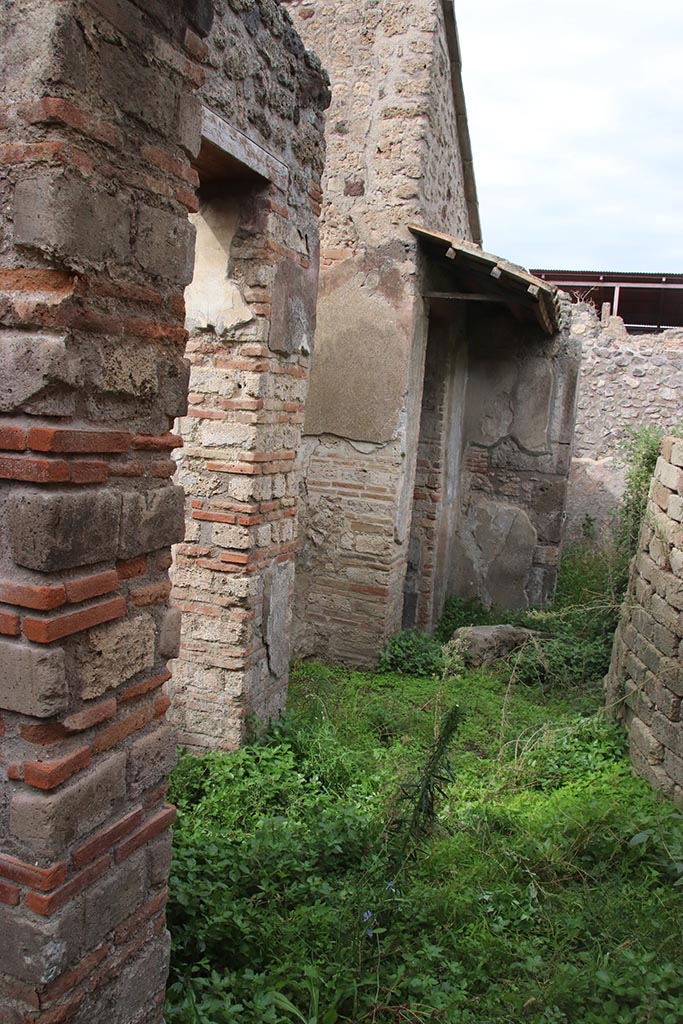
IX.7.16 Pompeii. October 2024.
Looking north through doorway from room 3, across atrium 2. Photo courtesy of Klaus Heese.
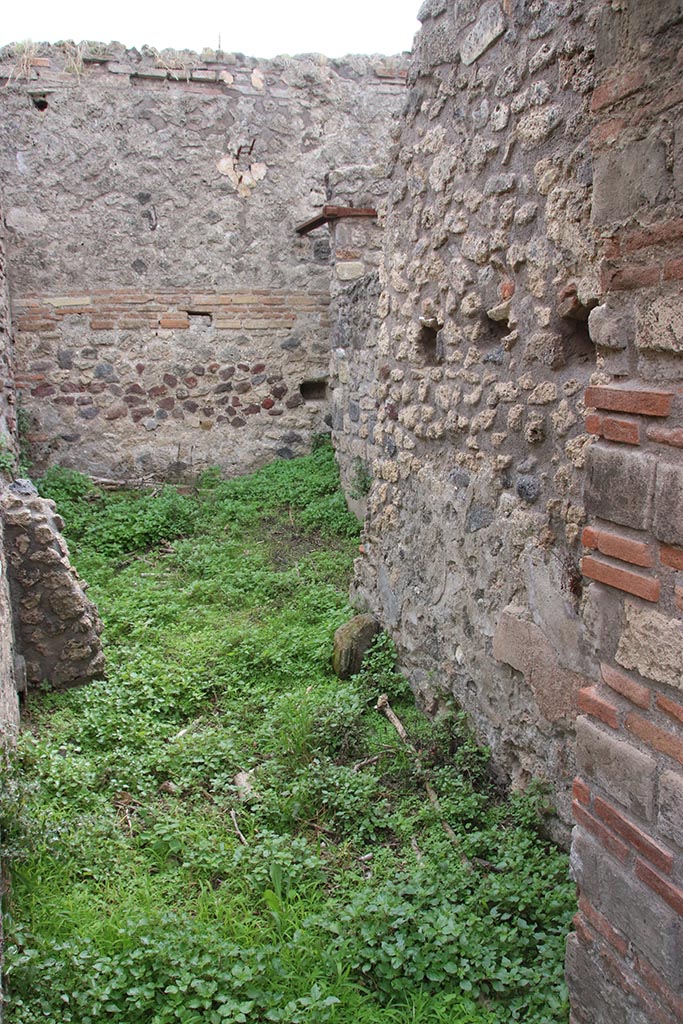
IX.7.16 Pompeii. October 2024.
Looking south-west from doorway into room 3, and through into room “d”. Photo courtesy of Klaus Heese.
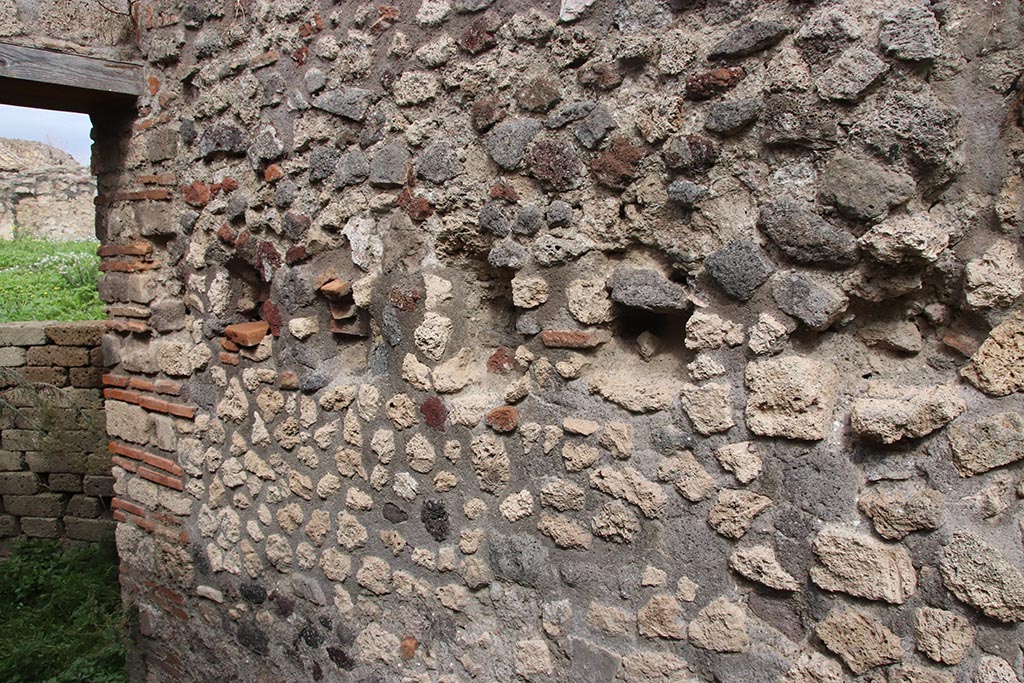
IX.7.16 Pompeii. October 2024. Room 3, north end of east wall. Photo courtesy of Klaus Heese.
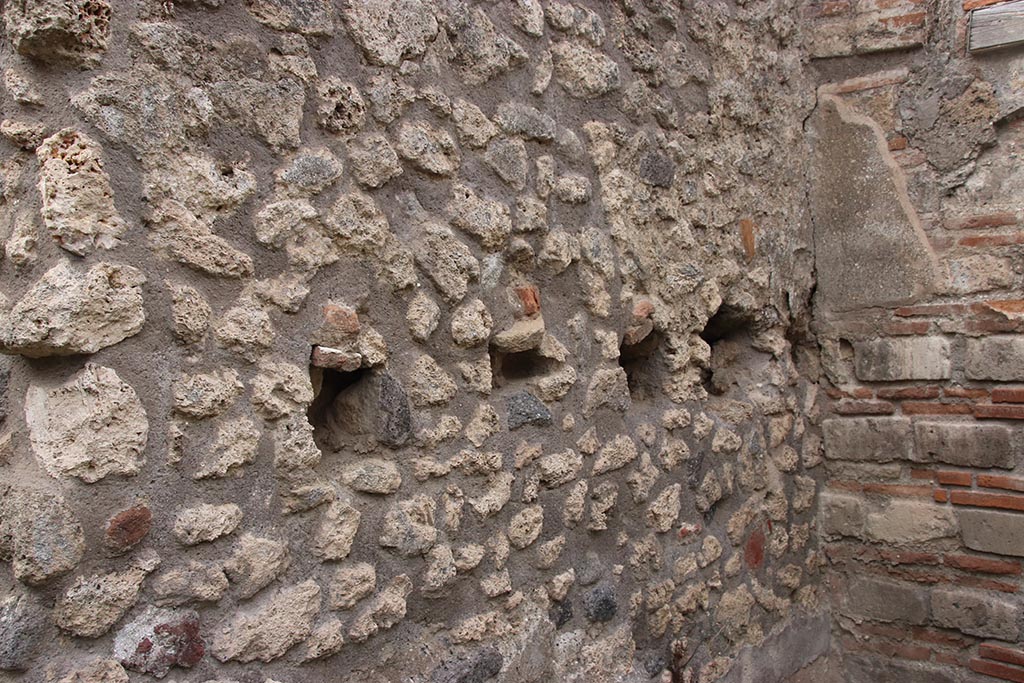
IX.7.16 Pompeii. October 2024. Room 3, north end of west wall. Photo courtesy of Klaus Heese.
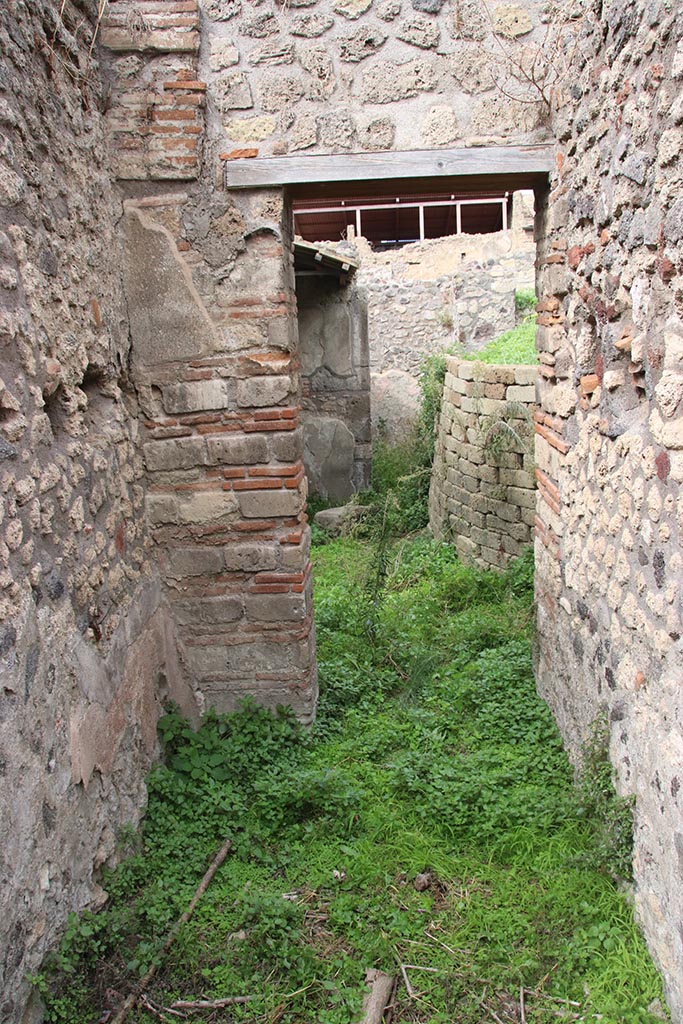
IX.7.16 Pompeii. October 2024. Room 3, looking north towards doorway to atrium.
According to Boyce, this room would have led into the kitchen on its south side.
Photo courtesy of Klaus Heese.
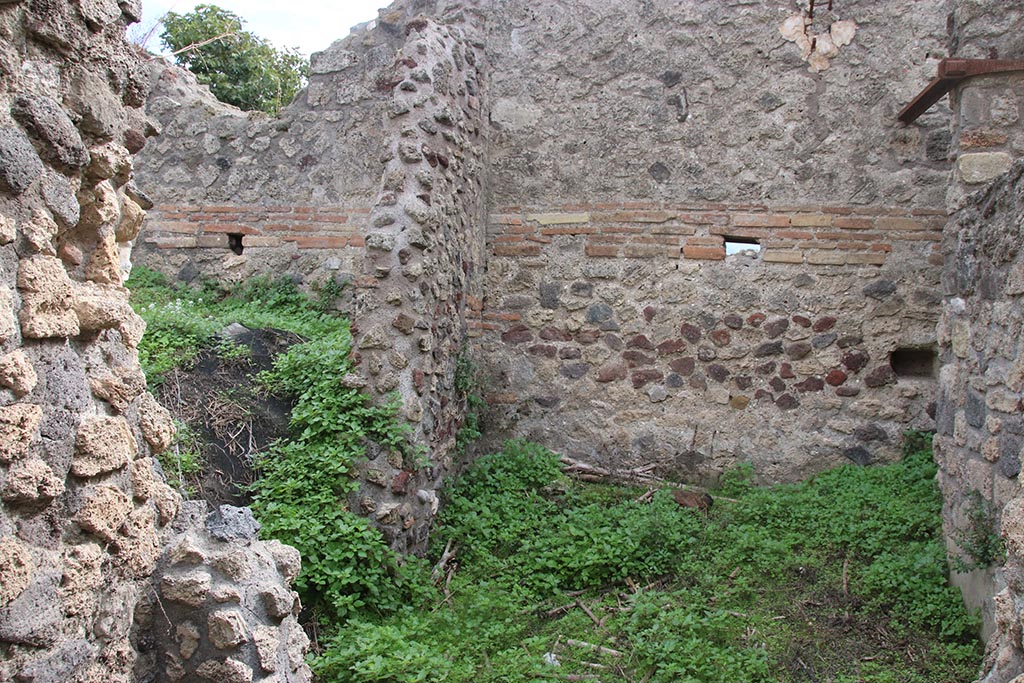
IX.7.16 Pompeii. October 2024.
Room “d”, on south side of room 3, on right, looking south. On the left would be a doorway into room 6. Photo courtesy of Klaus Heese.
According to Boyce –
“In the kitchen, which is entered through the first room on the right of the atrium, on the north wall to the right of the entrance and on the west wall, is the lararium painting (h.1.50, w. on north wall 0.60, on the west wall 1.94): on the right of an altar stands the Genius in the usual attire, pouring a libation from a patera; on the left is the lower part of the figure of the tibicen and behind him stands a camillus wearing white tunic and carrying in his left hand, a shallow dish, taeniae in the right hand. Behind the Genius the popa, wearing a crown of leaves, holds a knife to the throat of a hog adorned with a red band around its belly. On each side of this group of four is a Lar in the usual attire. In the lower zone two yellow serpents, each with red crest, are confronted at an altar. The painting thus described is all on the west wall of the room. On the north wall are painted the following kitchen objects (from top to bottom): a hearth, an uncertain object – perhaps the fire-wood for the hearth – a hog’s head, a pot on a fire.
Traces of the older lararium painting, not entirely covered over by the later, are to be seen on the west wall, where the figure of a Lar can be made out on the left side.”
See Boyce G. K., 1937. Corpus
of the Lararia of Pompeii. Rome:
MAAR 14. (p. 87, no. 436)
and Boyce gives
the reference Bullettino dell’Instituto
di Corrispondenza Archeologica (DAIR), 1883, 145.
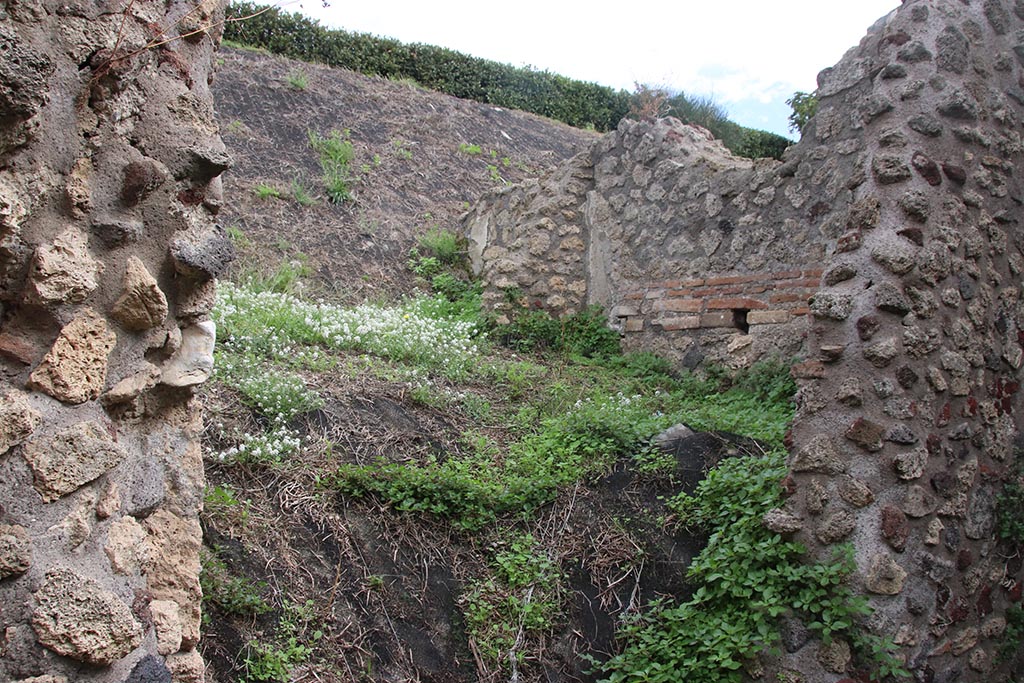
IX.7.16 Pompeii. October 2024.
Room 6, looking north through doorway from room “d”, with room 5 unexcavated into the bank of earth. Photo courtesy of Klaus Heese.
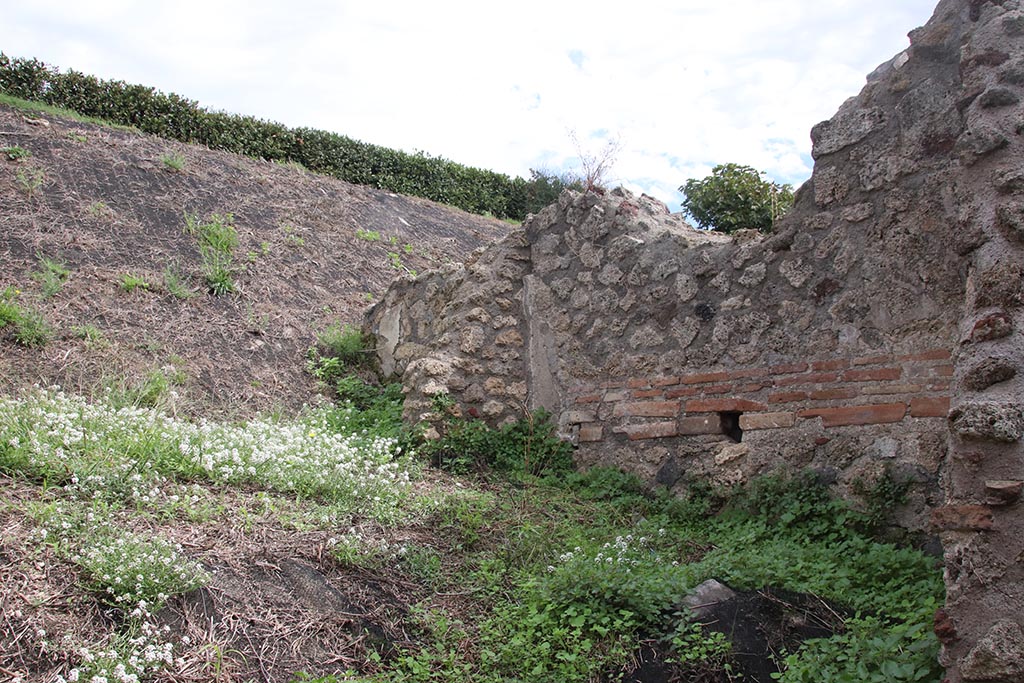
IX.7.16 Pompeii. October 2024. South wall of room 5, in centre, and room 6, on right. Photo courtesy of Klaus Heese.
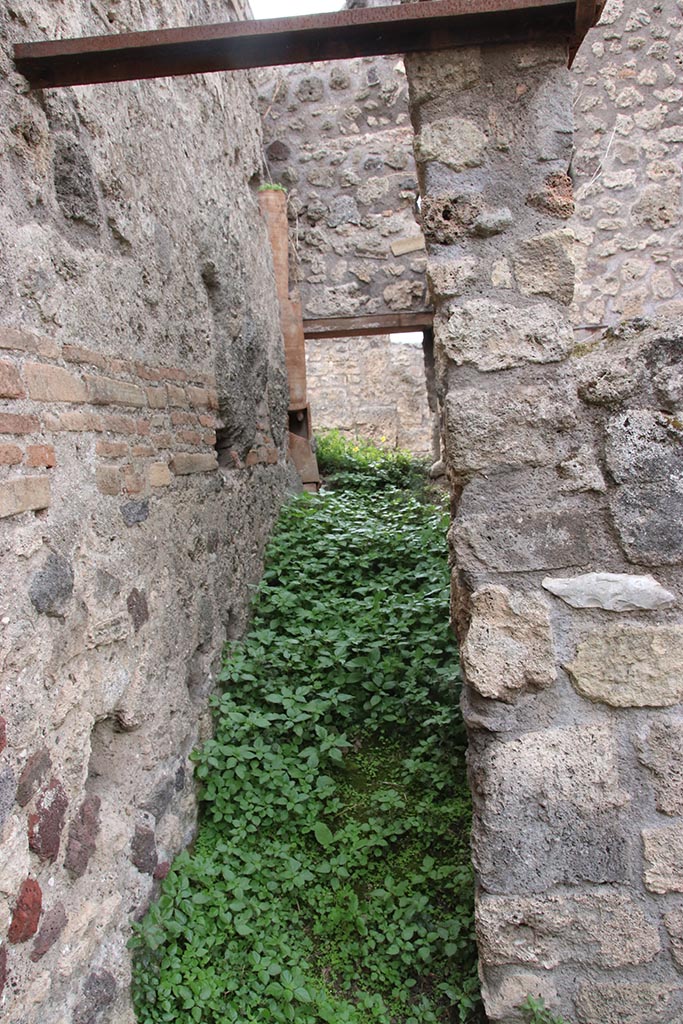
IX.7.16 Pompeii. October 2024.
Room “d”, looking west along south side. Photo courtesy of Klaus Heese.
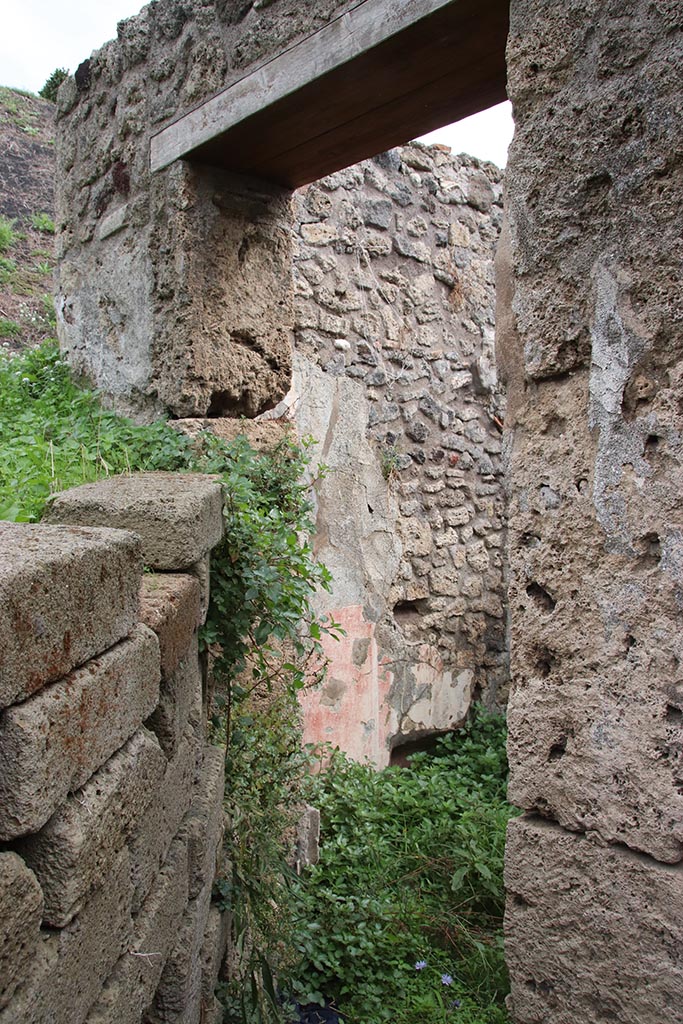
IX.7.16 Pompeii. October 2024.
Looking towards doorway into room “c”, cubiculum, on south side of atrium. Photo courtesy of Klaus Heese.
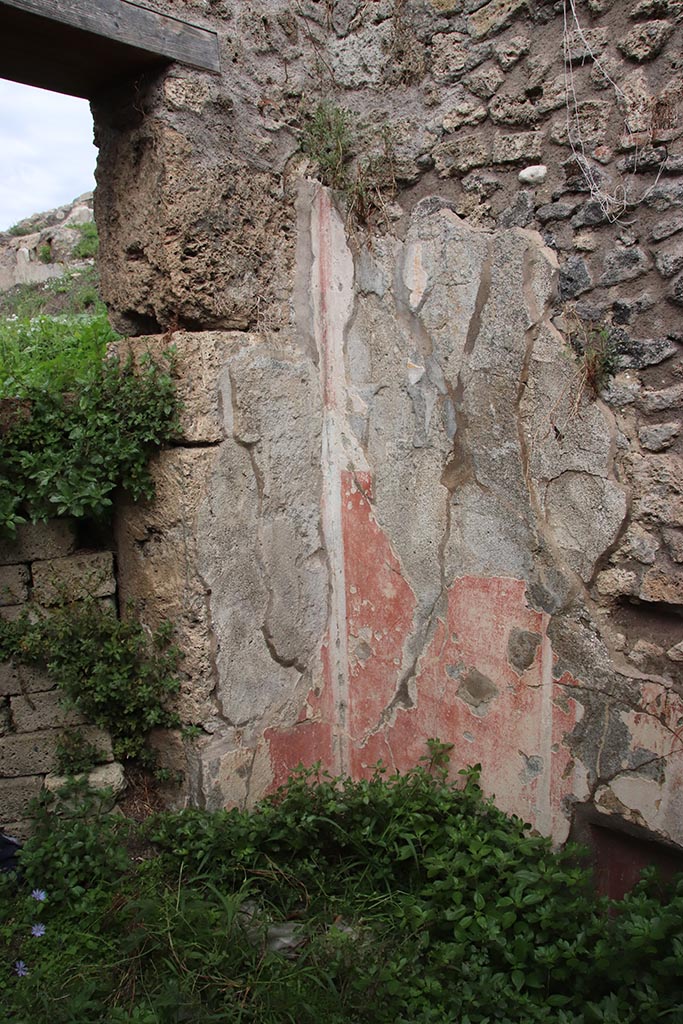
IX.7.16 Pompeii. October 2024. Room “c”, north-east corner. Photo courtesy of Klaus Heese.
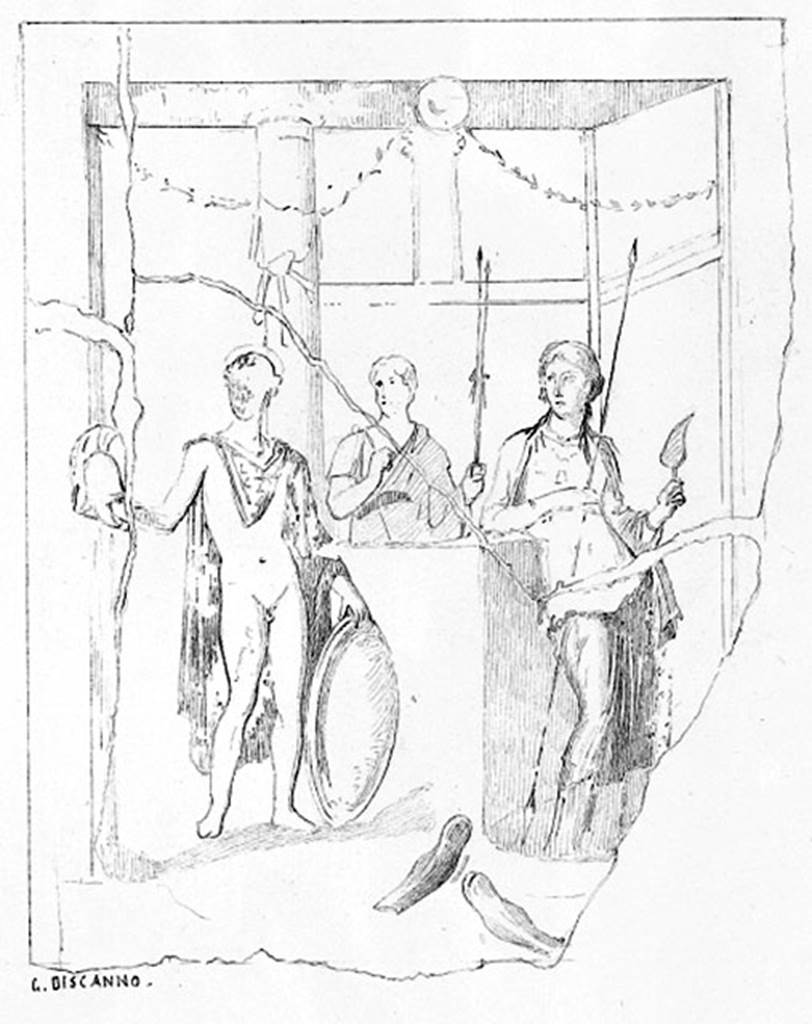
IX.7.16 Pompeii. East wall of cubiculum on south side of atrium.
Drawing by Discanno, sometimes identified as Thetis and Achilles, sometimes as Dido and Aeneas.
DAIR 83.307.
Photo © Deutsches Archäologisches Institut, Abteilung Rom, Arkiv.
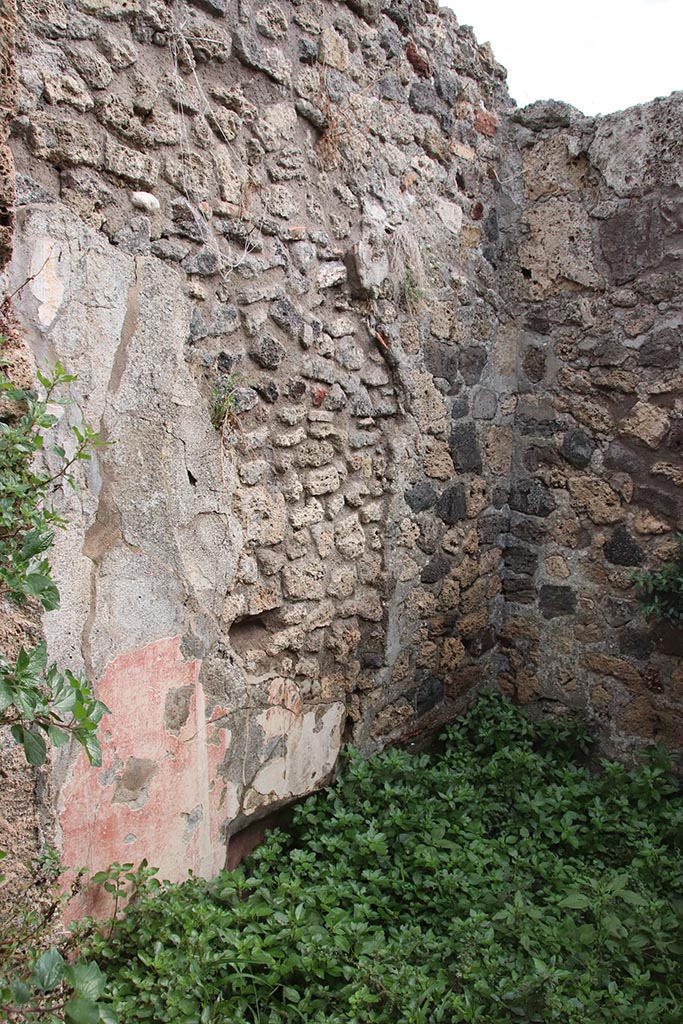
IX.7.16 Pompeii. October 2024. Room “c”, south-east corner. Photo courtesy of Klaus Heese.
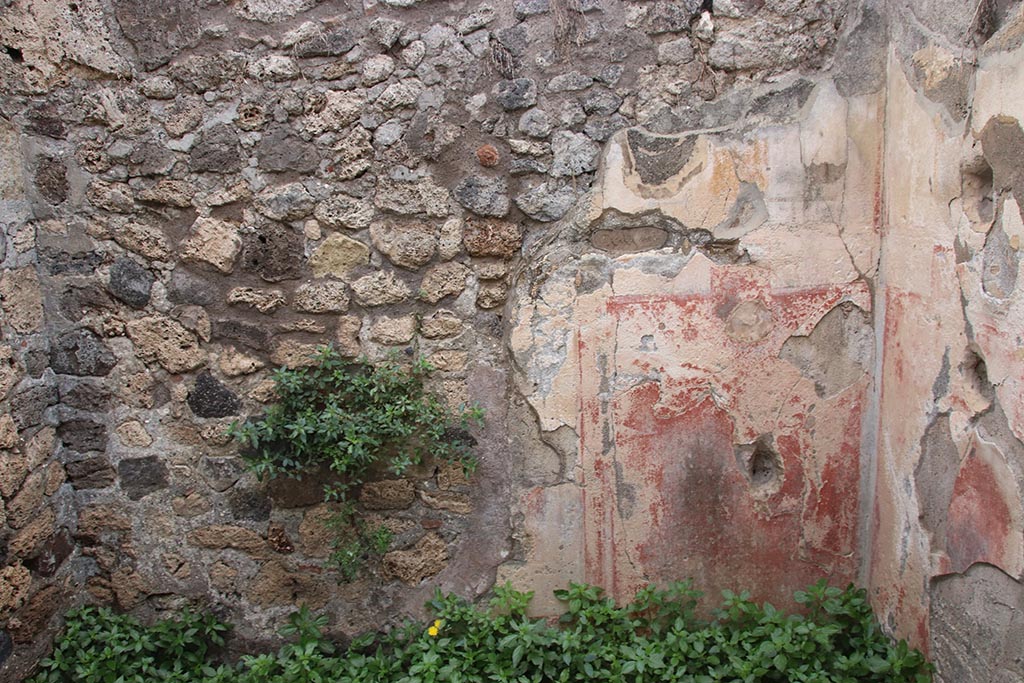
IX.7.16 Pompeii. October 2024. Room “c”, looking towards south wall. Photo courtesy of Klaus Heese.
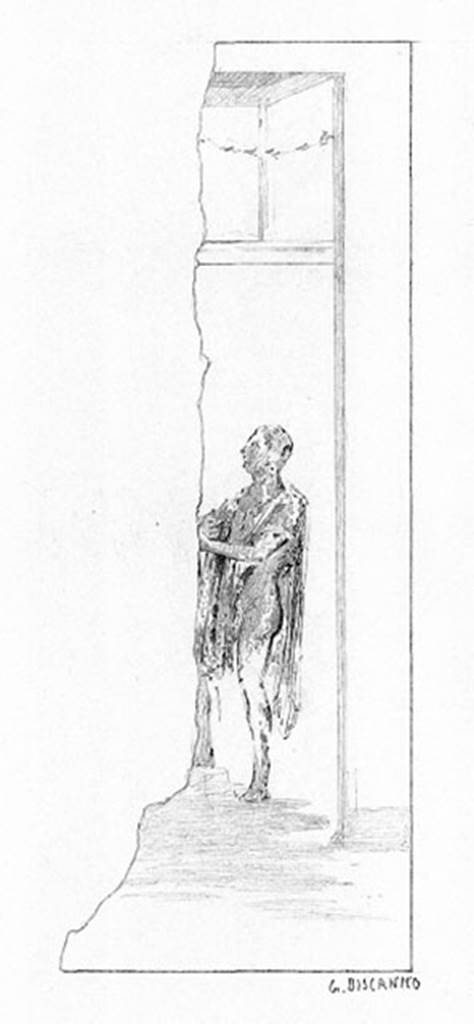
IX.7.16 Pompeii. South wall of cubiculum “c”.
Drawing by Discanno showing a fragment of painting from the prophecy of Cassandra.
DAIR 83.308.
Photo © Deutsches Archäologisches Institut, Abteilung Rom, Arkiv.
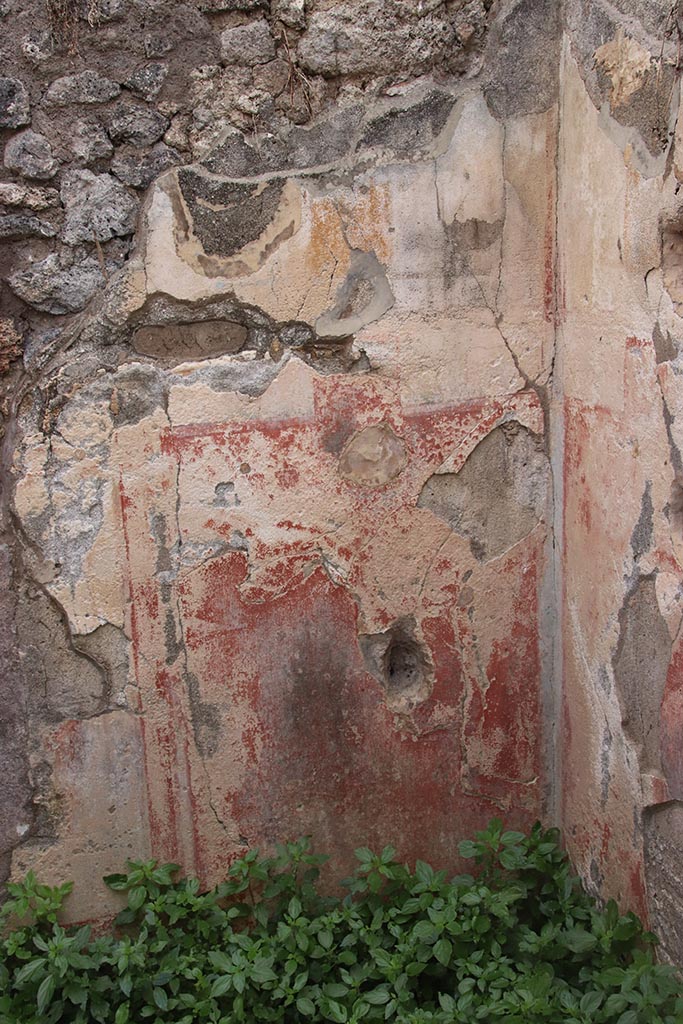
IX.7.16 Pompeii. October 2024.
Room “c”, detail from south wall at west end. Photo courtesy of Klaus Heese.
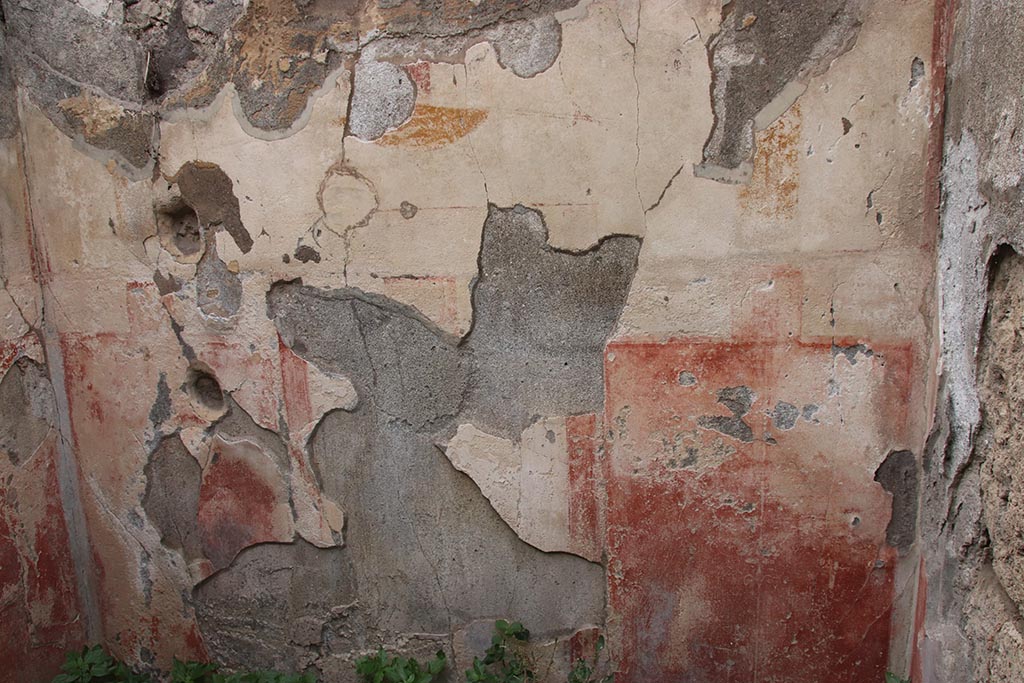
IX.7.16 Pompeii. October 2024. Room “c”, west wall. Photo courtesy of Klaus Heese.
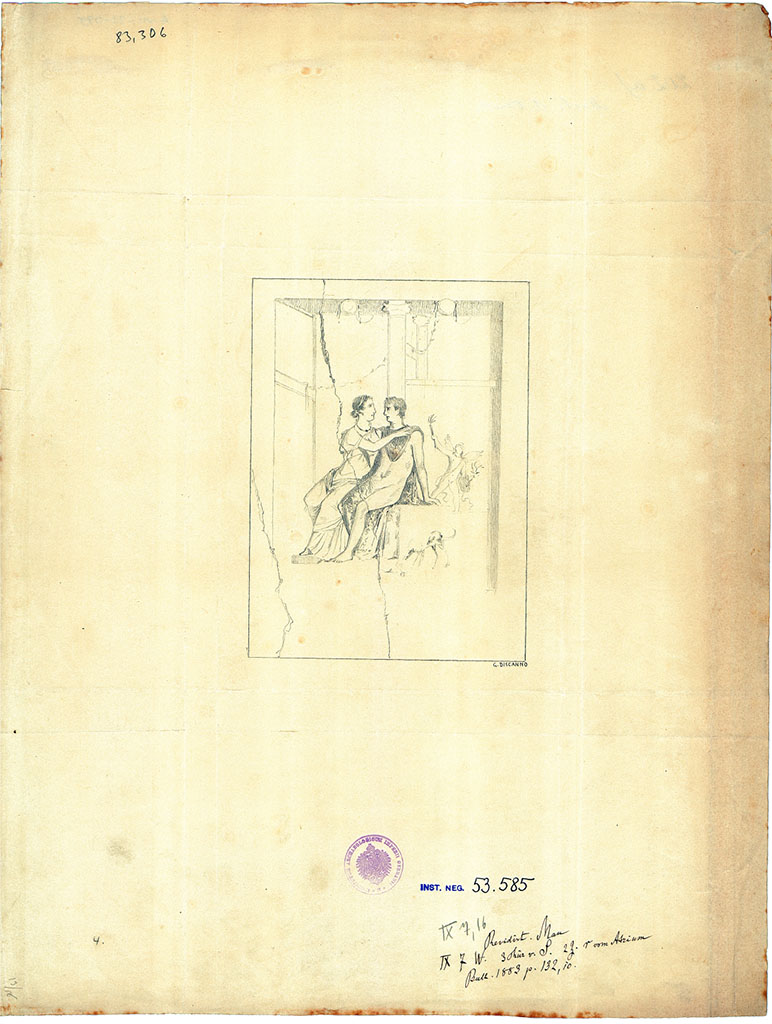
IX.7.16 Pompeii. West wall of cubiculum “c”, drawing by Discanno.
This was sometimes identified as Mars and Venus (Marte and Venere) or Dido and Aeneas (Enea).
DAIR 83.306.
Photo © Deutsches Archäologisches Institut, Abteilung Rom, Arkiv.
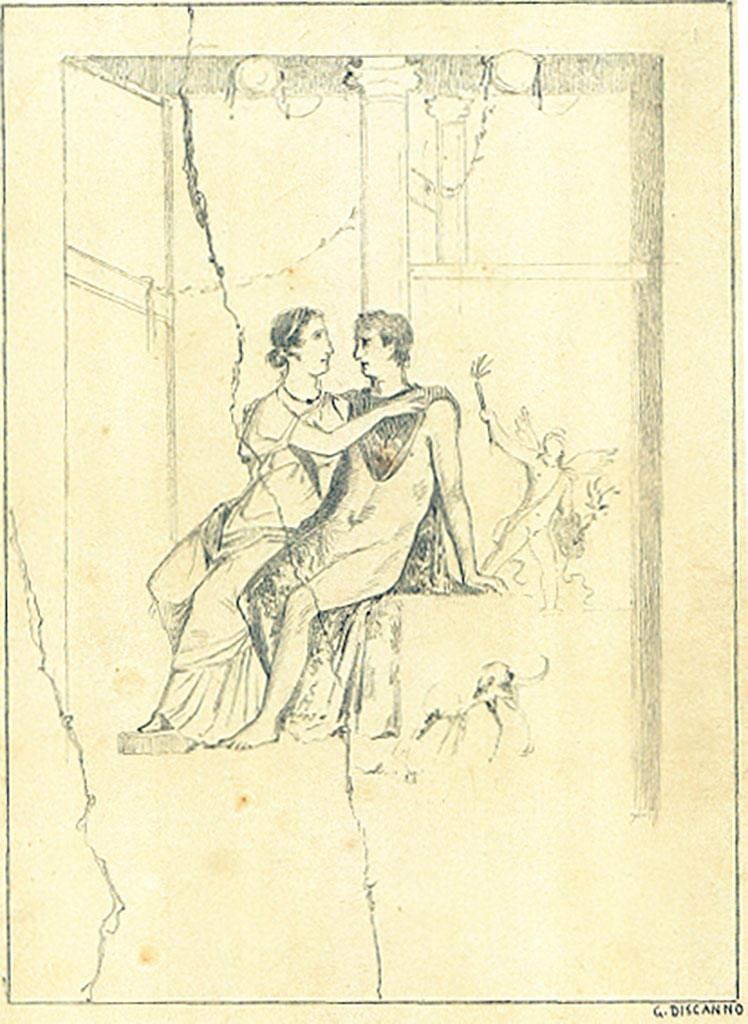
IX.7.16 Pompeii. West wall of cubiculum “c”, drawing by Discanno.
Detail of drawing sometimes identified as Mars and Venus (Marte and Venere) or Dido and Aeneas (Enea).
DAIR 83.306.
Photo © Deutsches Archäologisches Institut, Abteilung Rom, Arkiv.
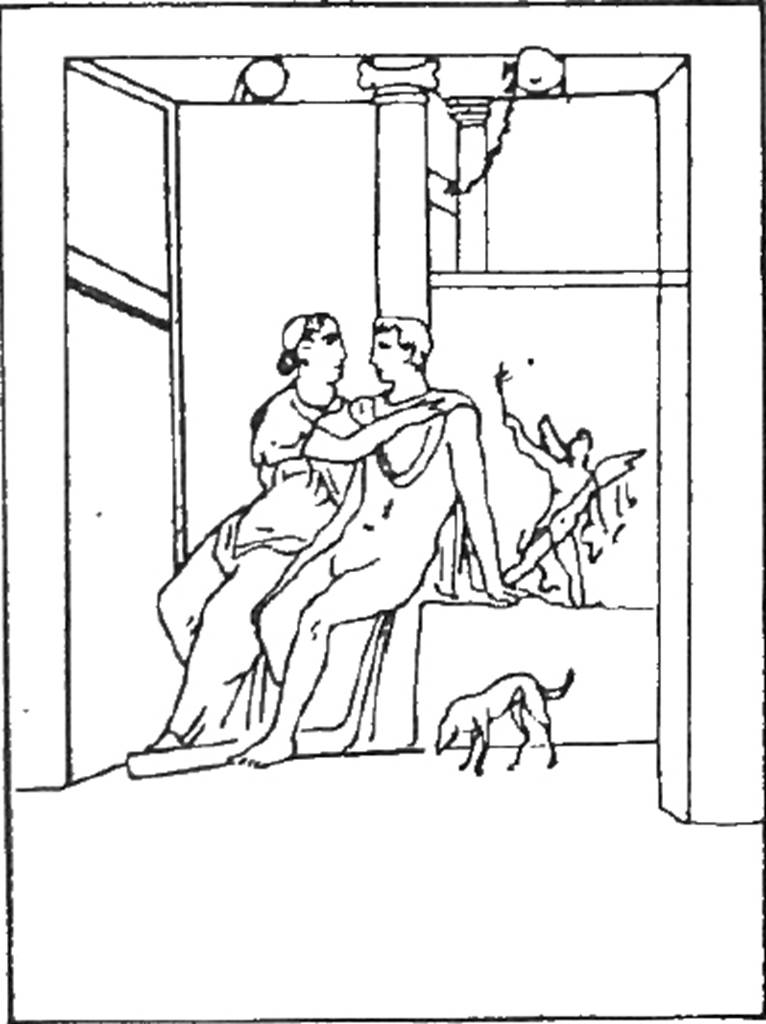
IX.7.16 Pompeii. May 2010. Cubiculum “c”, west wall.
Outline drawing of the painting of Aphrodite and Adonis or Mars and Venus.
See Reinach S.,
1922. Répertoire de peintures grecques
et romaines. Paris:
Leroux. (p. 65,5).
See Schefold, K.,
1962. Vergessenes Pompeji. Bern:
Francke. (Taf 55,3).
See Helbig, W., 1868. Wandgemälde der vom Vesuv verschütteten Städte Campaniens. Leipzig: Breitkopf und Härtel. (323)
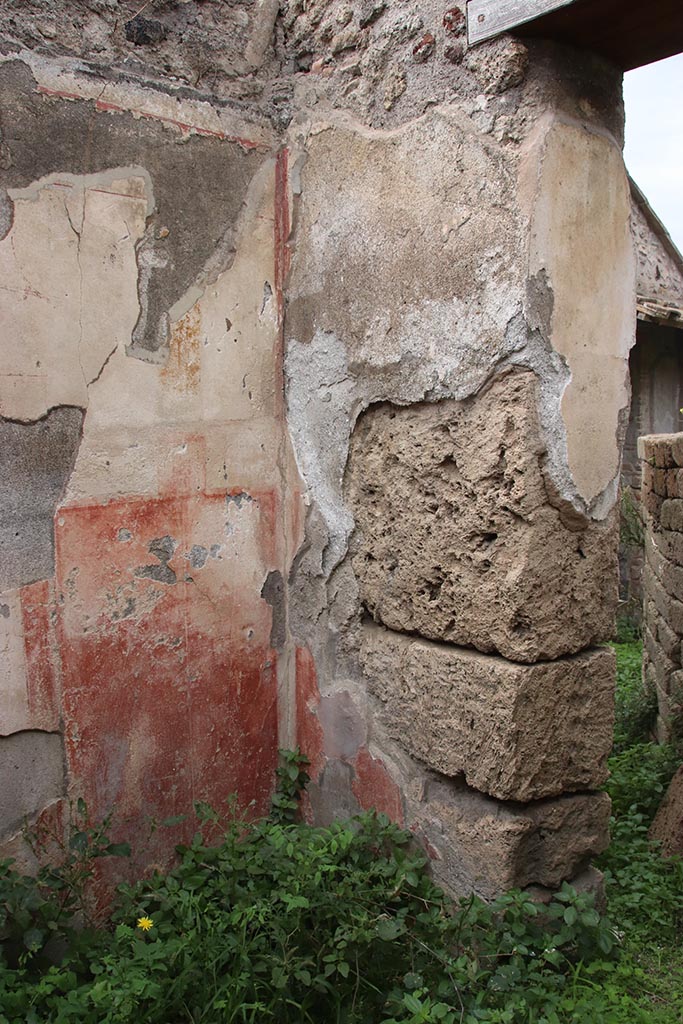
IX.7.16 Pompeii. October 2024.
Room “c”, north-west corner and doorway to atrium. Photo courtesy of Klaus Heese.
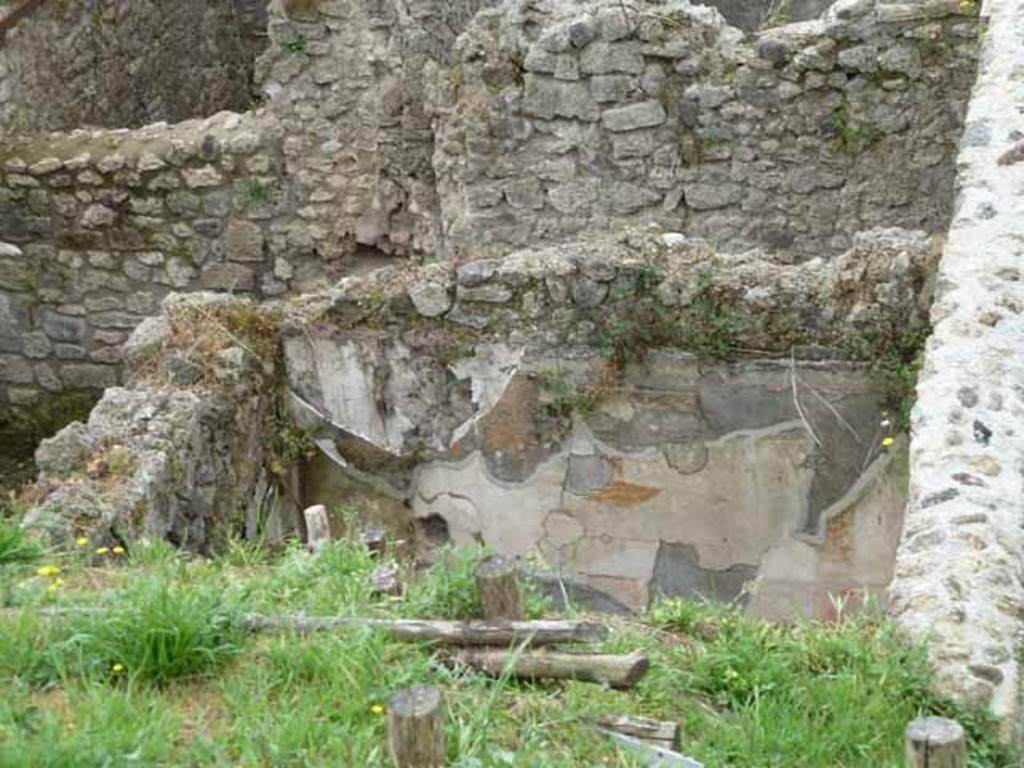
IX.7.16 Pompeii. May 2010. Cubiculum “c”, looking towards west wall.
Looking towards the west wall of room “c” with the remains of painted plaster, on the south side of the atrium.
According to Schefold, on the west wall a painting of Mars and Venus was found. (Helbig 323)
A drawing of the painting can be seen in Schefold, K., 1962.
Vergessenes Pompeji. Bern: Francke.
(fig.55, 3)
On the east wall, a drawing of the painting of Achilles receiving the arms can be seen in fig.55, 4.
On the south wall, on the left of the photo, a fragment of the wall painting of Cassandra, Hector, was found.
See Schefold, K., 1957. Die Wande Pompejis. Berlin: De Gruyter.
According to Mau, “The walls were of the same character as those in the triclinium and the other cubiculum.
The walls were simply decorated in the III style.
The zoccolo was painted with a black background, the middle of the wall was red, and the upper part was white.
The execution of the decoration was considered inferior, by Mau, to that of the other cubiculum.
In the middle of each wall was a painting in the usual painted pavilion.
- on the left (east) wall – the design showed the interior of a house with a column on the left middle of the painting, a second column was on the right, garlands were hanging on them. In front of this last, a little more to the left, was a young person with heroic stature, with a red cloak (......) In his right hand was a golden helmet. More to the right was a woman (...) Another woman stood beside the base (......) They all looked towards the helmet.
- on the rear wall (south) only a fragment remained: towards the right edge was a figure: the one here had a lance in his right hand (see also Sogliano 560, thought to be Hector) and Helbig 1381, 1391b)
- on the left (west) wall was a painting of Mars and Venus”.
See Mau, in Bullettino dell’Instituto di Corrispondenza
Archeologica (DAIR), 1883, (p. 131-133).
![IX.7.16 Pompeii. Plan by PPM.
See Carratelli, G. P., 1990-2003. Pompei: Pitture e Mosaici: Vol. IX, Parte II. Roma: Istituto della enciclopedia italiana, p. 782-3.
According to PPM, in relation to IX.7.16,
"The mosaic fountain, present in the partially excavated garden, located to the E of the peristyle of the house at no. 20, was added to this house [IX.7.16], since it was reachable from it".
This is number 8 on their plan, continuing the IX.7.16 numbering.
See Carratelli, G. P., 1990-2003. Pompei: Pitture e Mosaici: Vol. IX, Parte II. Roma: Istituto della enciclopedia italiana, p. 782-3.](9%2007%2016%20p2_files/image077.jpg)
IX.7.16 Pompeii. Plan by PPM.
See Carratelli,
G. P., 1990-2003. Pompei: Pitture e
Mosaici: Vol. IX, Parte II. Roma: Istituto della enciclopedia italiana, p. 782-3.
According to PPM,
in relation to IX.7.16,
"The mosaic fountain, present in the partially excavated garden, located to the E of the peristyle of the house at no. 20, was added to this house [IX.7.16], since it was reachable from it".
This is number 8 on their plan, continuing the IX.7.16 numbering.
See Carratelli,
G. P., 1990-2003. Pompei: Pitture e
Mosaici: Vol. IX, Parte II. Roma: Istituto della enciclopedia italiana, p. 782-3.
![IX.7.16 (?) Pompeii. October 2024. Mosaic fountain area at rear of IX.7.20. Photo courtesy of Klaus Heese.
(For more photos of this area, see IX.7.20).
According to PPM, in relation to IX.7.16,
"The mosaic fountain, present in the partially excavated garden, located to the E of the peristyle of the house at no. 20, was added to this house [IX.7.16], since it was reachable from it".
This is number 8 on their plan, continuing the IX.7.16 numbering.
See Carratelli, G. P., 1990-2003. Pompei: Pitture e Mosaici: Vol. IX, Parte II. Roma: Istituto della enciclopedia italiana, p. 783.](9%2007%2016%20p2_files/image078.jpg)
IX.7.16 (?) Pompeii. October 2024. Mosaic fountain area at rear of IX.7.20. Photo courtesy of Klaus Heese.
(For more photos of this area, see IX.7.20).
According to PPM, in relation to IX.7.16,
"The mosaic fountain, present in the partially excavated garden, located to the E of the peristyle of the house at no. 20, was added to this house [IX.7.16], since it was reachable from it".
This is number 8 on their plan, continuing the IX.7.16 numbering.
See Carratelli, G. P., 1990-2003. Pompei: Pitture e Mosaici: Vol. IX, Parte II.
Roma: Istituto della enciclopedia italiana, p. 783.
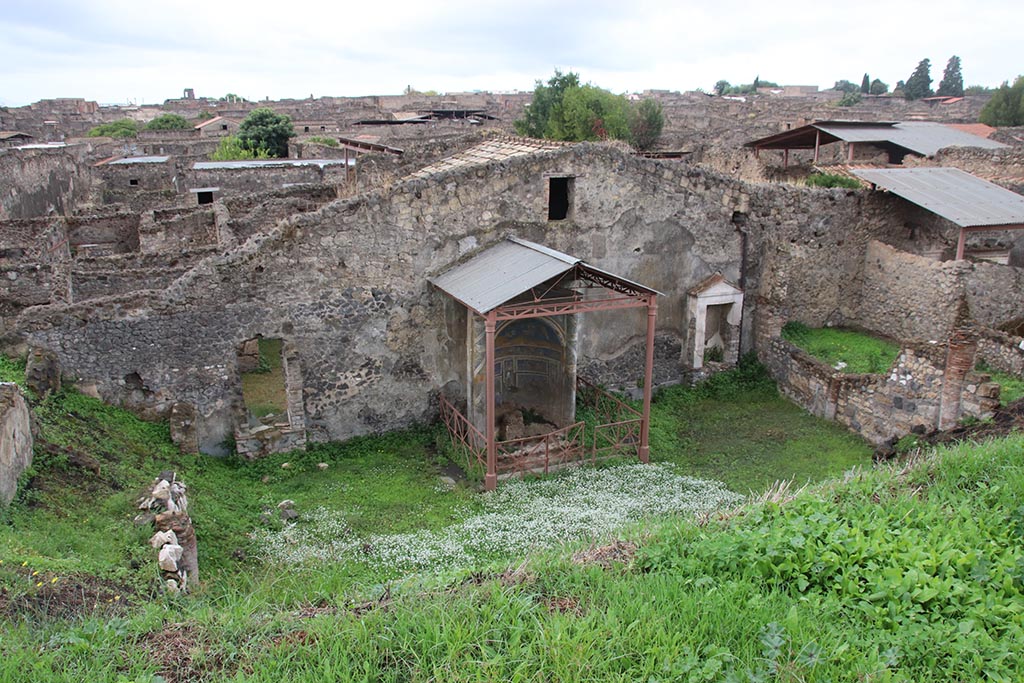
IX.7.16 (?) Pompeii. October 2024. Looking west. Photo courtesy of Klaus Heese.
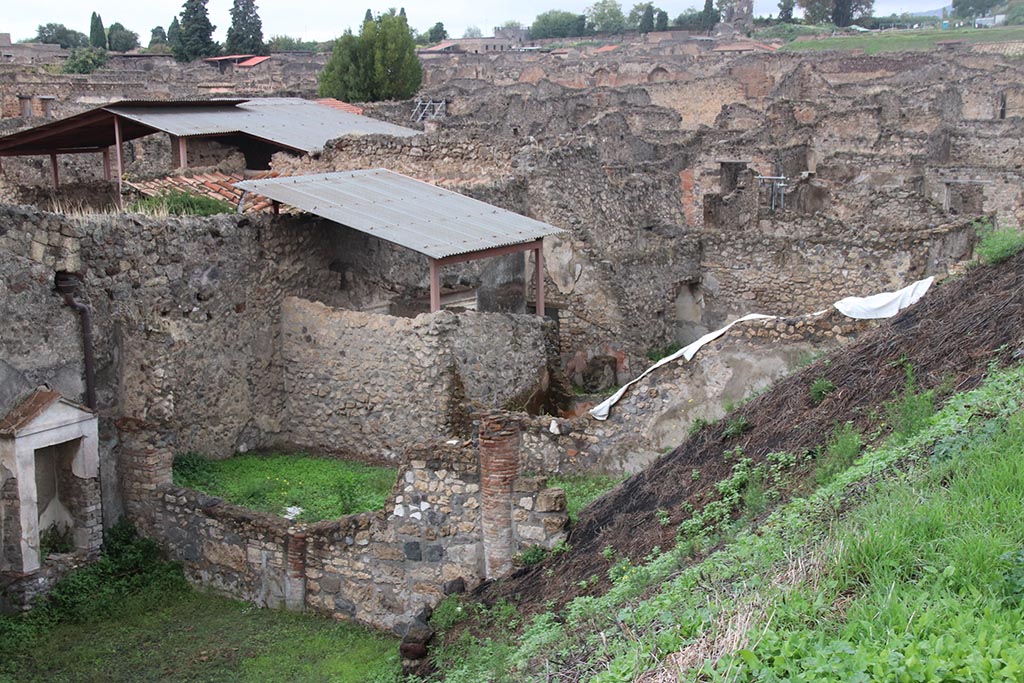
IX.7.16 (?) Pompeii, on left. October 2024. Looking north-west towards IX.7.25, on right of photo. Photo courtesy of Klaus Heese.
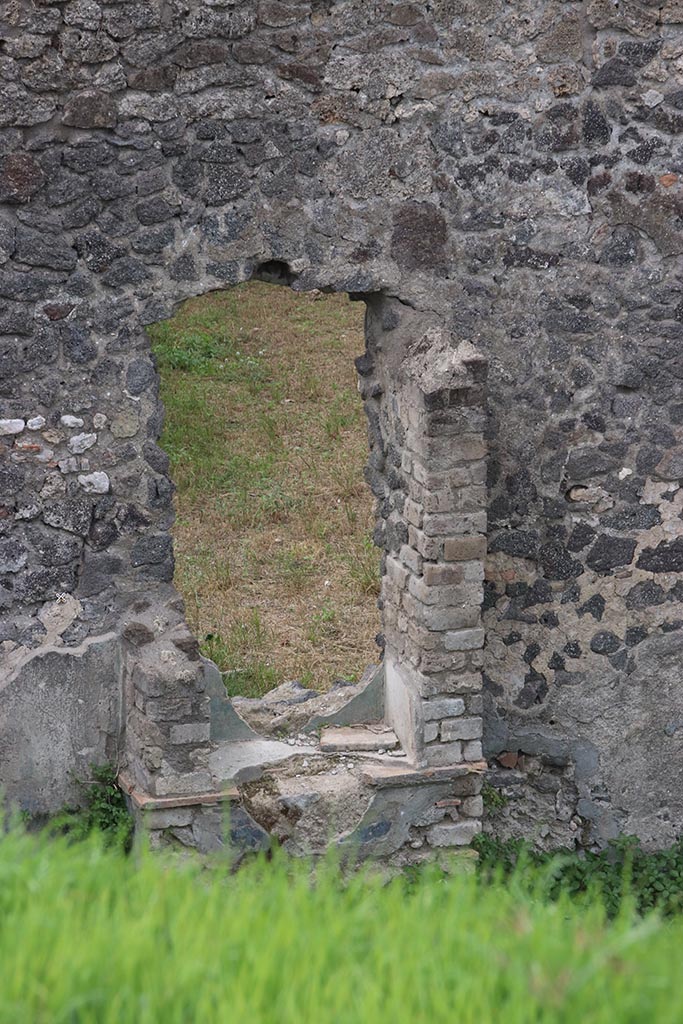
IX.7.16 (?) Pompeii. October 2024.
Niche against west wall, on south side of fountain. Photo courtesy of Klaus Heese.
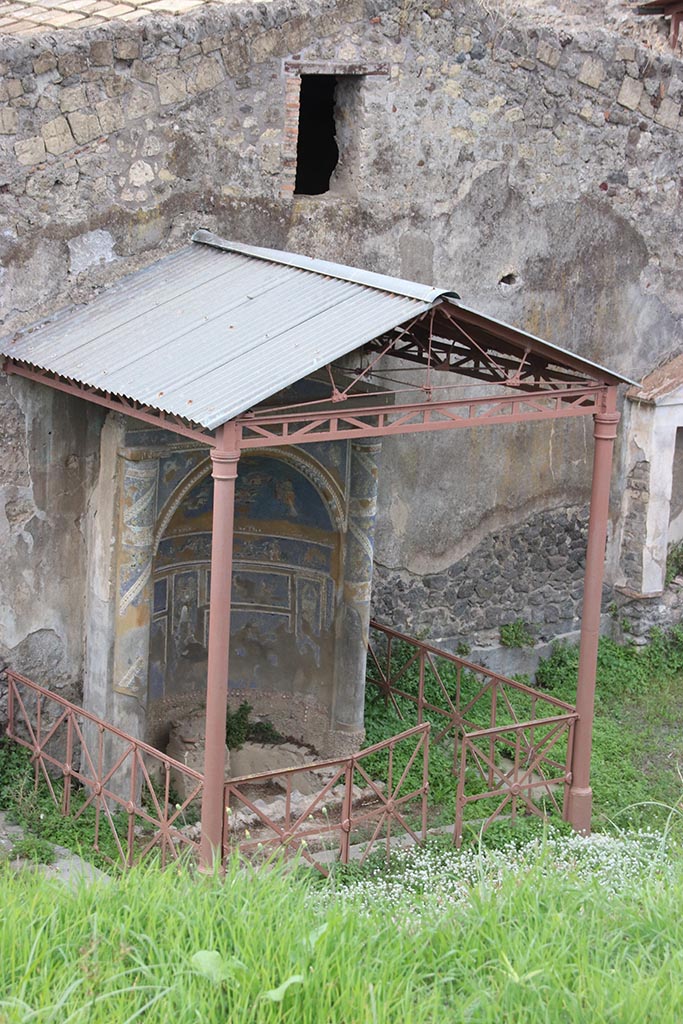
IX.7.16 (?) Pompeii. October 2024. Fountain against west wall. Photo courtesy of Klaus Heese.
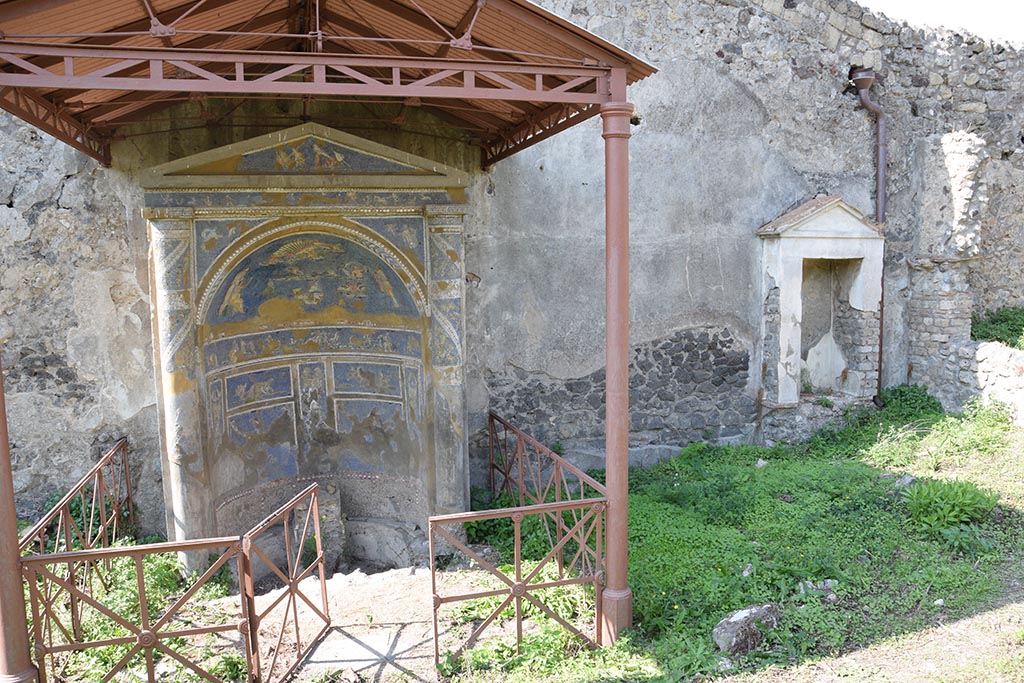
IX.7.16 (?) Pompeii. October 2017. Looking towards west wall with fountain and niche. Photo courtesy of Johannes Eber.
(Note: also entered at IX.7.20).
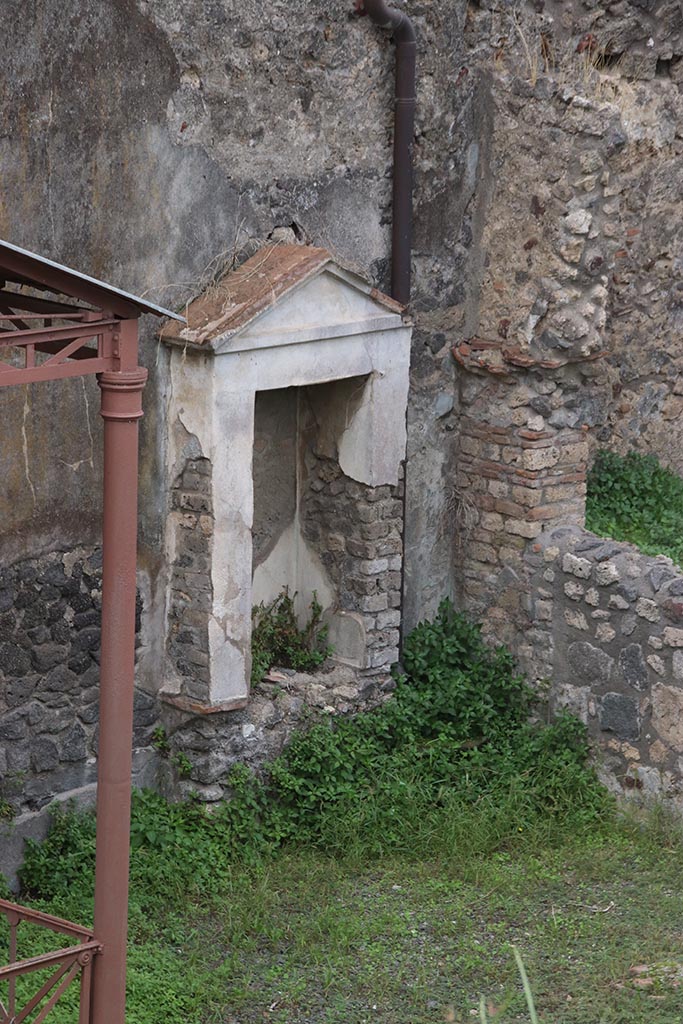
IX.7.16 (?) Pompeii. October 2024.
Niche against west wall, on north side of fountain. Photo courtesy of Klaus Heese.
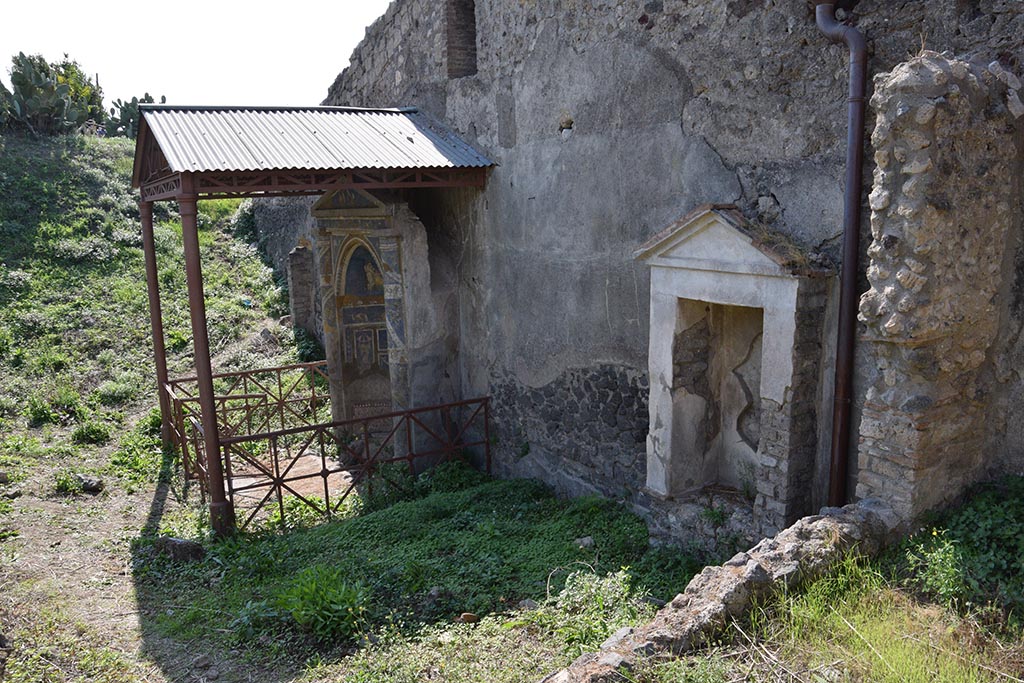
IX.7.16 (?) Pompeii. October 2017. Looking south along west wall. Photo courtesy of Johannes Eber.
(Note: this has also been entered at IX.7.20).
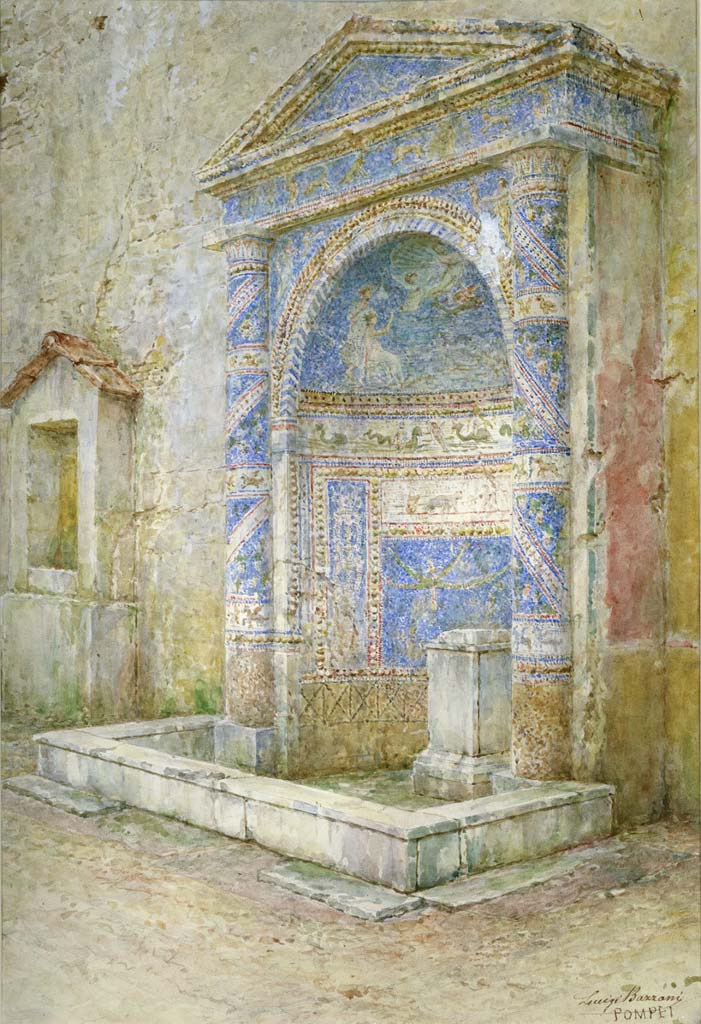
IX.7.16 (?) Pompeii. Room 8. Undated watercolour by Luigi Bazzani.
Looking south-west towards fountain, and an aedicula niche on its south side.
Now in Naples Archaeological Museum, inv. no. 139427.
(described as “Fountain of the House of C.
Virnius Modestus (IX 7, 16) in Pompeii”.
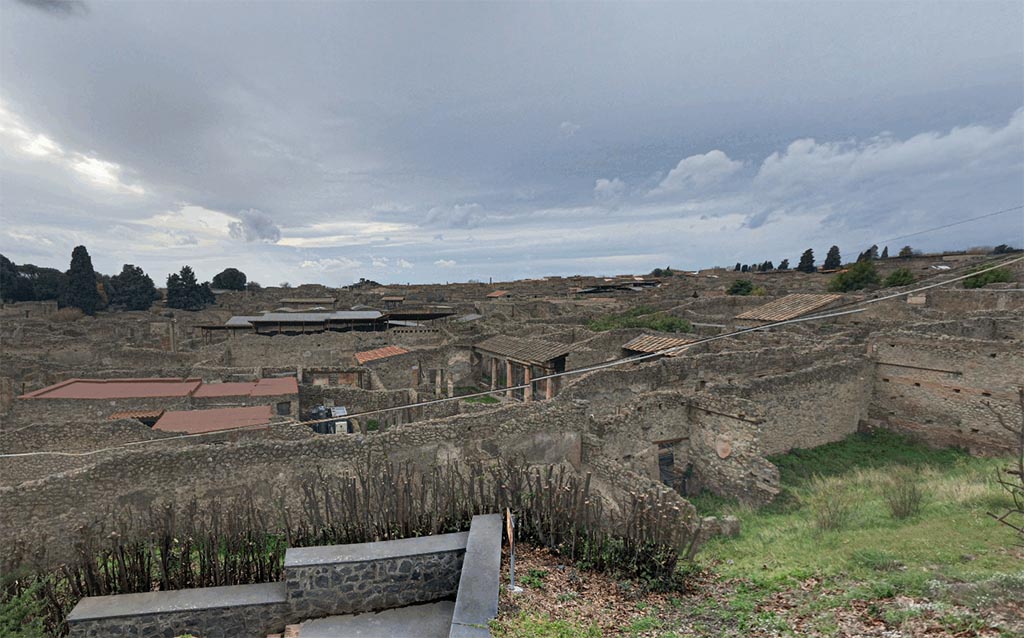
IX.7.12, 14 or 16 (?) Pompeii. 2017.
Looking down from the Casina dell’Aquila towards an aedicula lararium in the north-west corner of the garden area “e”, on the right in the photo.
Photo courtesy of Google Earth.
Due to the fact that the area has not been fully excavated, it is not known whether this garden area belongs to IX.7.12, 14 or IX.7.16.
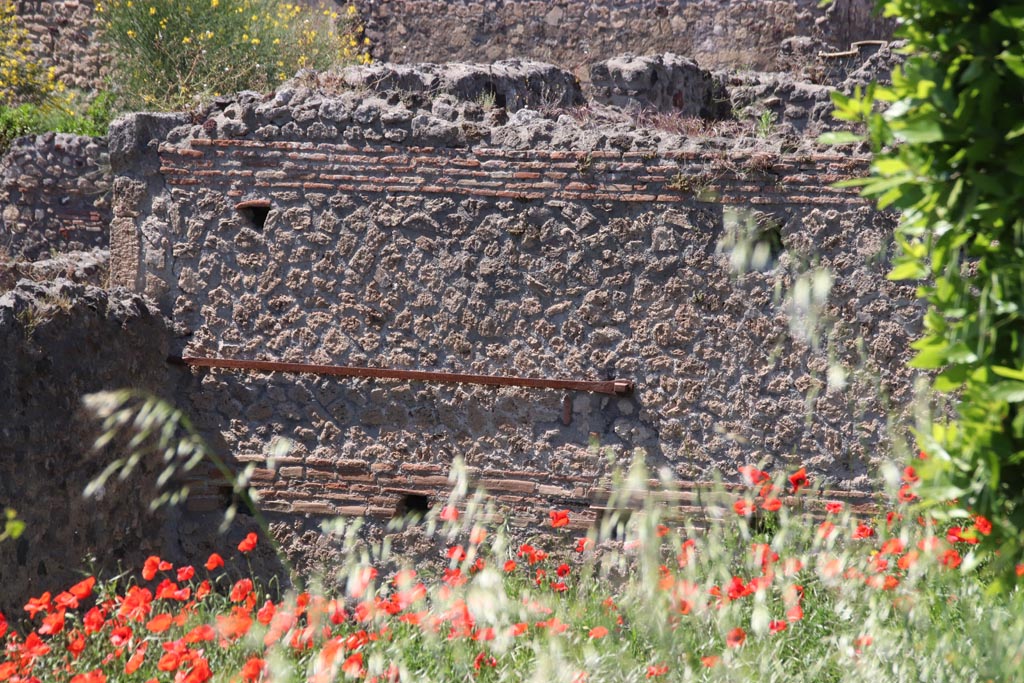
IX.7.12, 14 or 16 (?) Pompeii. May 2024.
Looking towards upper north wall and north-west corner of garden area “e”. Photo courtesy of Klaus Heese.
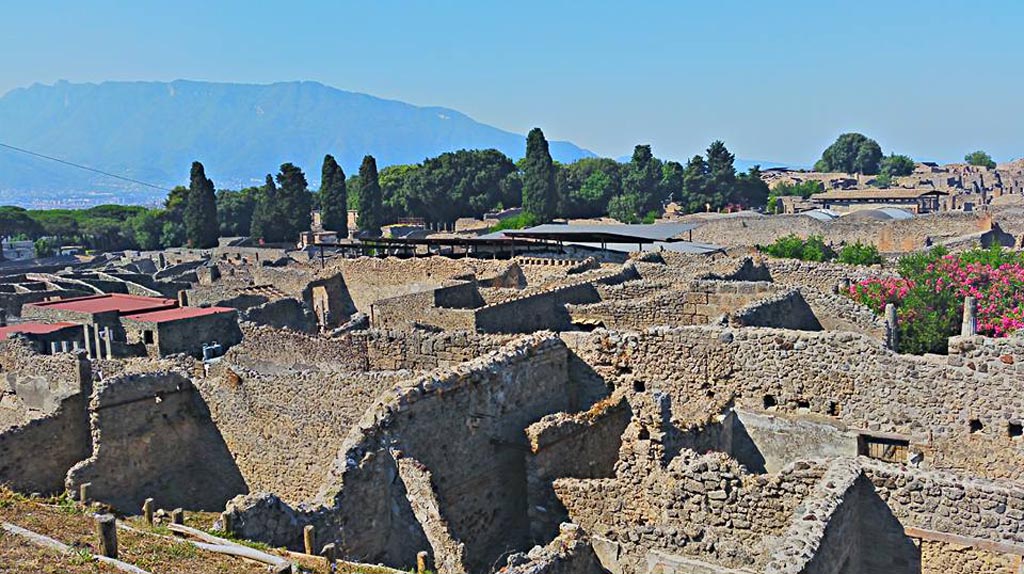
IX.7.14/15/16 Pompeii. 2015/2016.
Looking south-west
from Casina dell’Aquila towards east side of Vicolo di Tesmo, in lower photo.
The garden area is on the left of the photo,
between entrances at IX.7.14 and IX.7.15.
The rooms on the right are part of
IX.7.16. Photo
courtesy of Giuseppe Ciaramella.
According to Boyce and Jashemski, a garden was excavated near here.
Whether it belonged to IX.7.12, 14, or 16 cannot be seen until further excavation.
See Boyce G. K., 1937. Corpus of the Lararia of Pompeii. Rome: MAAR 14. (p.89, no.445)
According to Jashemski, she quoted the location as IX.7.12(?).
She said in the north-west corner of this partially excavated garden, at the left of the entrance, stood an aedicula lararium.
In front of the lararium was a small altar, and a lararium painting on the wall around the shrine.
Many marble sculptures decorated the garden.
See Jashemski, W. F., 1993. The Gardens of Pompeii, Volume II: Appendices. New York: Caratzas. (p.239).
(For more photos of garden area “e”, see IX.7.14).
Part 2 Part 1