IX.6.3 Pompeii. House of P. F. L. Excavated 1878-9.
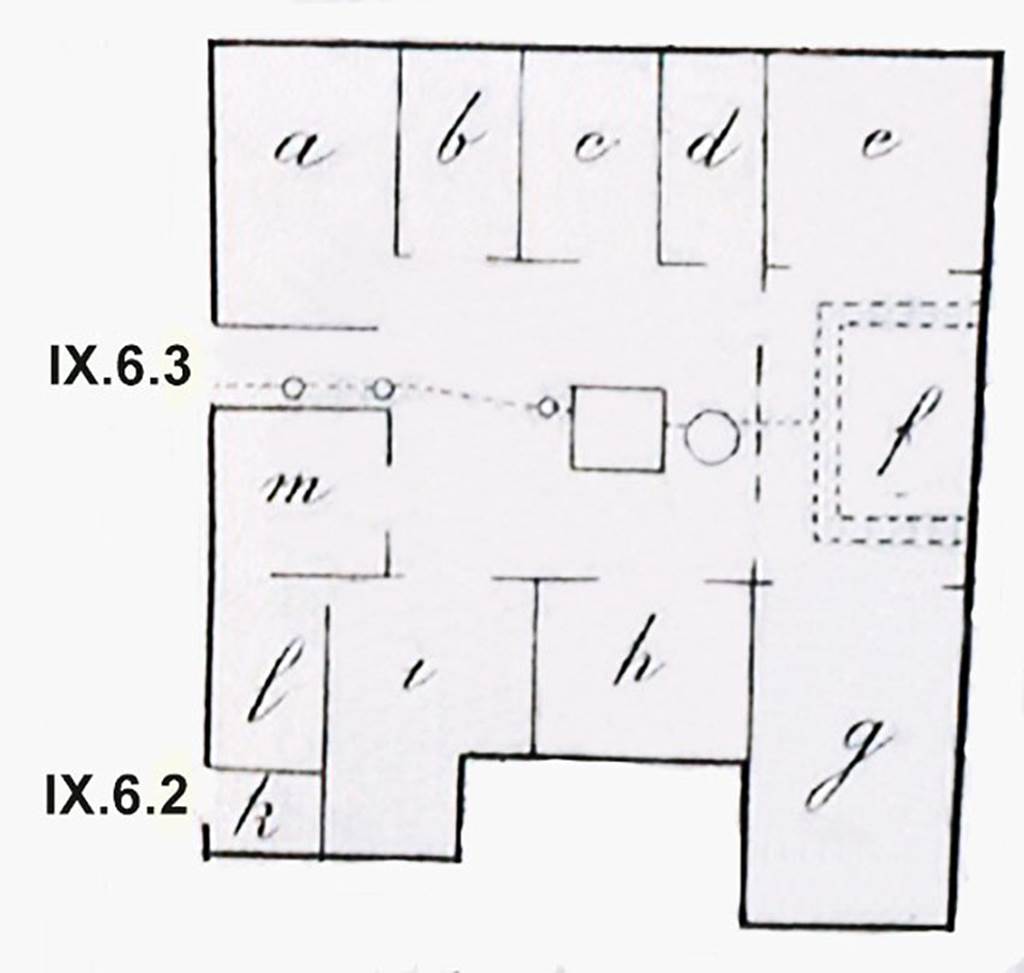
IX.6.2 and IX.6.3 Pompeii. 1880 plan from BdI.
See Bullettino dell’Instituto di Corrispondenza
Archeologica (DAIR), September 1880, p.194.
Key:
a: Triclinium
b: Ala or exedra
c: Cubiculum
d: Storeroom or cupboard
e: Winter triclinium
f: Garden
g: Triclinium
h: Room with bed recess
i: Kitchen
k: IX.6.2 Staircase to upper floor. With cella meretricia beneath?
l: Room with a high threshold
m: Room with paintings of a cupid and animals and window looking on to Vicolo di Tesmo.
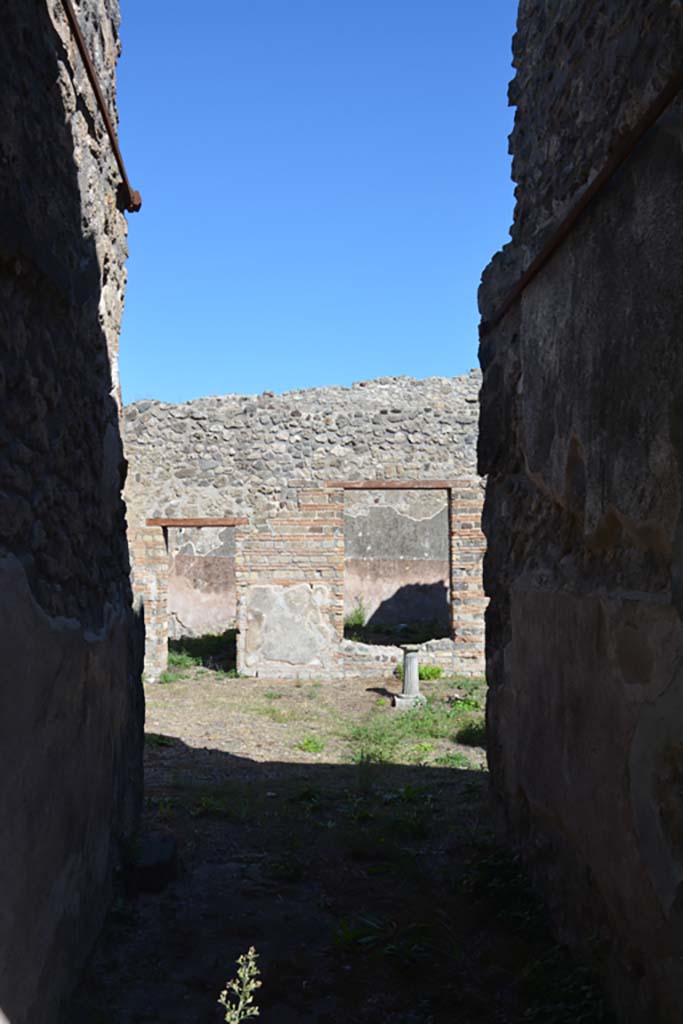
IX.6.3 Pompeii. October 2019.
Looking east along entrance corridor.
Foto Annette Haug, ERC Grant 681269 DÉCOR.
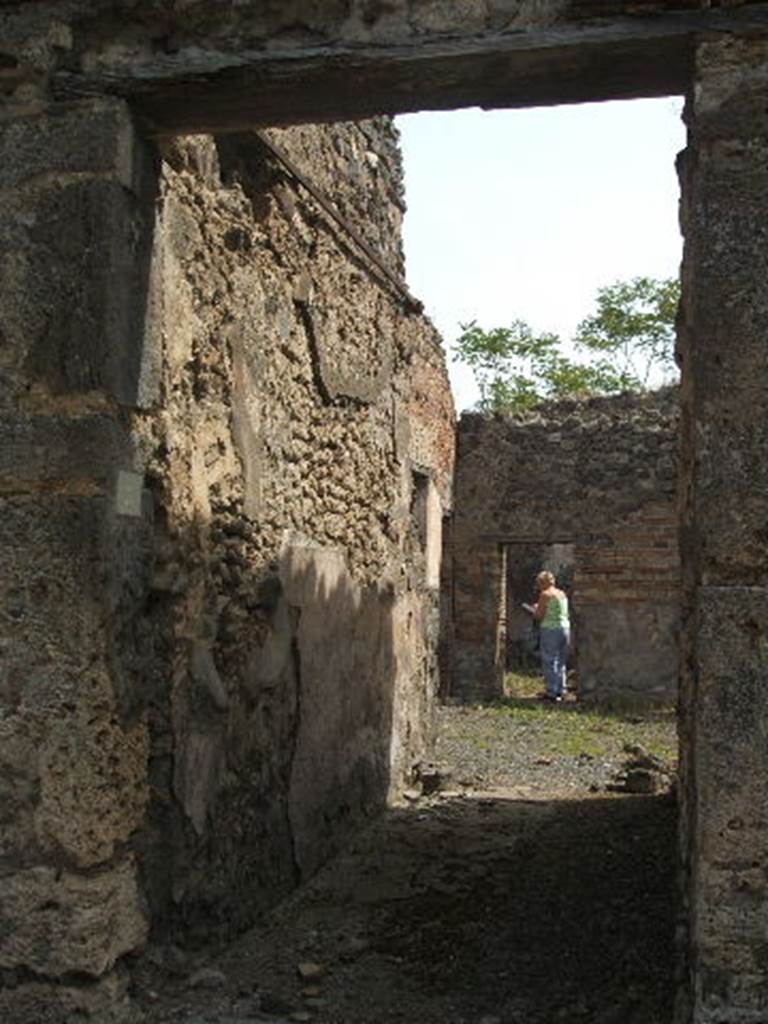
IX.6.3 Pompeii. May 2005. Entrance doorway and corridor.
According to Della Corte, a finger ring found in this house had the initials P.F.L.
See Della Corte,
M., 1965. Case ed Abitanti di Pompei. Napoli:
Fausto Fiorentino. (p.165, S.40)
According to Giacobello, the initials were on a seal on a bronze lamp, identified in a cubiculum of the house.
See Giacobello, F., 2008. Larari Pompeiani: Iconografia e culto dei Lari in ambito domestico. Milano: LED Edizioni. (p.209).
According to Mau
The fauces/ entrance corridor was immediately closed from the road by a door with two shutters:
one of the hinges was preserved in the lava threshold/sill,
and there you could see the square hole where the other hinge had been embedded,
and the hollows for the four bolts, which were larger than they were at the end of each shutter.
Next to the door were the antepagmenta [door posts], as could be verified by the grooves in the threshold.
At the corners between the fauces and the atrium are embedded in the floor two lava stones, which, however, he did not think would have supported a second door, as was supposed by Sogliano in Notizie degli Scavi di Antichità, 1879.
The ceiling of the fauces was supported by four beams placed lengthwise.
See Mau in Bullettino dell’Instituto di Corrispondenza
Archeologica (DAIR), 1880, p.197-8.
See Notizie degli Scavi di Antichità, 1879,
p.20.
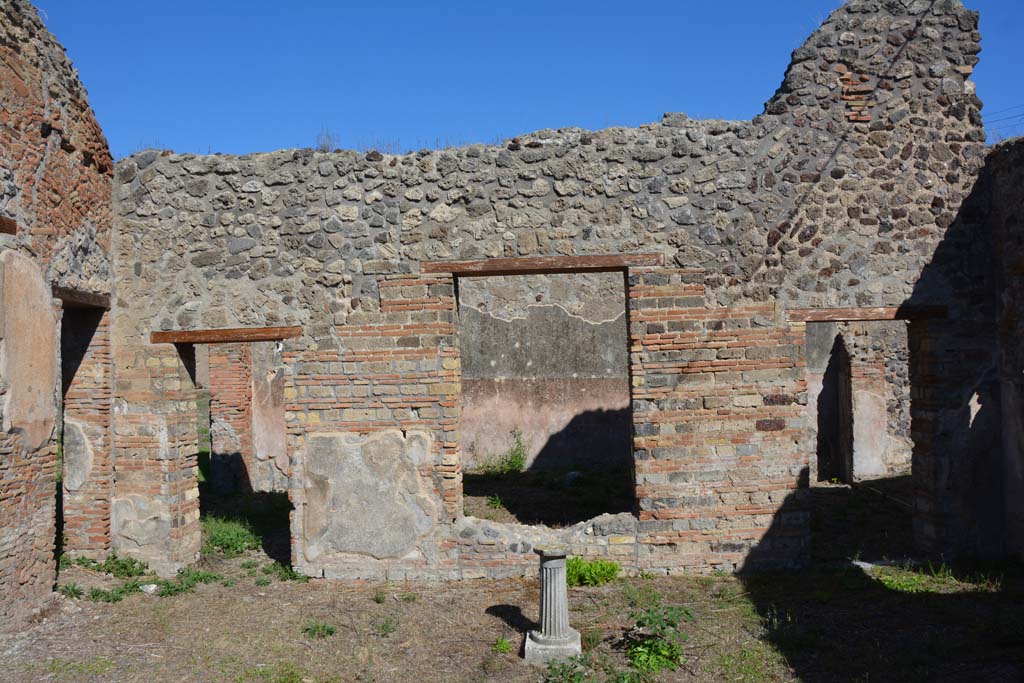
IX.6.3 Pompeii. October 2019. Looking towards east side of atrium
with window into garden, in centre.
Foto Annette Haug, ERC Grant 681269 DÉCOR.
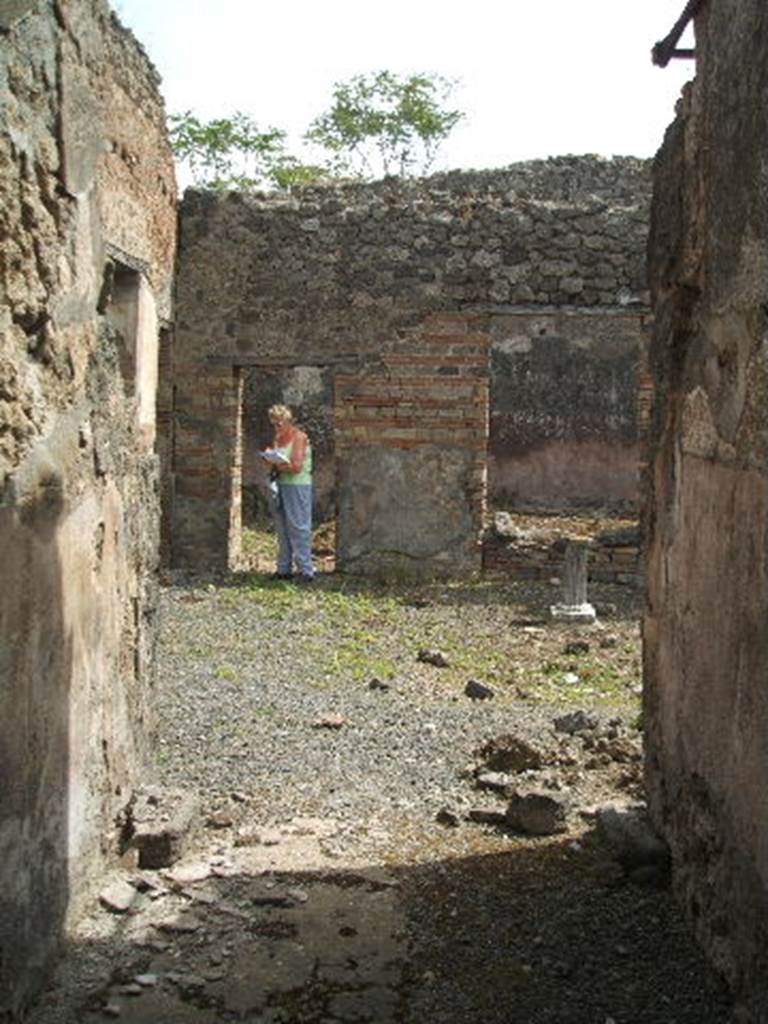
IX.6.3 Pompeii. May 2005. Looking east from entrance corridor across atrium.
According to Della Corte, the house would have been under the protection of Fortuna.
In the vestibule, one used to be able to see a wheel with eight spokes in white tesserae in the floor made of cocciopesto.
See Della Corte, M., 1965. Case ed Abitanti di Pompei. Napoli: Fausto Fiorentino. (p.164)
This does not appear to be visible in either of the above two photos, presumably now it has been lost.
The vestibule floor was made of lavapesto dotted with a few white tesserae, and in the centre presented “the wheel of Fortuna”, i.e. a circle with eight spokes also outlined in white tesserae.
At the east end of the entrance corridor or vestibule, there are two blocks of stone at floor level and adjacent to the side walls.
Mau believed they were the supports of the jambs that marked the passage into the atrium.
These would have excluded the possibility of a door, which was the idea supported and believed by Sogliano.
The walls of the entrance corridor showed the remains of a high zoccolo (plinth) showing a black background with white slanting stripes, divided into large panels by narrow red bands: the middle area was in rough plaster.
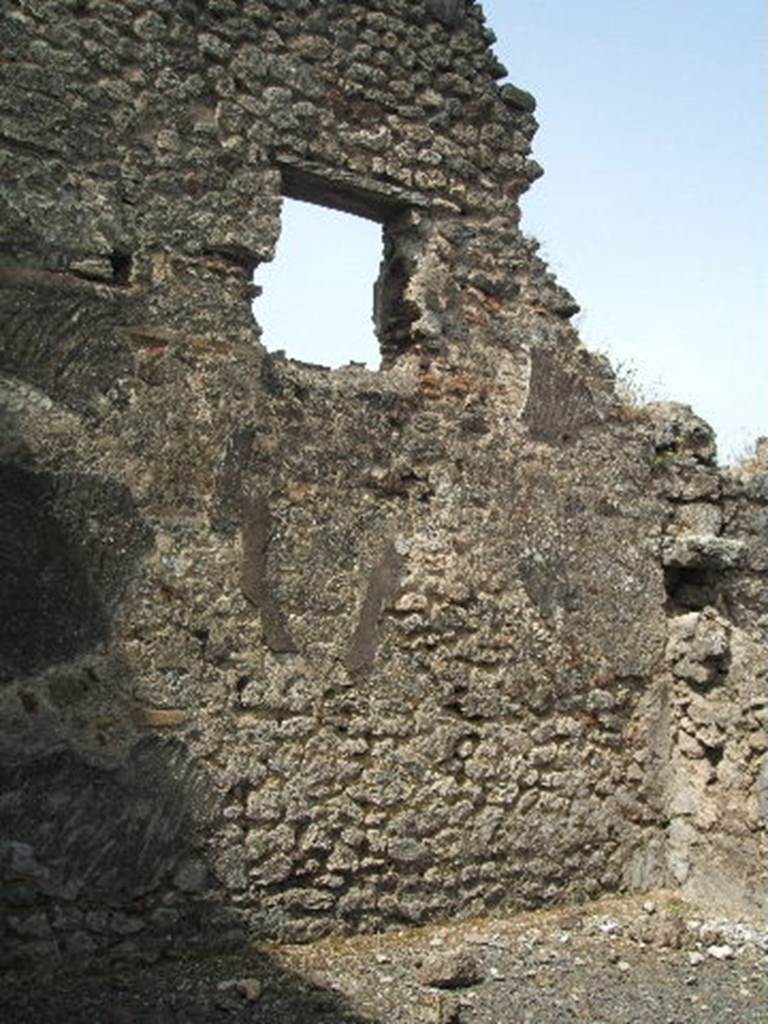
IX.6.3 Pompeii. May 2005. West wall of triclinium “a” to north of entrance.
This room had a window overlooking Vicolo di Tesmo.
According to Mau, this room had a wooden threshold and a floor ornamented with irregular pieces of marble.
None of the wall decoration was preserved other than the rough plaster that was destined to be covered again with a finer layer.
This room may have been used to store various objects, as on 10th July 1879 various bronze and terracotta vases were found, together with the fragments of a saw, some bronze coins, etc.
See Notizie degli Scavi di Antichità, 1879,
p. 207.
See Mau in Bullettino dell’Instituto di Corrispondenza
Archeologica (DAIR), 1880, p. 217.
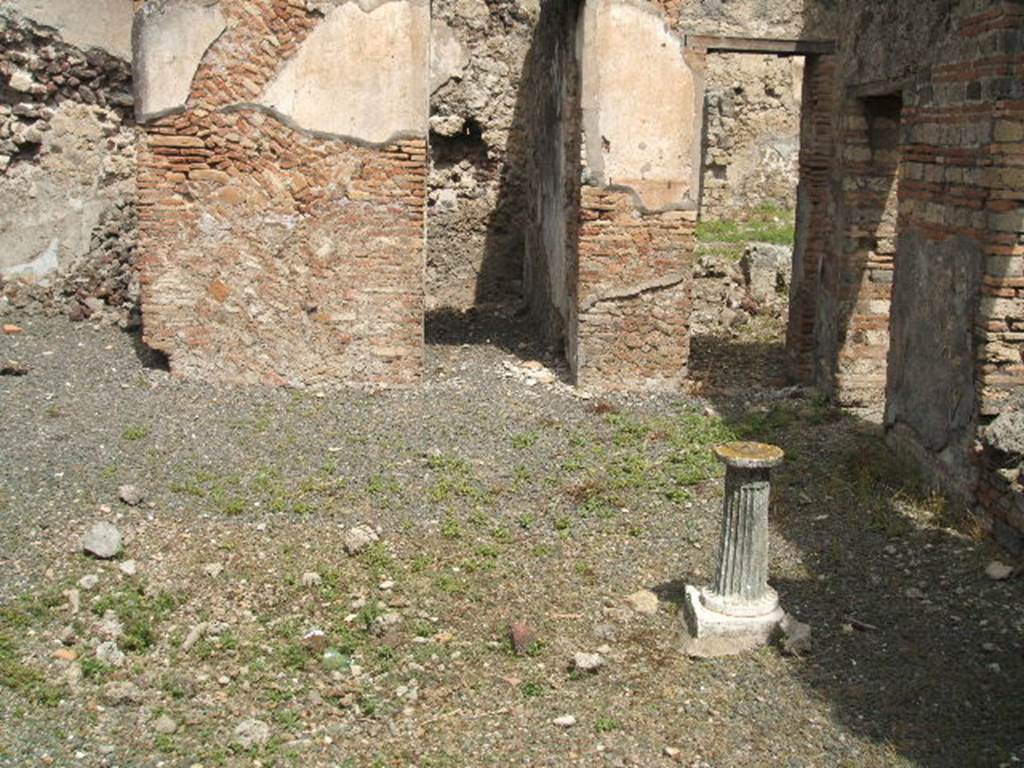
IX.6.3 Pompeii. May 2005. Looking north across atrium and site of impluvium to doorways to three small rooms, “b”, “c”, and “d”.
The edge of the impluvium was made of opus signinum of crushed brick and ornamented with irregular pieces of marble and black and white stones arranged in rows.
Instead the bottom of the impluvium was formed of black and white mosaic, without a recognisable design.
The circular marble table with a grooved foot was found behind it.
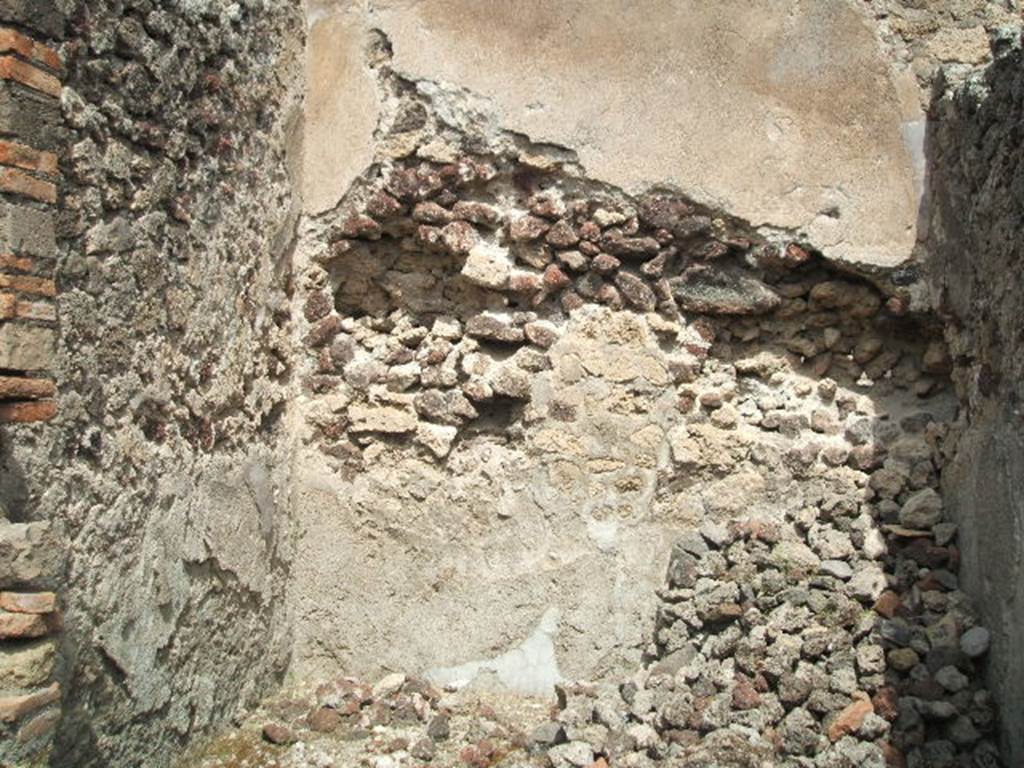
IX.6.3 Pompeii. May 2005. Looking northwards in room “b”. This was a type of ala or exedra, found with a wooden threshold.
The floor had in its entrance a decoration of white stones like a threshold, and three rows of similar stones all around the room.
The wall decoration here was not preserved other than that of rough plaster.
The entrance had been adorned with a wooden door-frame.
See Mau in Bullettino dell’Instituto di Corrispondenza Archeologica
(DAIR), 1880, p.217-8.
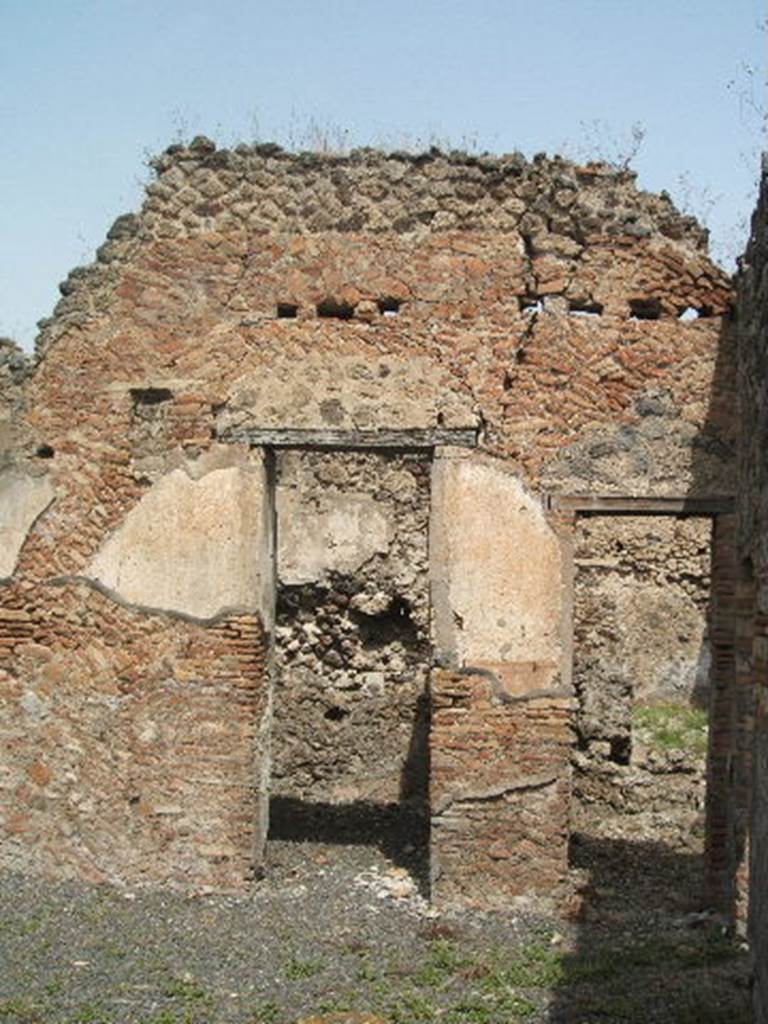
IX.6.3 Pompeii. May 2005. Doorways to two rooms “c” and “d” on north side of atrium.
The small square window of room “c”, placed very high which faced onto the atrium, can be seen on the left.
This was probably the bedroom of the owner, and it was his seal that was found here with the letters P.F.L.
Also found here were a bronze lantern, a weight, a measuring jar, a necklace of 21 vitreous paste globes, and three marble mortars.
See Notizie degli Scavi di Antichità, 1879, p.154, 29th March.
The walls had badly preserved decoration and of no value, executed in the IV style.
In the moon-shape of the decorative vault, opposite the entrance doorway, was seen a large painted peacock that was going to the left towards a fruit, which was between low plants on the earth.
To the right of the entrance was a square window placed very high, which faced onto the atrium.
The doorway was without a threshold; the hinges were fixed onto two marble slabs stuck in the floor below the door jambs.
Recesses were missing for the bolts; instead the inside of the door could be closed with a cross beam inserted into two holes visible in the jambs.
At a distance of around 1,0 out from the door was a rough hole in the floor, and it seemed that this also served to close the door using a beam placed obliquely, with one end in that hole, with the other against the door.
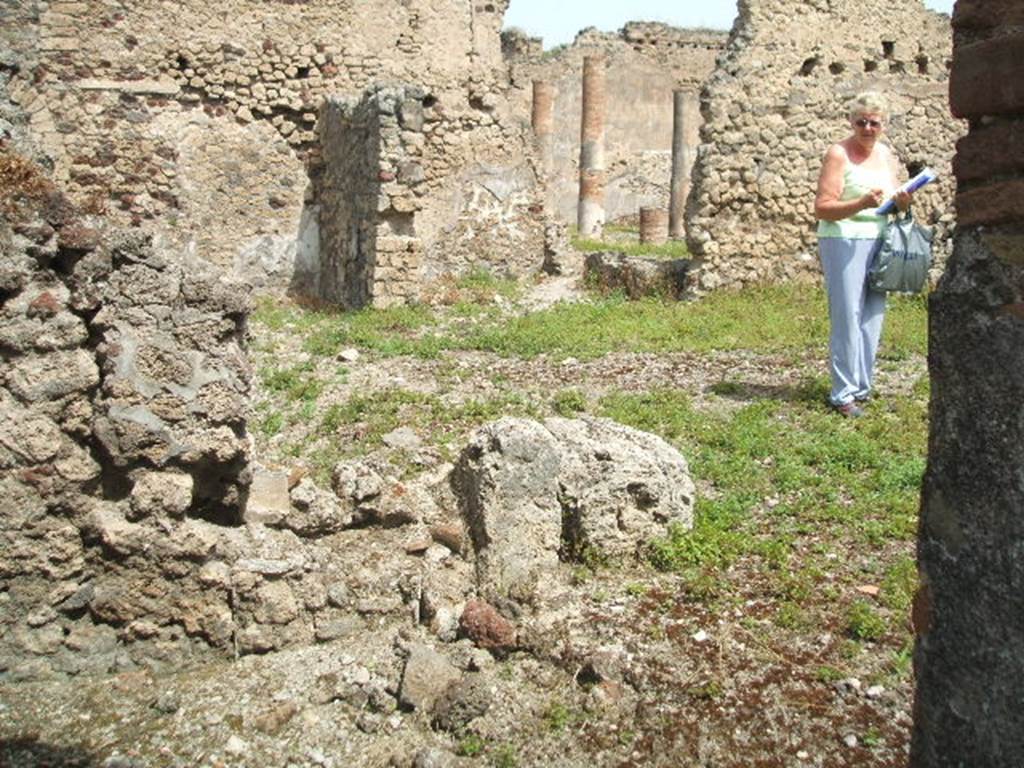
IX.6.3 Pompeii. May 2005. Looking north-east towards peristyle of IX.6.5 in distance.
Side and rear walls are missing between IX.6.3 and IX.6.4, due to 1943 bombing.
The lower left of the picture is the area of a small room “d” on the north side of the atrium.
Room “d” was possibly a small storeroom or cupboard. It had a wooden threshold and the floor was in opus signinum without decoration.
At the left wall were the traces of a wooden staircase which gave access to the upper floor of the northern part of the house.
In the rear wall, the holes for the supports for two shelves could have been seen, it seemed therefore that this room was used as a storeroom/cupboard.
This could be confirmed by the objects found there: bronze, glass and terracotta vases and plates, a balance and an axe.
See Notizie degli Scavi di Antichità, 1879, p.154, 23rd May.
See Mau in Bullettino dell’Instituto di Corrispondenza
Archeologica (DAIR), 1880, p.217-8.
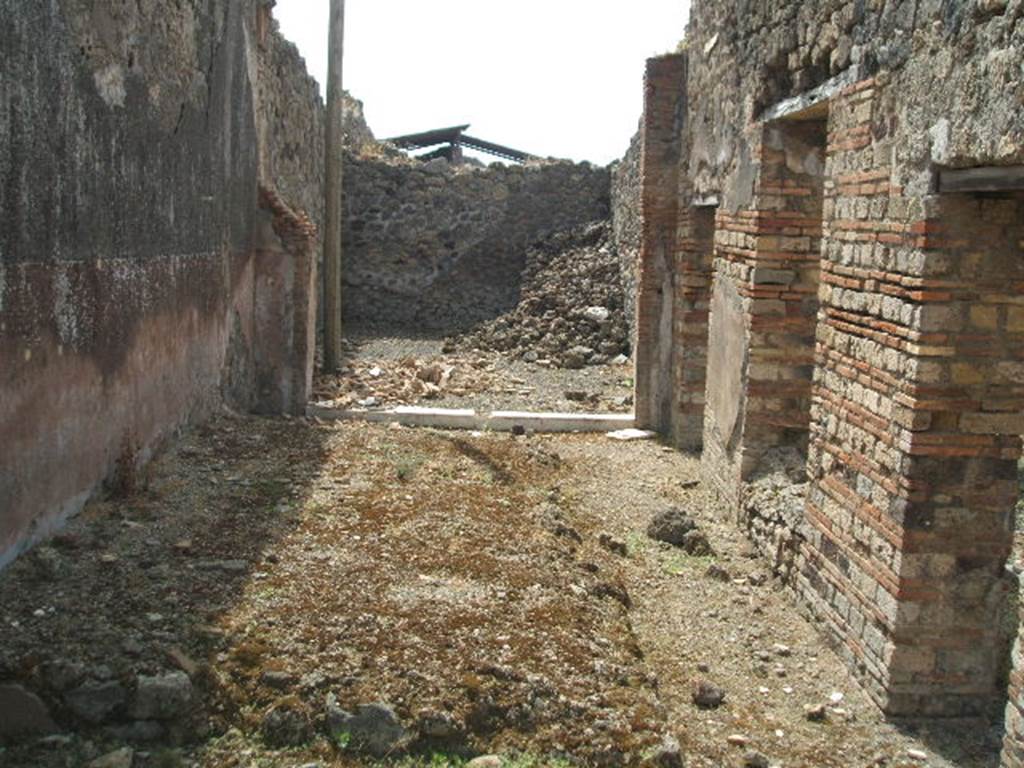
IX.6.3 Pompeii. May 2005. Looking south along small garden area “f” to large triclinium “g”, on south side.
According to Jashemski, this small open area at the rear of this small house was visible from the entrance through a window at the rear of the atrium (on right of photo between the doorways).
Attached to the wall on the east side were 3 steps which in the middle had a small basin the height of the lowest 2 steps.
The passageways around the open area were roofed by the overhang of the adjacent rooms.
See Jashemski, W. F., 1993. The Gardens of Pompeii, Volume II: Appendices. New York: Caratzas. (p.238)
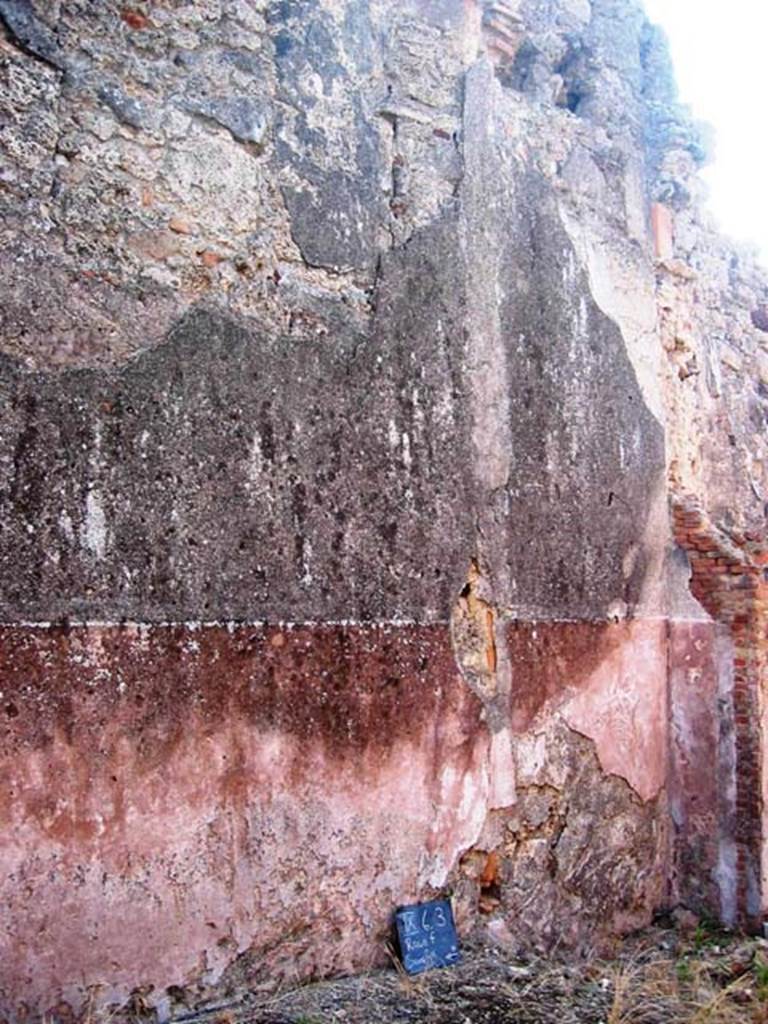
IX.6.3 Pompeii. July 2008.
East wall of small garden area “f”, with downpipe. Photo courtesy of Barry Hobson.
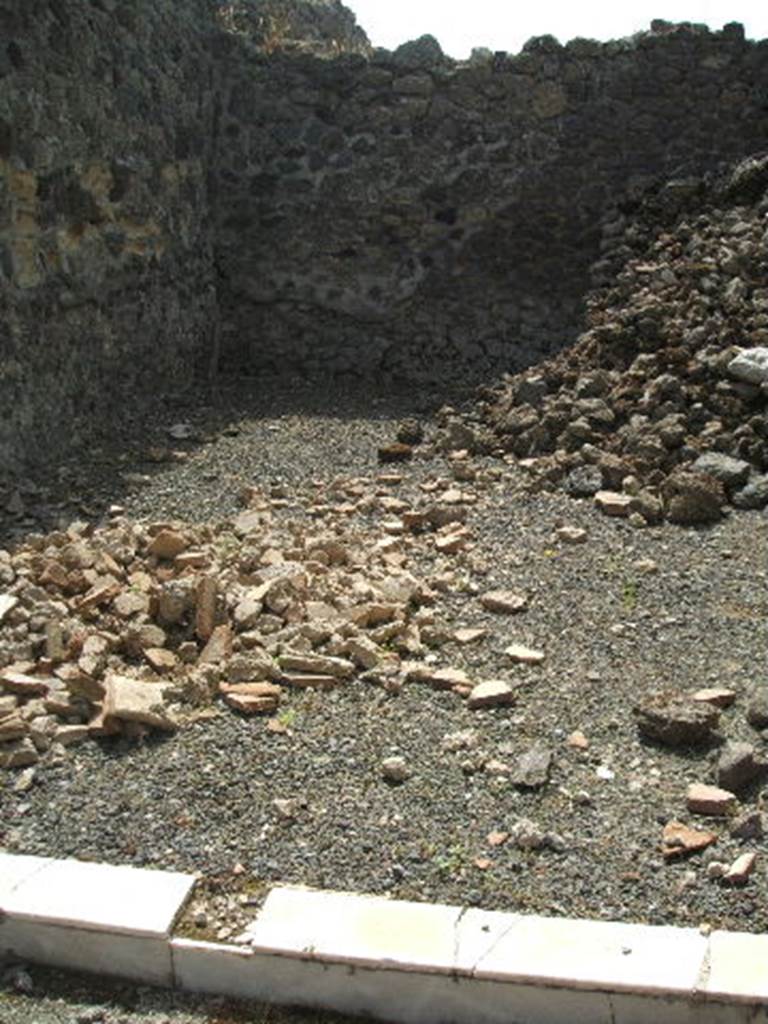
IX.6.3 Pompeii. May 2005. Triclinium “g” with marble step, on south side of garden.
According to Mau, room “g” may have been the summer triclinium.
He described room “e” (no picture, but at the northern end of garden “f”) as the winter triclinium.
At the time of his writing, he described room “e” as having the best preserved wall decoration of any other part of the house: it was simple but without value. (p.218)
In room “g” not much remained of the wall decoration other than the rough plaster.
Nevertheless, this showed the floor and threshold, making this the favourite room of this modest dwelling.
The threshold was made of white marble slabs.
See Mau in Bullettino dell’Instituto di Corrispondenza
Archeologica (DAIR), 1880, (p.219)
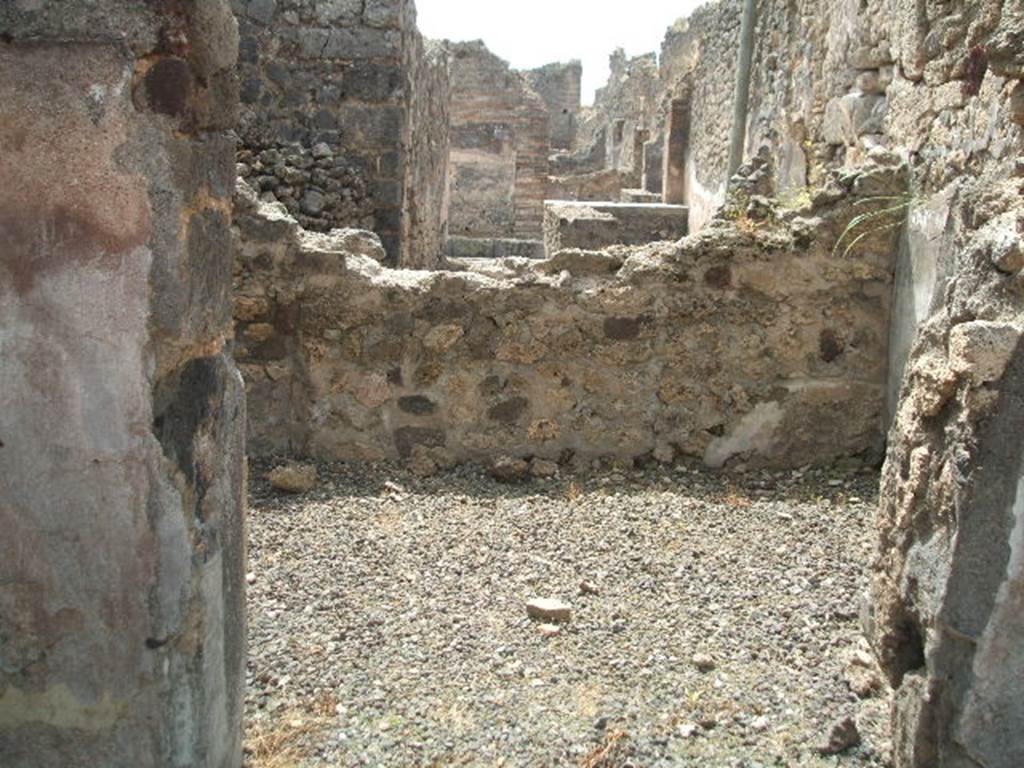
IX.6.3 Pompeii. May 2005. Looking south across room “h” (into rear of IX.6.b), on south side of atrium.
According to Mau, this room was found with a wooden threshold and white plaster on its walls.
Seen on the extreme left of the rear wall, was the usual recess for the short side of the bed which would have been against the left wall.
In fact, in this part, the rough floor was a little better preserved.
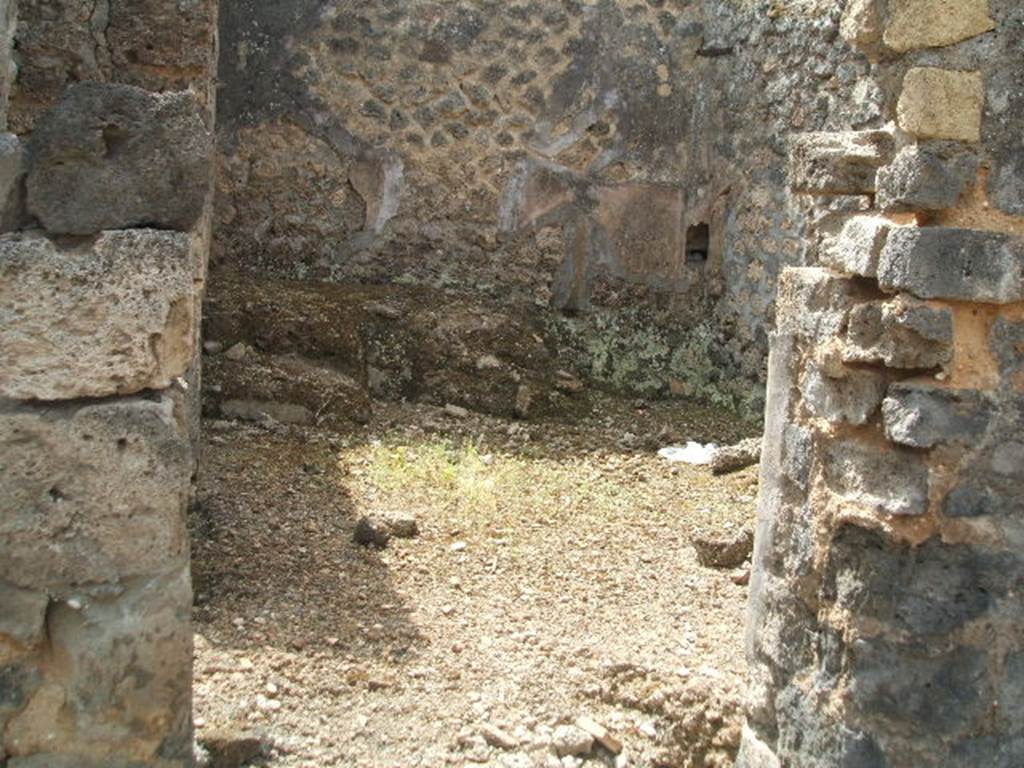
IX.6.3 Pompeii. May 2005. Doorway to kitchen area, “i” looking south.
According to Boyce –
on the east wall (not photographed) was a lararium painting, (h. uncertain as the upper part was damaged when found w.1.32).
An altar stood between the Genius on the right, and the tibicen on the left.
On each side was a Lar with rhyton and situla standing between two shrubs.
In the lower zone were two serpents confronted at an altar furnished with two eggs.
See Boyce G. K., 1937. Corpus
of the Lararia of Pompeii. Rome:
MAAR 14. (p.86, no.428)
See Sogliano, A., 1879. Le pitture murali campane scoverte negli anni 1867-79. Napoli: (p.12, no. 25)
According to Giacobello, today the painting has been totally lost.
See Giacobello, F., 2008. Larari Pompeiani: Iconografia e culto dei Lari in ambito domestico. Milano: LED Edizioni. (p.209, no.104).
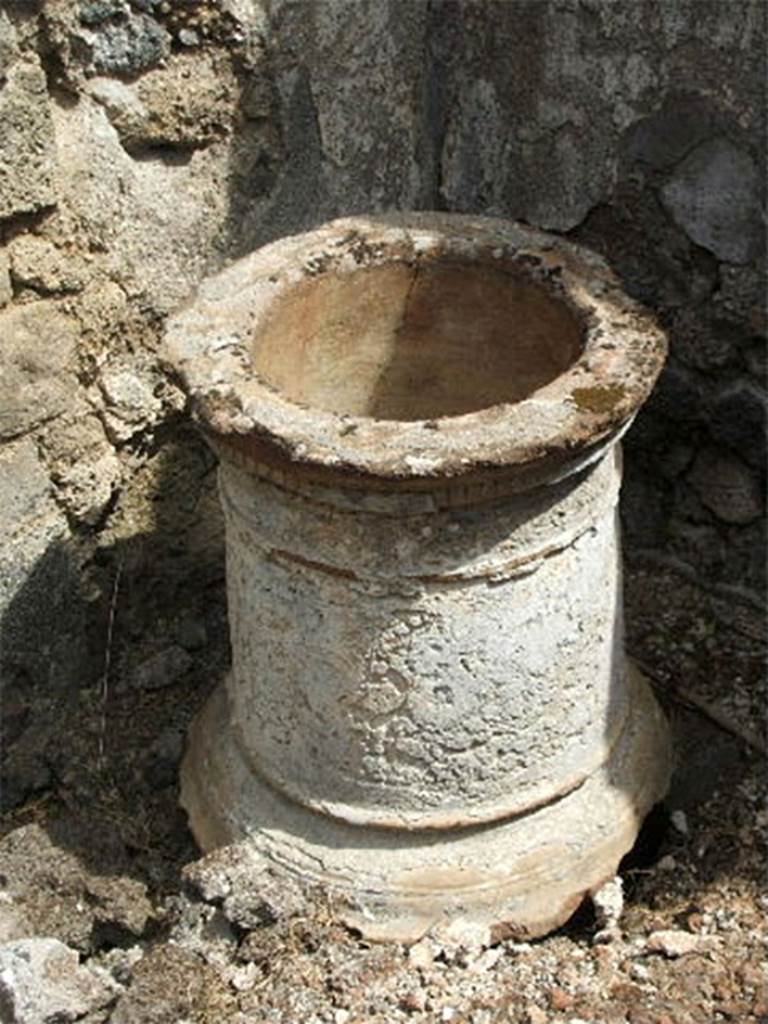
IX.6.3 Pompeii. May 2005. Terracotta puteal in kitchen area, “i”.
According to Mau, in the corner to the left of the entrance doorway was the mouth of the cistern with terracotta puteal.
Back in time this had been roughly refaced with white stucco.
In a nearby corner was a low basin (0.74 x 0.98, 0,18 deep).
The hearth, in the south-east corner, was of an irregular shape.
Nearby on the left wall was the usual lararium painting.
See Mau in Bullettino dell’Instituto di Corrispondenza
Archeologica (DAIR), 1880, (p.220).
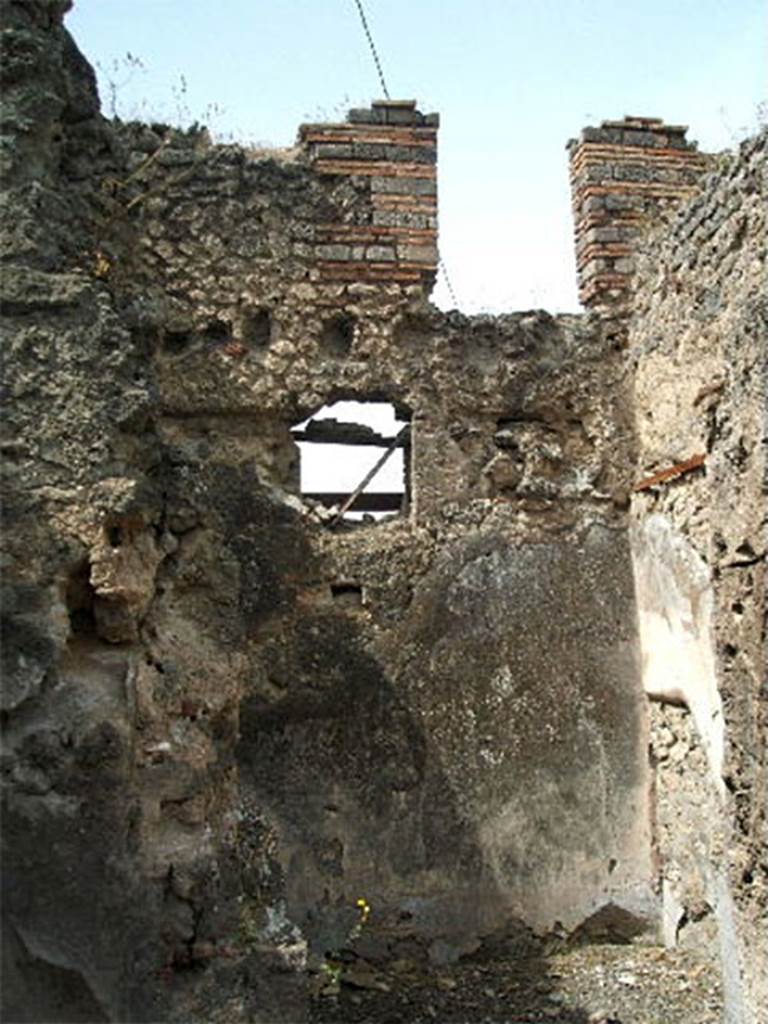
IX.6.3 Pompeii. May 2005. Room “m” to south of entrance corridor, with window in west wall onto Vicolo di Tesmo.
According to Mau, room "m" had a wooden threshold, the jambs of the entrance were furnished with door-frames.
The floor, a type of opus signinum, was decorated with stars and in the centre, with a square-shaped ornament, simple but with good effect, all made from white stones.
The plaster of the walls showed a rough decoration with a white background in the IV style:
Originally in the centre of each wall had been a flying cupid;
the one on the right carried a thyrsus and crown,
that to the rear a thyrsus and a helmet on its left,
the one on the left carried a shepherd’s crook and an unrecognizable object.
In the south-west, a narrow doorway gave passage to room "L".
The threshold was exceedingly high and had the appearance of having been the first step of a staircase, which maybe first gave access to the upper floor before the stairs were built in room "i".
See Mau in Bullettino dell’Instituto di Corrispondenza
Archeologica (DAIR), 1880, p.220-1.
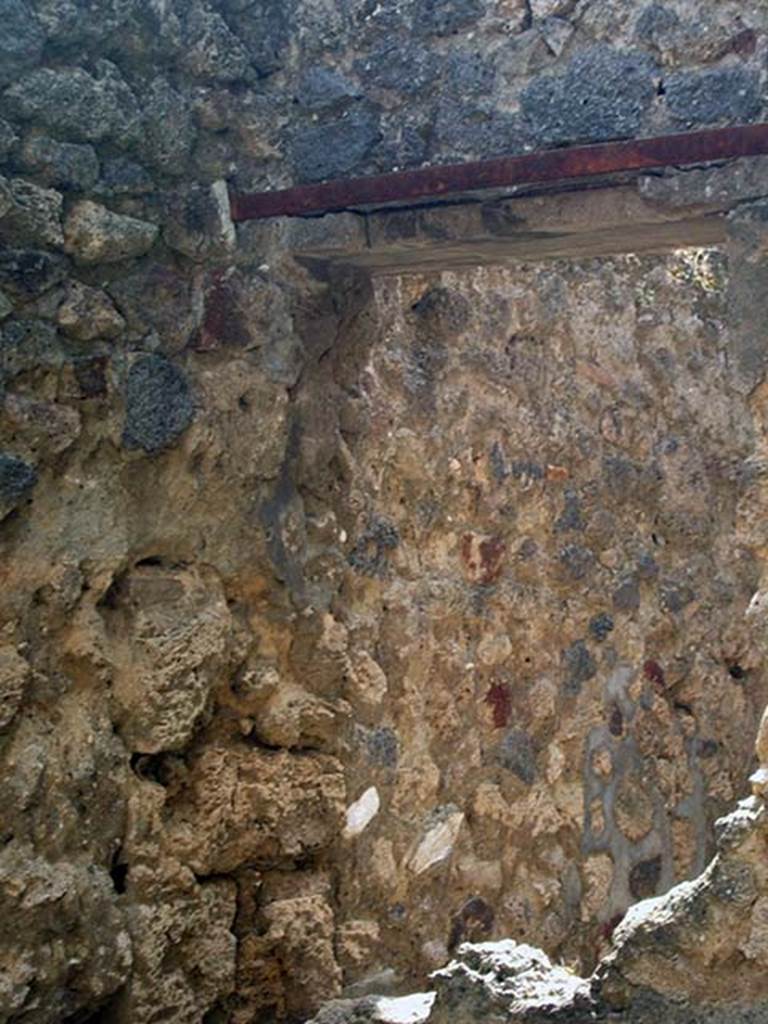
IX.6.3 Pompeii. May 2005. Doorway in room “l” (L), looking north into room “m”.
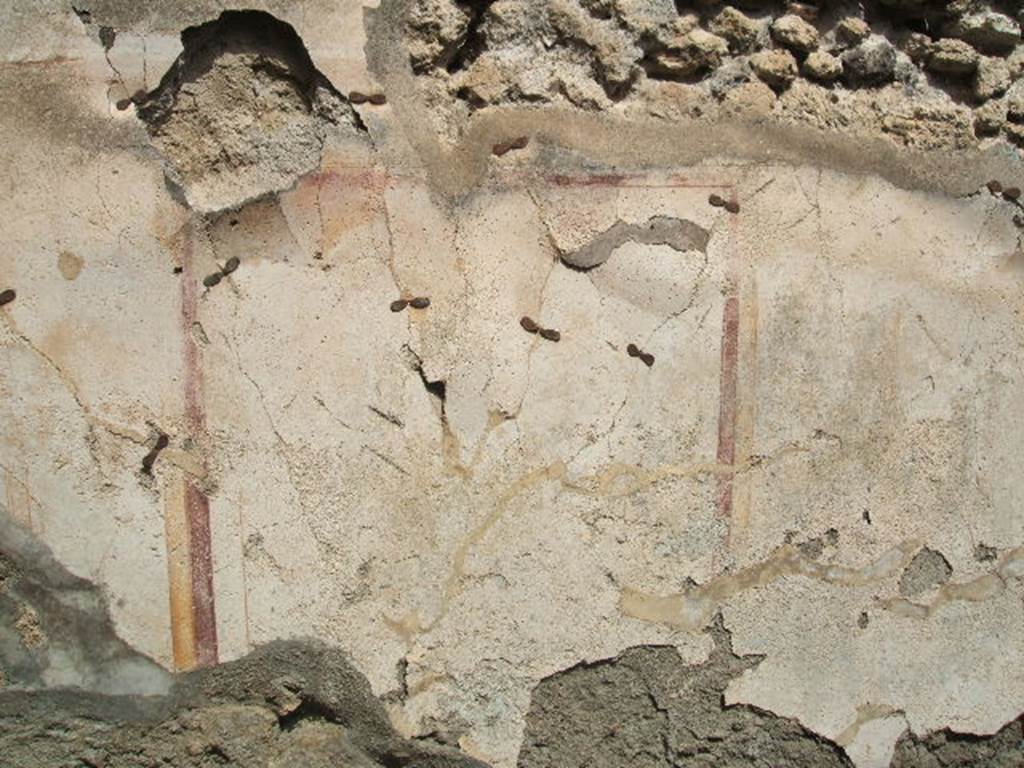
IX.6.3 Pompeii. May 2005. North wall of room “m” on south side of entrance with remains of painted wall plaster.
The zoccolo would have been dark red, the middle zone was white, at the centre of which was seen a vignette of a cupid with thyrsus and crown.
In the side panels, bordered by edges showing semicircles, one could have seen rampant animals; the upper zone of the wall was white.