VII .6.3 Pompeii. Casa della Diana Arcaizzante,
Casa della Diana III
or House of M. Spurius Saturninus and D. Volcius Modestus.
Excavated 1760, 1841, 1910. Re-examined 2007-2010. Bombed on 13th September 1943.
According to Garcia y Garcia Region VII, Insula VI was one of the insulae most devastated over the years since its excavation.
He calls it the “Cinderella” of Pompeii. Between the years 1759 and 1762 it was vandalised and stripped by the Bourbons, then re-interred.
Then came the slow and non-systematic uncovering again before the final destruction in September 1943.
The area was ignored and abandoned during the years following the war, which reduced the insula to a heap of bricks and masonry.
See Garcia y
Garcia, L., 2006. Danni di guerra a Pompei. Rome: L’Erma di Bretschneider. (p.102).
According to
Fiorelli –
VII.6.1-6 –
Diversi aditi in gran parte obliterati, che trovansi sulla fronte
settentrionale dell’isola a cominciare da occidente, sembrano aver l’ingresso a
tre botteghe, ad una casa, e a due gradinate indipendenti per cenacoli
sovrapposti.
(VII.6.1-6 – Several entrances in large part
obliterated that were found on the north side of the insula beginning on the
west side, they seemed to be the entrances to three shops, to a house, and to
two independent steps leading to rooms above.)
See Pappalardo, U., 2001. La Descrizione di Pompei per Giuseppe Fiorelli (1875). Napoli: Massa Editore. (p.159).
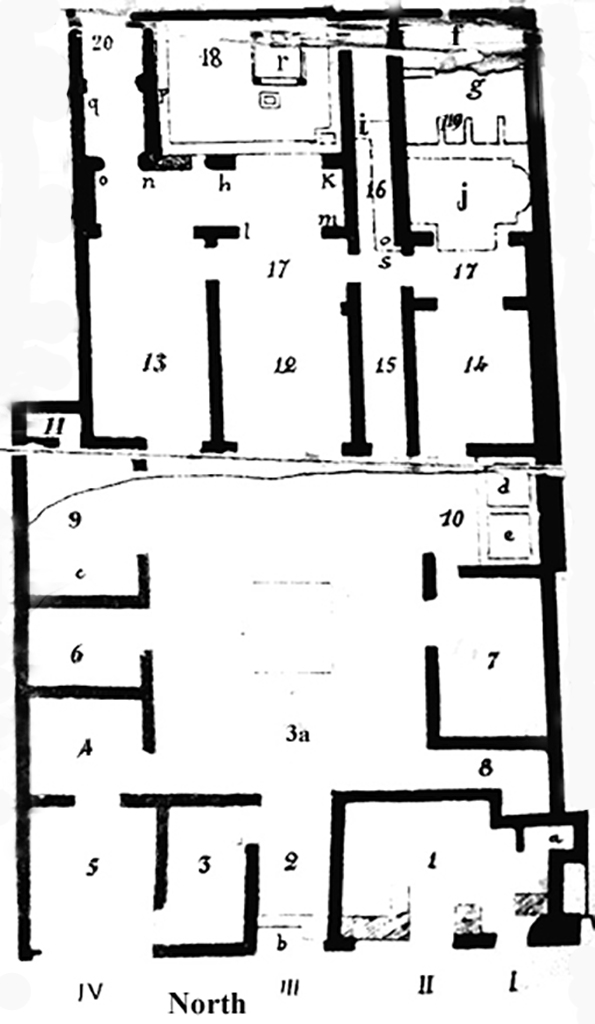
VII.6.1-4 Pompeii. 1910 plan. By Spano.
See Notizie degli Scavi di Antichità, 1910,
fig. 1, p. 437.
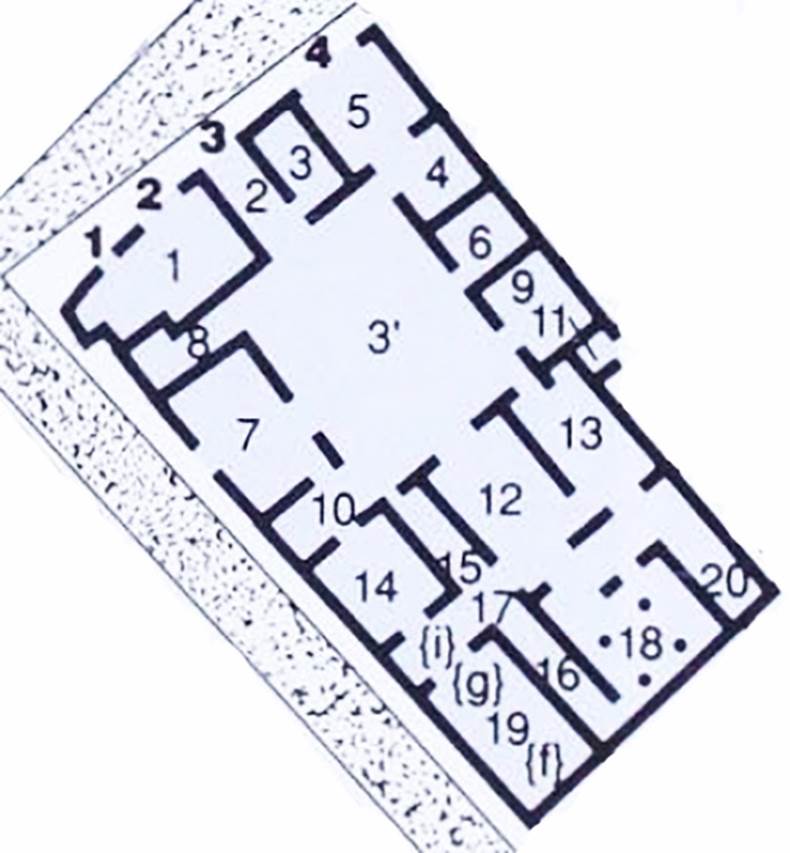
VII.6.3 Pompeii. Plan based on PPM.
See Carratelli,
G. P., 1990-2003. Pompei: Pitture e
Mosaici: Vol. VII. Roma: Istituto della enciclopedia italiana, p. 173.
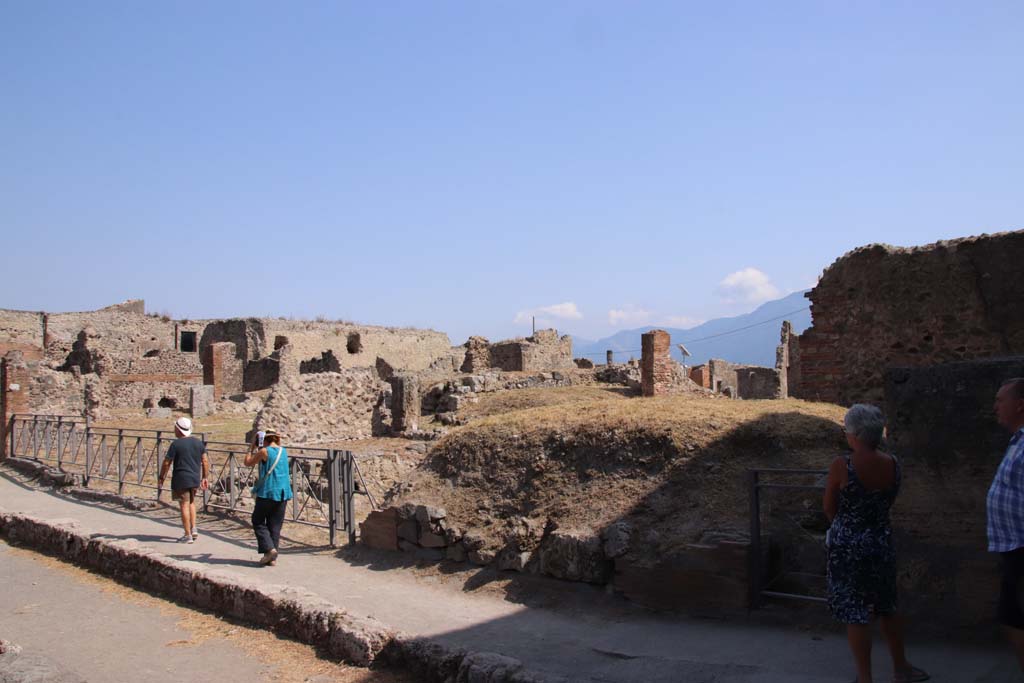
VII.6.3, Pompeii, doorway left
of centre, next to person in turquoise. September 2019.
Looking south-east across VII.6 on south side of Via delle Terme, from junction with Vicolo del Farmacista, on right.
VII.6.2 would be the doorway under the mound of soil, centre right, followed by doorway of VII.6.1, on right.
Photo courtesy of
Klaus Heese.
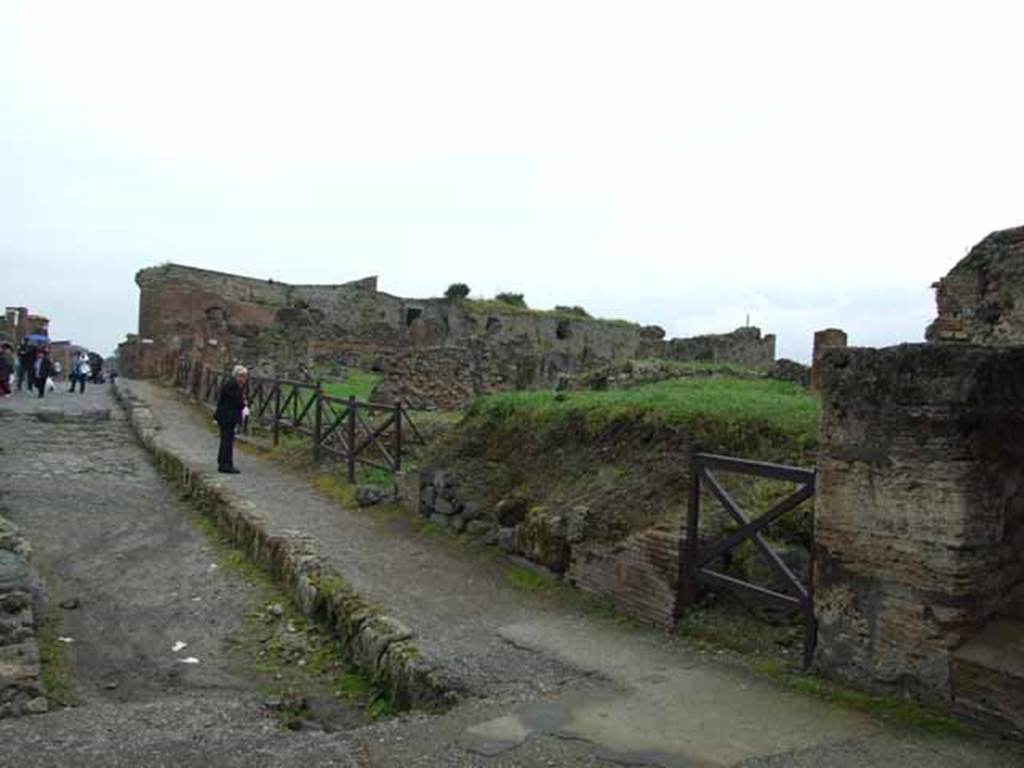
Looking east, past VII.6.1 and VII.6.2 to the entrance to VII.6.3 in the centre. North side of insula on Via delle Terme.
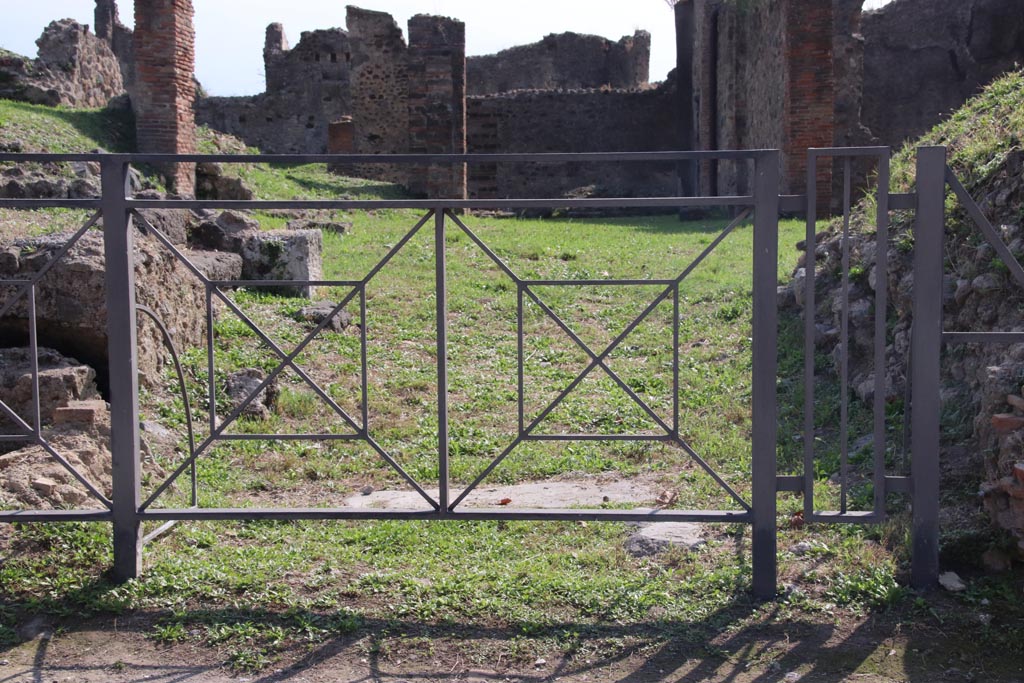
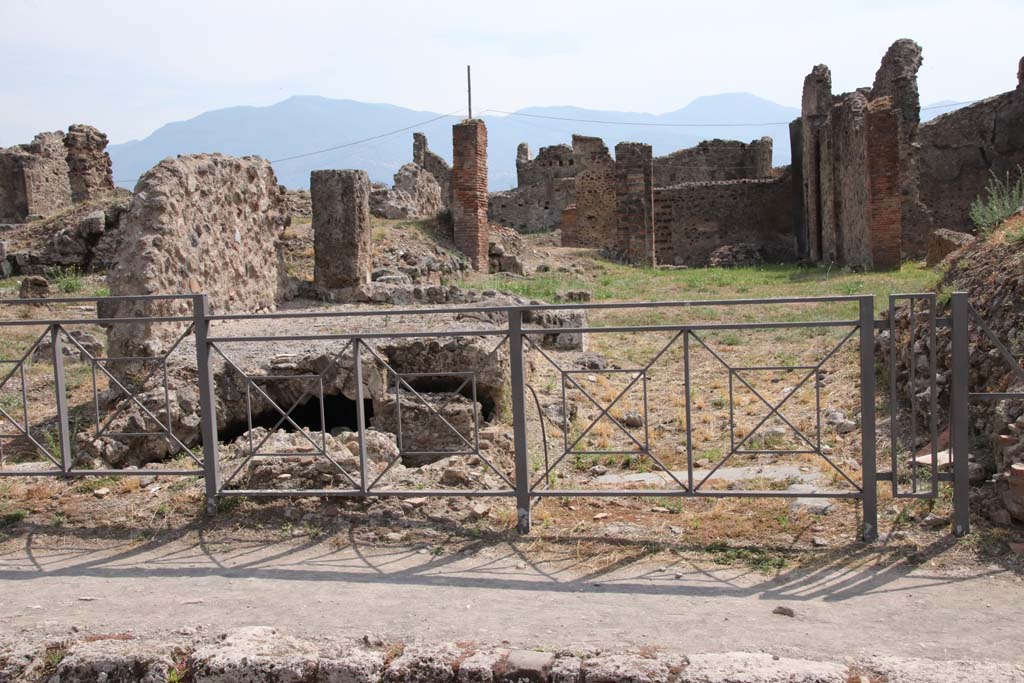
On the left are the vaulted ceilings of a basement room. Photo
courtesy of Klaus Heese.
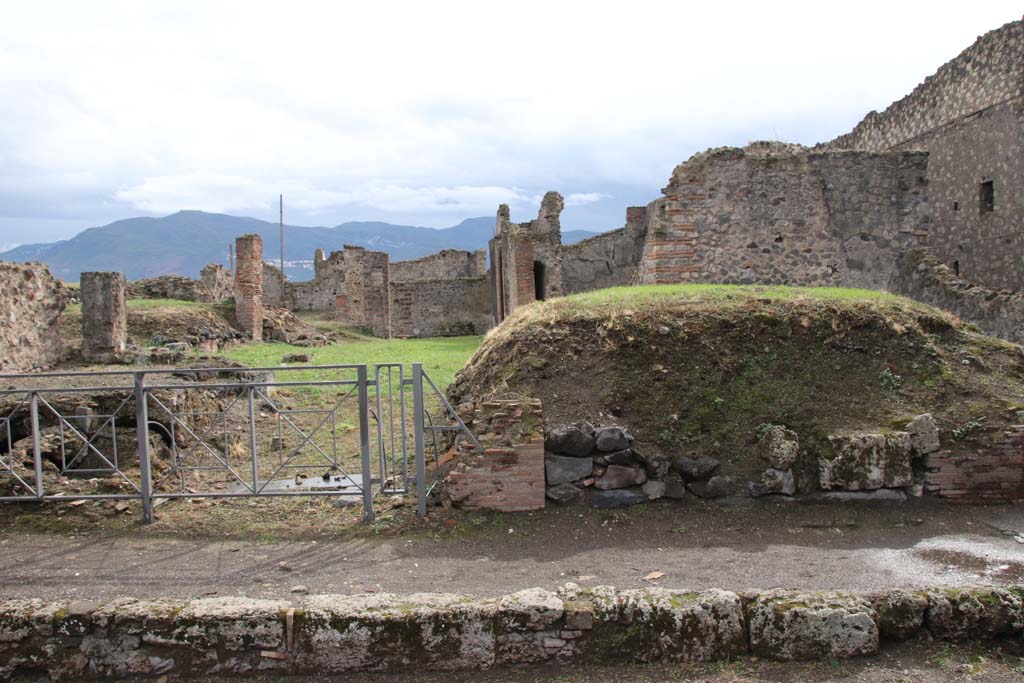
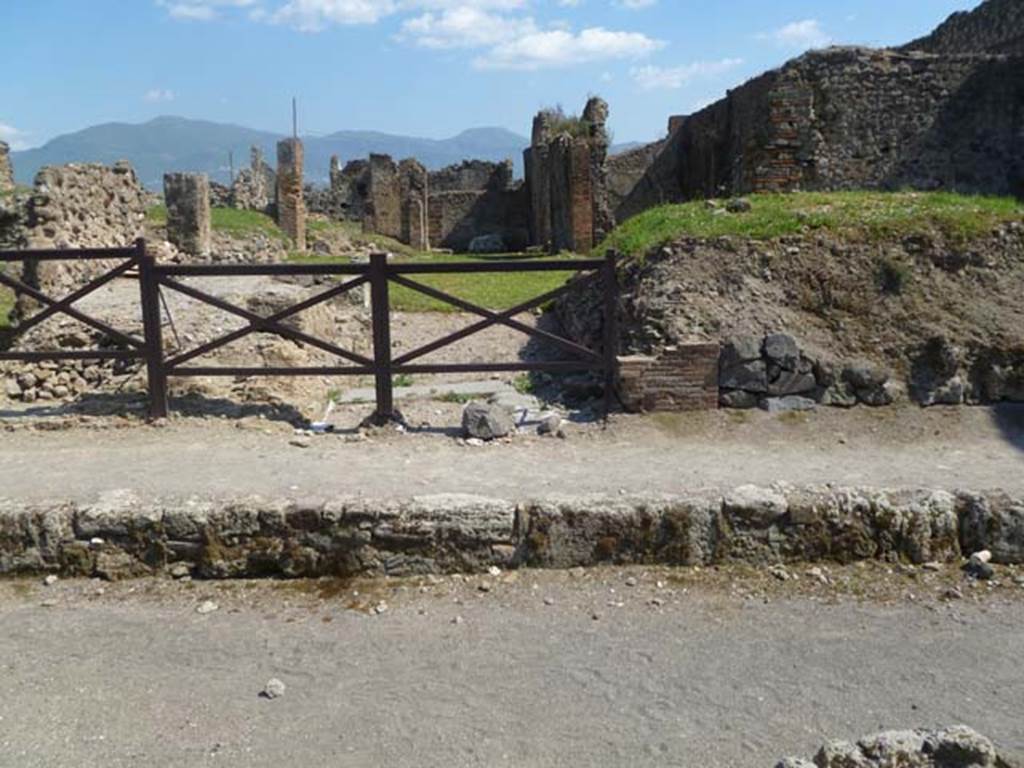
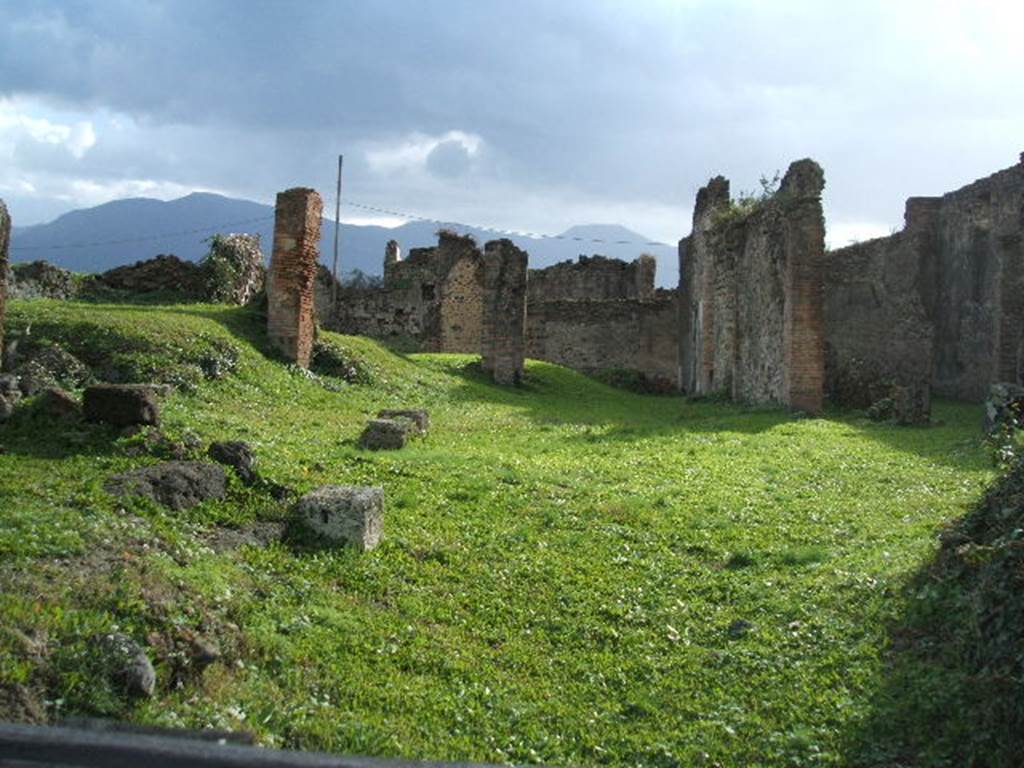
VII.6.3 Pompeii. May 2011. Looking south to entrance doorway. Photo courtesy of Michael Binns.
Notizie degli Scavi,
1910, pp. 439-453.
VII.6.3 was
a house, which was constructed in very ancient times, as was shown by the large
Sarno limestone paralellepids, used here and there and with the tall tapered
doorways, in various parts latterly remade. It consisted of an atrium, tablinum and peristyle,
almost in the axis between them, and of many smaller rooms, arranged around the
first. At one time it was linked with the house existing immediately to the
south of it (No. XXXVIII), (VII. 6.38) after which it was divided by the
masonry of the two rooms.
In front of
the entrance was a small vestibule “b”, facing which was the main door, and to
the right another smaller doorway, both with a lava threshold.
The
fauces/entrance corridor 2, had a cocciopesto floor, slightly sloping towards
the street, and walls of opera incerta, today unadorned. At the extreme
left, three steps lead into room 3, somewhat raised above the level of
the whole house.
The atrium 3’,
was tuscanic, with flooring of signinum, and with various rooms around it,
which were accessed from it by tall and tapered doorways, with Sarno stone
door-jambs. The floor was decorated with parallel rows of white marble tesserae,
placed at equal intervals, and with a graceful meandric line forming a cornice
at the impluvium. This
seemed to have been covered with marble slabs.
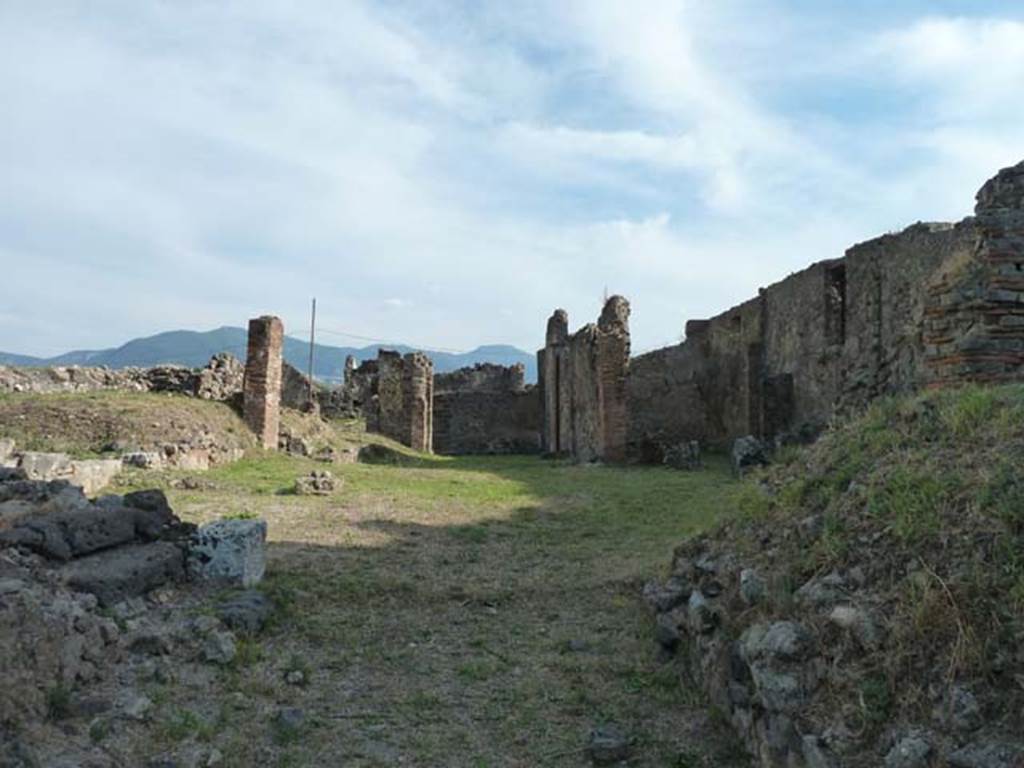
VII.6.3 Pompeii. September 2015. Looking south from entrance corridor.
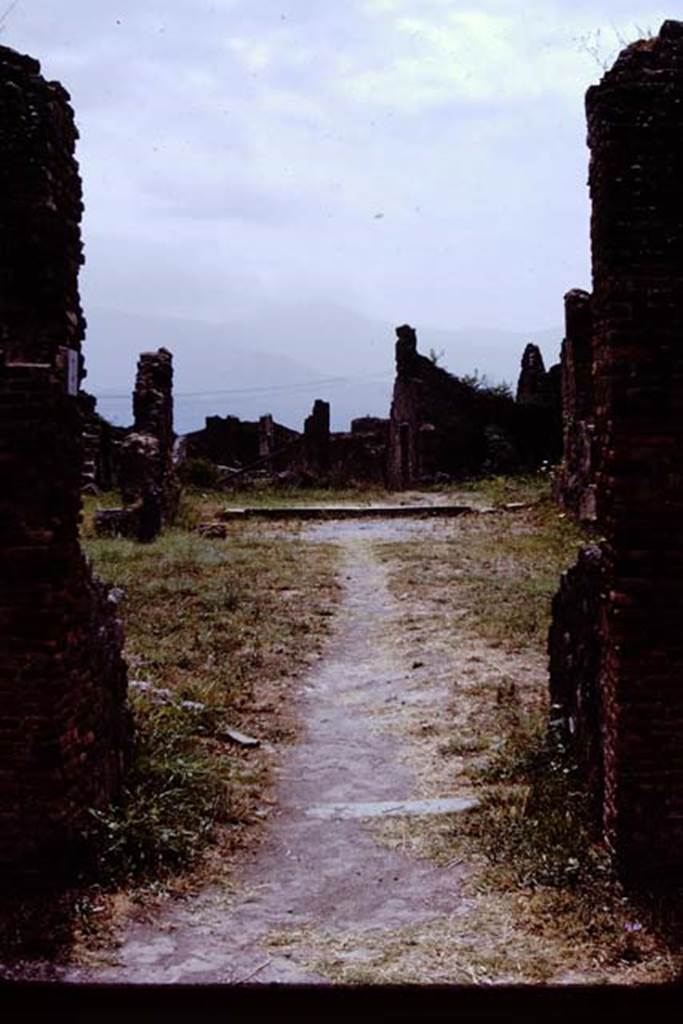
VII.6.3
Pompeii. 1972.
Looking south
from entrance doorway, across atrium to rear. Photo by Stanley A. Jashemski.
Source: The
Wilhelmina and Stanley A. Jashemski archive in the University of Maryland
Library, Special Collections (See collection page) and made available under the Creative
Commons Attribution-Non Commercial License v.4. See Licence and use details.
J72f0531
In January 1761, two seal/signets were found in this area.
![VII.6.3 Pompeii. Signet seal found in January 1761. This contained the wording:
M(arci) Spuri
Saturnini [CIL X, 8058, 83]
Now in Naples Archaeological Museum, inventory number 4748.](7%2006%2003_files/image020.jpg)
M(arci) Spuri
Saturnini [CIL X, 8058, 83]
Now in Naples Archaeological Museum, inventory number 4748.
![VII.6.3 Pompeii. Signet seal found in January 1761. This contained the wording:
D(ecimi) Volci D(ecimi) f(ilii)
Modesti [CIL X, 8058, 95]
Now in Naples Archaeological Museum, inventory number 4754.
These seals gave the house its alternative name to Casa della Diana III.
See Pagano, M. and Prisciandaro, R., 2006. Studio sulle provenienze degli oggetti rinvenuti negli scavi borbonici del regno di Napoli. Volume 1. Naples : Nicola Longobardi. (p. 37
They can be seen as Rami Inediti, fig 30b, and Rami Inediti, fig 65 a-b.
See Pagano, M. and Prisciandaro, R., 2006. Studio sulle provenienze degli oggetti rinvenuti negli scavi borbonici del regno di Napoli. Volume 2: Indexes. Naples : Nicola Longobardi. (p. 331)](7%2006%2003_files/image022.jpg)
D(ecimi) Volci D(ecimi) f(ilii)
Modesti [CIL X, 8058, 95]
Now in Naples Archaeological Museum, inventory number 4754.
These seals gave the house its alternative name to Casa della Diana III.
See Pagano, M. and Prisciandaro, R., 2006. Studio sulle provenienze degli oggetti rinvenuti negli scavi borbonici del regno di Napoli. Volume 1. Naples: Nicola Longobardi. (p. 37
They can be seen as Rami Inediti, fig 30b, and Rami Inediti, fig 65 a-b.
See Pagano, M. and Prisciandaro, R., 2006. Studio sulle provenienze degli oggetti rinvenuti negli scavi borbonici del regno di Napoli. Volume 2: Indexes. Naples: Nicola Longobardi. (p. 331)
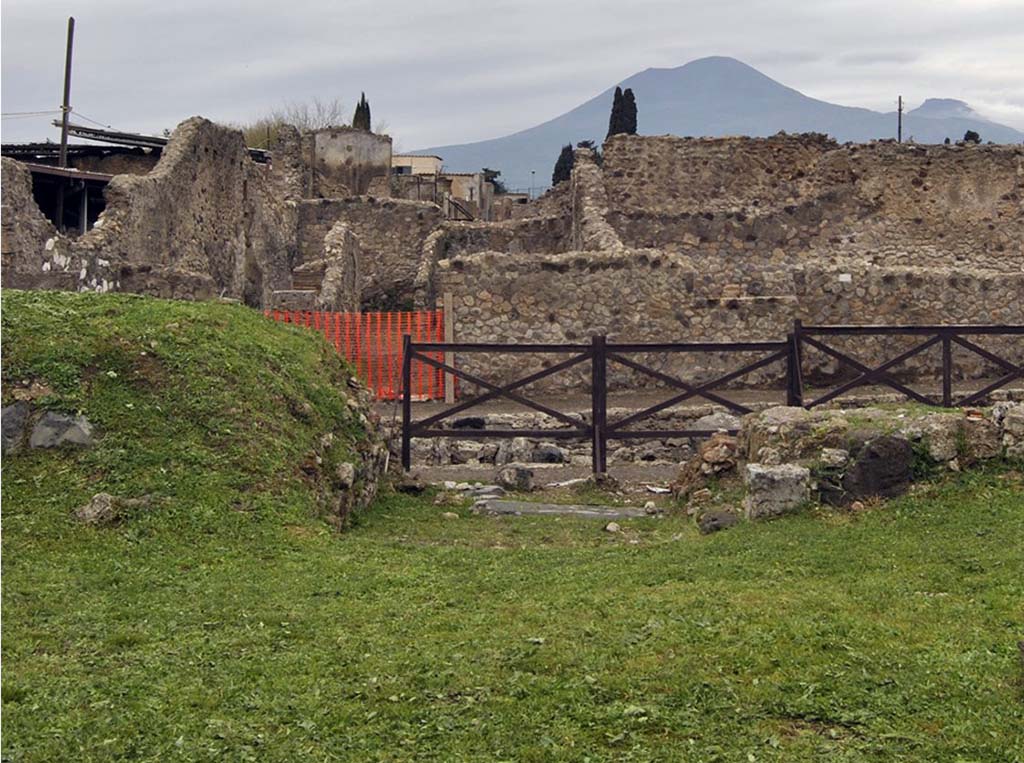
Next to the white stone block there are steps up from the fauces to the higher floor of the room.
Excavations in 2010 have shown this room covers a previously unknown vaulted basement.
See http://www.dianaarcaizante.com/ .
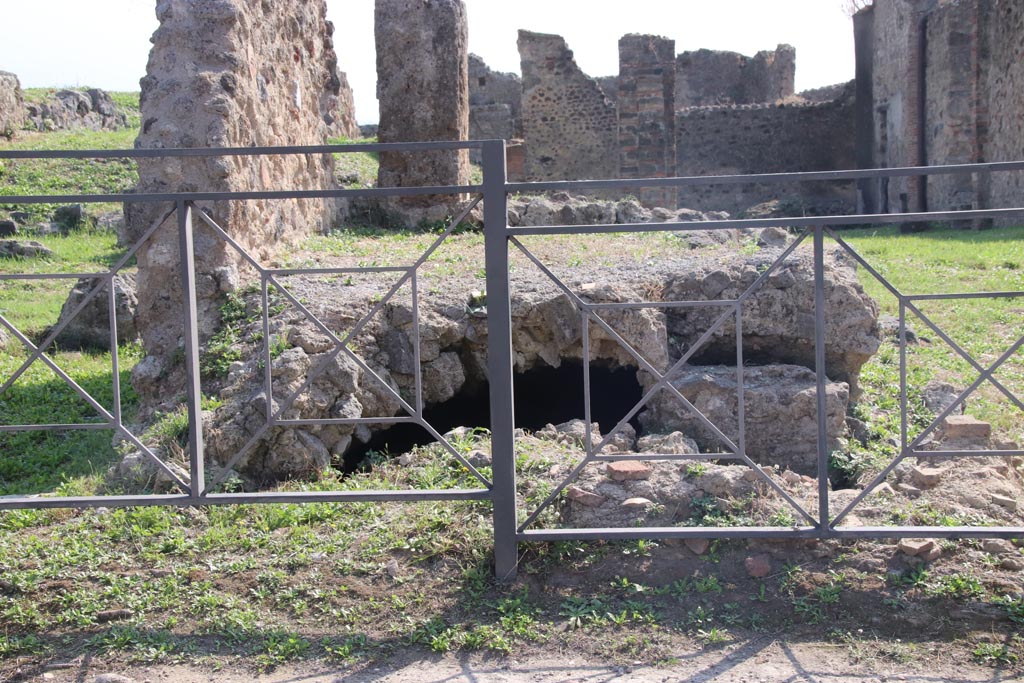
VII.6.3 Pompeii. October
2023. Looking south to site of room 3, and vaulted basement. Photo courtesy of
Klaus Heese.
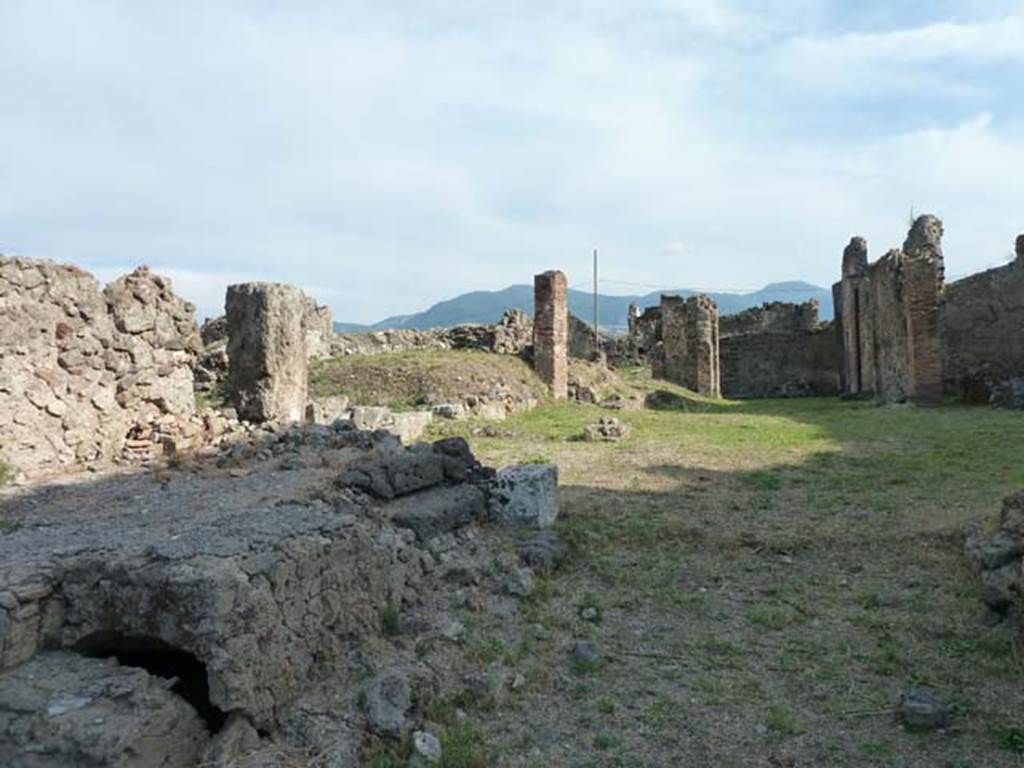
VII.6.3 Pompeii. September 2015.
Looking south-west from entrance across site towards room 3 and previously unknown vaulted basement, on left.
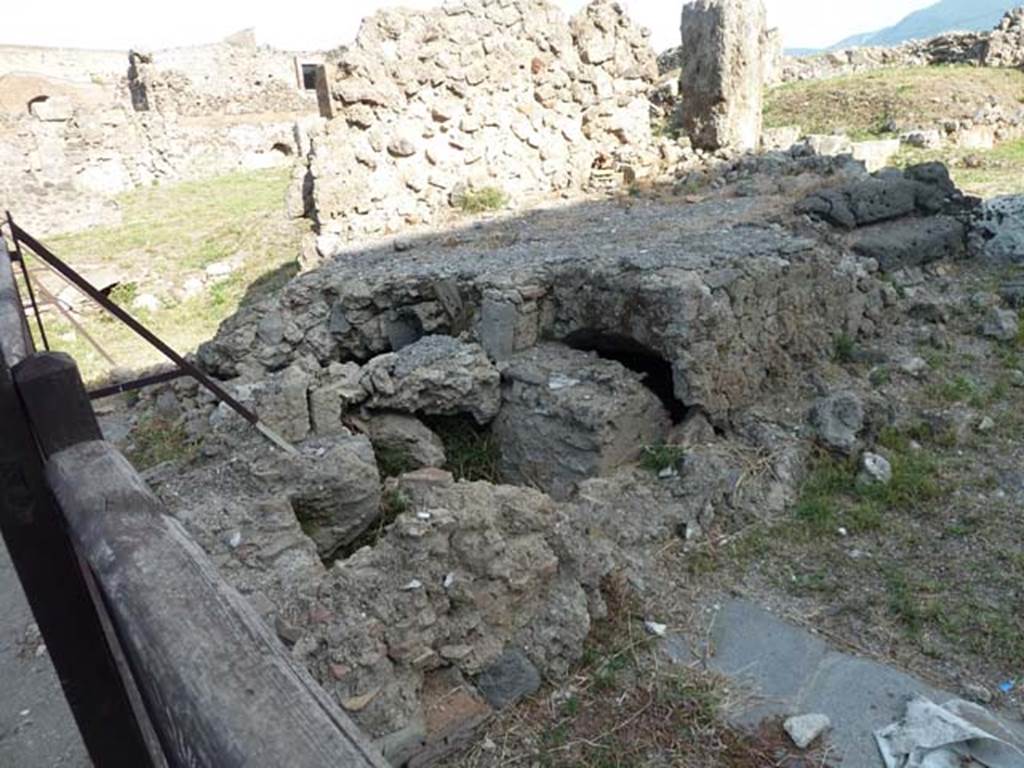
VII.6.3 Pompeii. September 2015. Site of room 3, and vaulted basement.
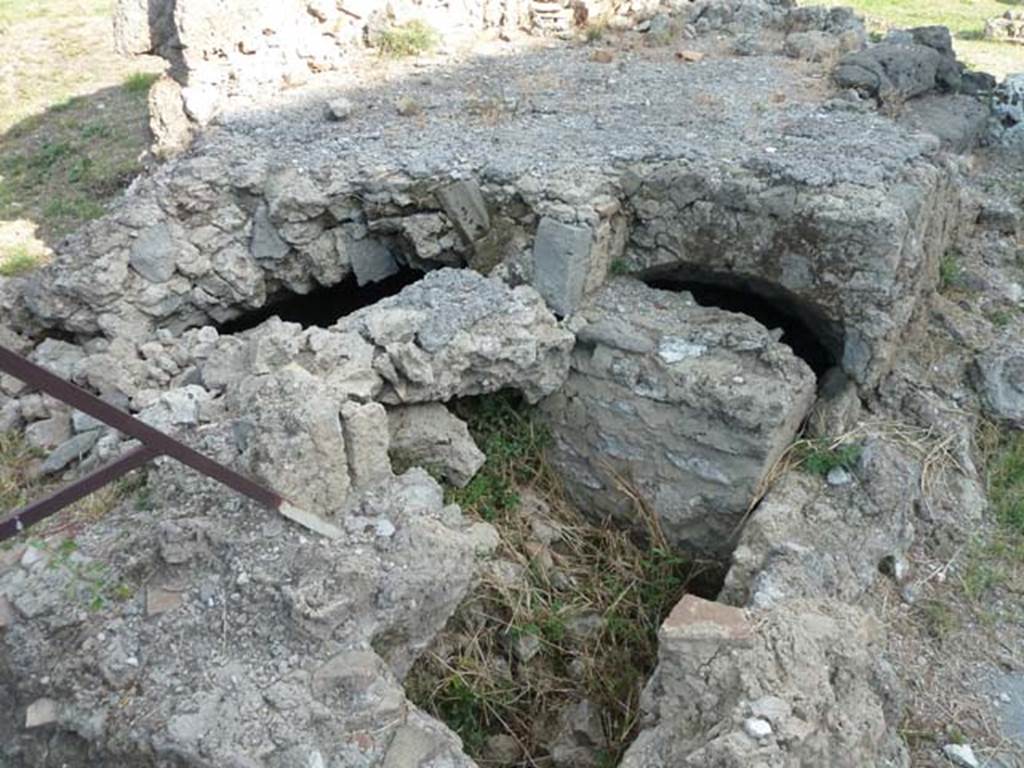
VII.6.3 Pompeii. September 2015. Detail of vaulted basement below room 3.
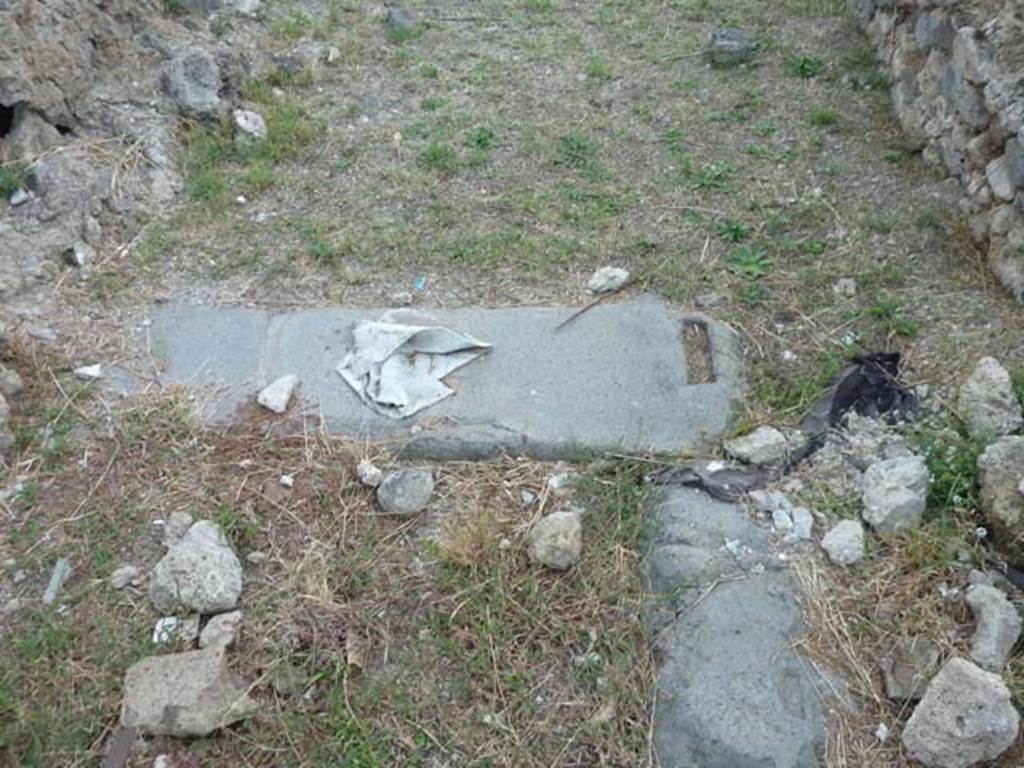
VII.6.3 Pompeii. September 2015. Doorway threshold on west side of room 3.
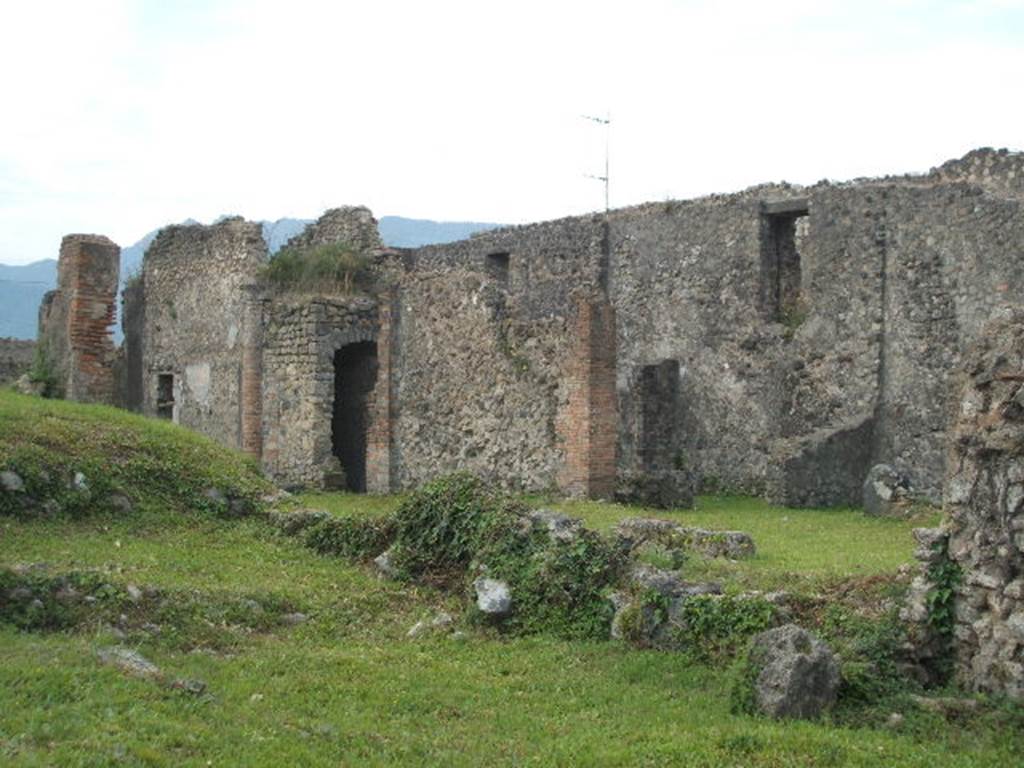
VII.6.3 from VII.6.6 Pompeii. May 2005. Looking south-west from room 5.
Across atrium 3a are rooms 10 and 14 and corridor 15.
Rooms 4 and 6 are to the left of room 5. The tablinum room 12 is in the
centre.
Notizie degli Scavi,
1910, pp. 439-453.
The first doorway
on the left of the eastern wall of the atrium, leads into a small square room
4, preserving corroded plaster at the foot of the walls, a room by which one
passed into a second room 5, which opened on the Via delle Terme, almost in all
of its width (VII.6.4). Evidently it was a shop, with which it had some
relation to the owner of the house, as is often observed in Pompeii. The
plaster of the shop was destroyed.
Following from the small room 4 was another of rectangular shape, numbered 6, preserved only in the lower part of the walls. The entrance doorway had a lava threshold: the flooring was of cocciopesto: the plaster, where conserved, was corroded.
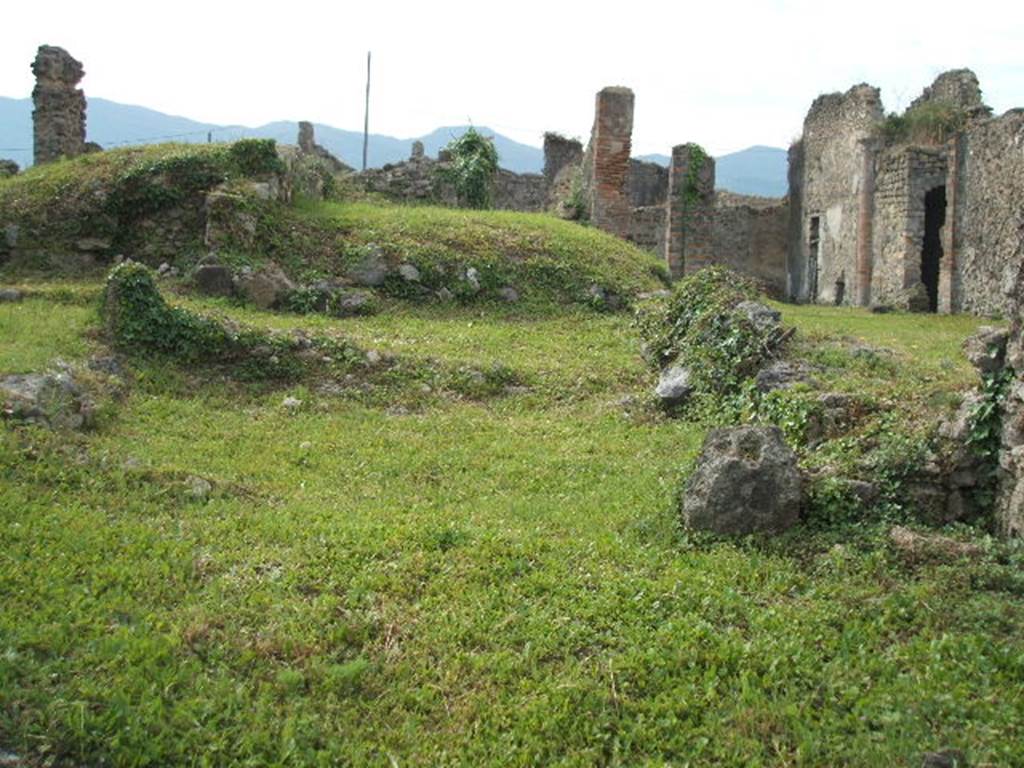
VII.6.3 Pompeii. May 2005. Looking south from shop-room 5 (VII.6.4), into
room 4, cubiculum.
This room also has a doorway on its west side linking to the atrium 3a.
Beyond is room 6 also a cubiculum.
The mound of earth behind is the site of the closed ala 9 on the east
side of the atrium.
See Eschebach, L., 1993. Gebäudeverzeichnis
und Stadtplan der antiken Stadt Pompeji. Köln: Böhlau.
(p.293).
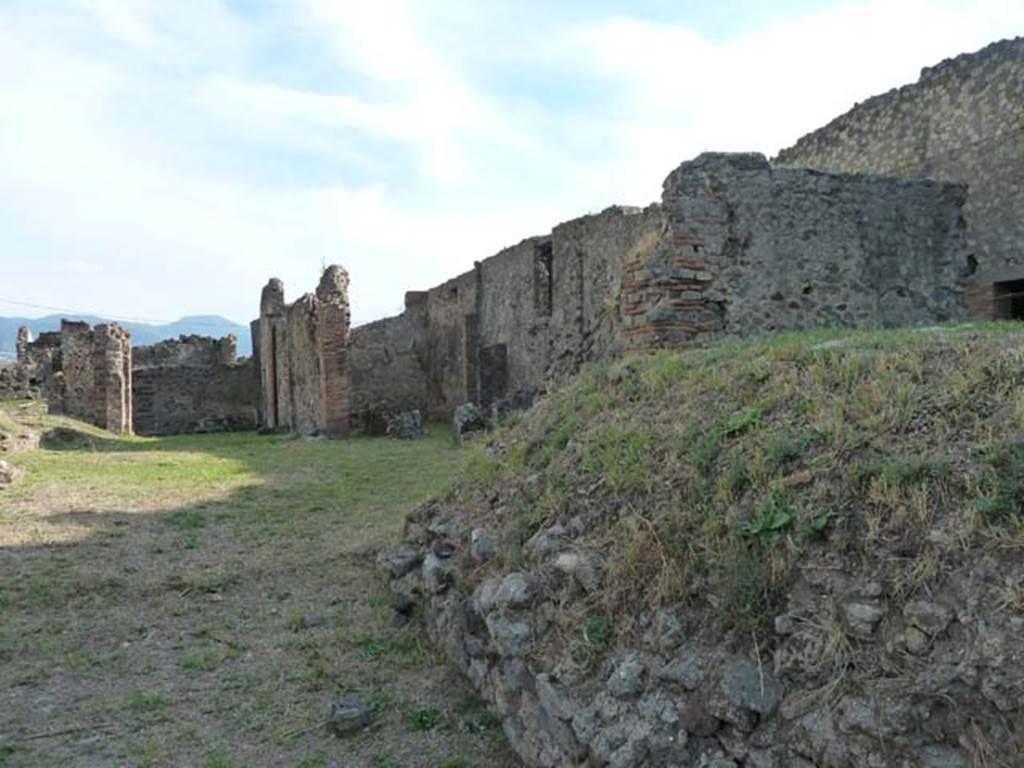
VII.6.3 Pompeii. September 2015. Room 2, fauces.
Looking south-west across atrium towards remains of rooms 8, 7, 10 and 14 on west side.
Notizie degli Scavi, 1910, pp. 439-453.
Facing room 4 was the rectangular room numbered 7, from the entrance latterly remade with broken tiles, which had a lava threshold, with a floor of mosaic, and with reasonable remains of decoration painted on the walls. On the top of the western one, were a few holes for the roof-timbers. The mosaic consisted of a black geometric design on a white background, in which the centre probably saw a representation, which perhaps at the time of the first excavation was removed and taken elsewhere. Of the wall decoration, large rectangles on a yellow background could be seen, divided by bands, or perhaps by poorly preserved architectural prospects and a dark-red zoccolo/plinth divided into panels by white/clear lines, some of which showed two green darting dolphins.
Following from this room was a type of corridor 8, which one entered likewise from the atrium and which leads into a small alcove which was at its end, on the right, was a recess for a bed. The floor was quite raised in the place where the bed was, as could be seen in other Pompeian cubicula: and in the left wall you could see the usual recess for one of the ends of the same bed. The walls showed remains of dark-red rectangles, and of a zoccolo/plinth of the same colour. At the top of the wall, it seemed to show traces of the frieze on a white background. The floor was of cocciopesto.
Rooms 9 and 10 were two types of alae.
The first (9) preserved a few remains of a zoccolo with a black background, with panels formed from white/clear lines, and with a few remains of a white mosaic floor, with wide black band around, which formed a square, which does not invade the area, “c”, reserved for a bed. It would seem that the mosaic threshold, or of marble, had been removed by those who preceded us in this excavation.
In the south wall was a small doorway which led into a small rustic room numbered 11, full of white tesserae and the material to form a floor of signinum.
The corresponding ala, room 10, had originally the true shape of an ala, with decoration painted on a black background, of which nothing of particular is recognised anymore, and with a white mosaic floor with a black band around it. Following, however, the room underwent a large modification by having built in the innermost part of it, two masonry square tubs, “d and e,” raised up from the ground, with the base formed by the same flooring of the room. The threshold of the wide entrance was made by a mosaic with white background, with a black band and two rows of triangles, also in black. The door-jambs, preserved only in the lower part, were made with Sarno stone and showed rear repairs. To the left of the south wall was a large doorway with marble threshold, one of the entrances into room 14.
The tablinum 12 was in axis with the atrium and with the fauces. Its walls, made with Sarno stones, with slag and pieces of lava, all in bulk, were reinforced posteriorly in the corners by means of pillars, made with the usual pieces of tiles and stones cut into parallelepipeds. Its floor, at least today, is of soil, and the walls are without plaster; the threshold is missing by the side of the atrium. At the sides, two rooms, 13 and 14, in the first of which we enter mainly from the atrium, and into the second, as we have already said, from the ala numbered 10.
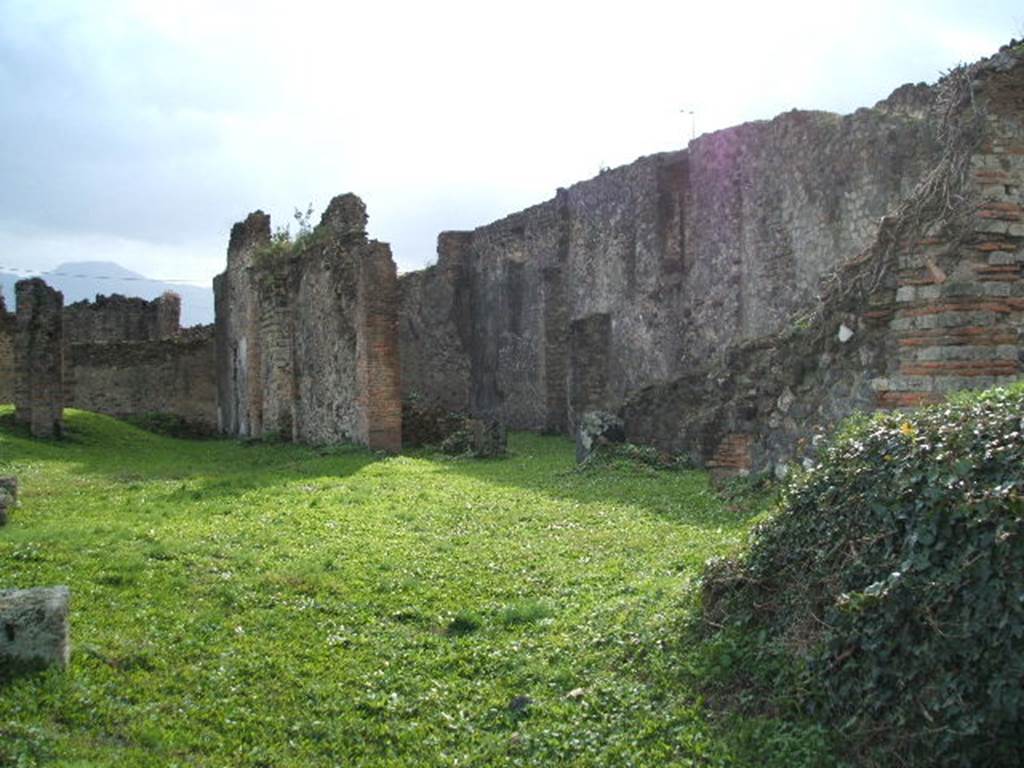
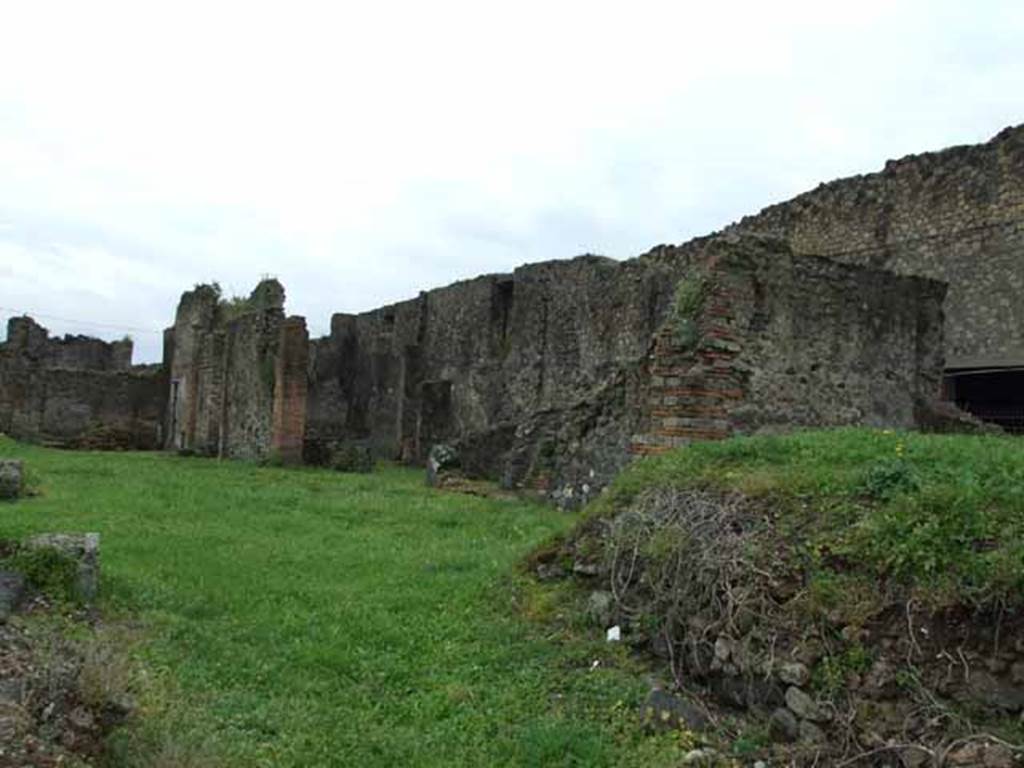
According to Garcia y Garcia, the bombing of 13th September 1943 resulted in the destruction
- of the prothyron, and four rooms to the north and north-east of the atrium.
- three columns of the portico were knocked down in the south-east corner of the peristyle.
- in the west ala, the beautiful mosaic in black and white which had been disturbed in the last days of Pompeii by the construction of a wall for a cupboard base, just before its ruin by Vesuvius (Fig.232 on page 104).
According to the map of the bombing (on page 26) 5 bombs hit this insula.
Diary of Incursions on page 31-34 lists the damage to the surrounding houses –
13th September 1943 (17.00 hrs)
(listed as VII.vii.3, but probably VII.vi.3) south and south-east of the peristyle, part of the south perimeter wall.
VII.vi.28, north and north-west of the peristyle
VII.vi.38, south-west of the house and neighbouring rooms.
VII.vi.7, west of the atrium and south-west of peristyle.
See Garcia y
Garcia, L., 2006. Danni di guerra a Pompei. Rome: L’Erma di Bretschneider. (p.102
& p.104, Fig.232).
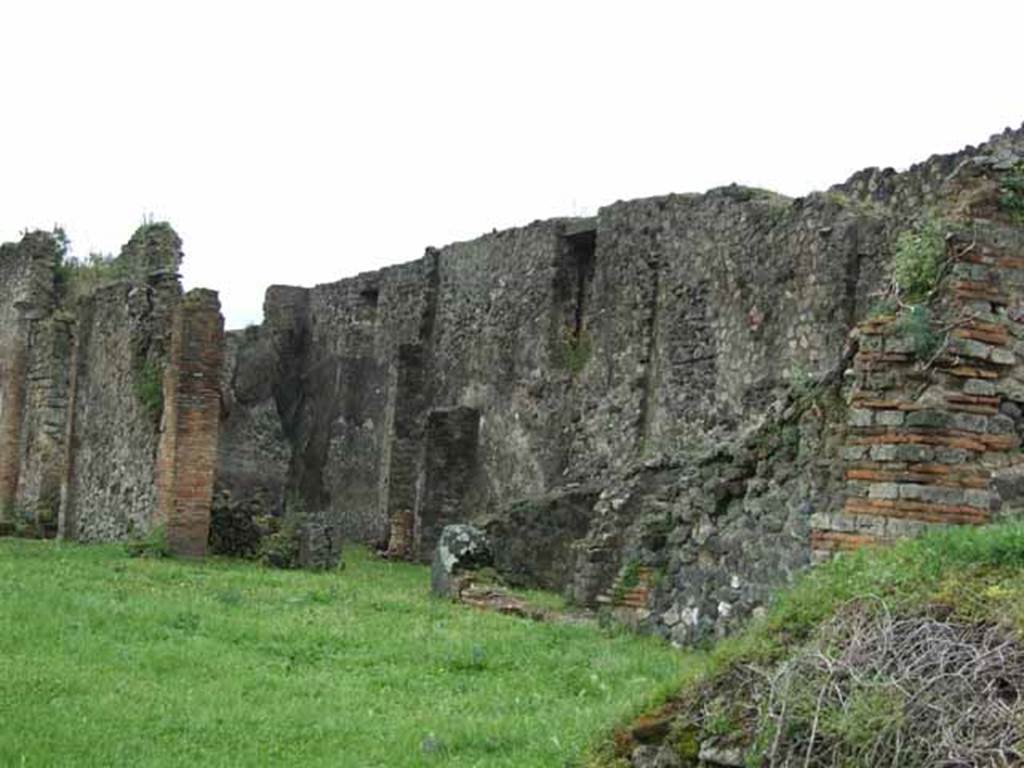
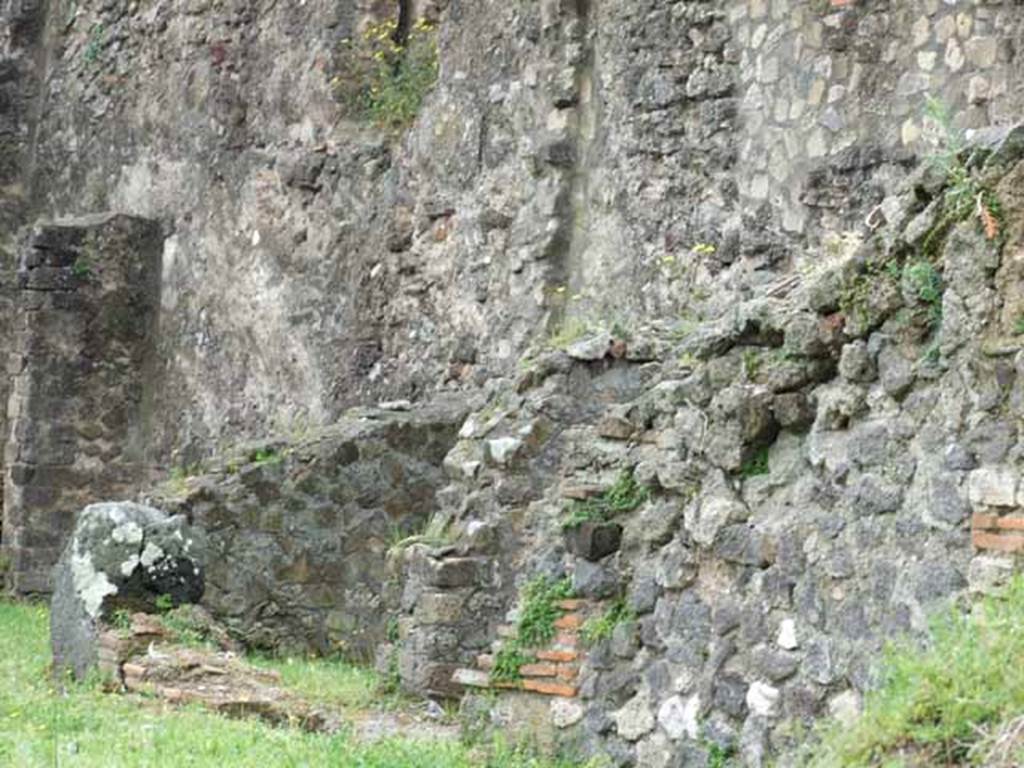
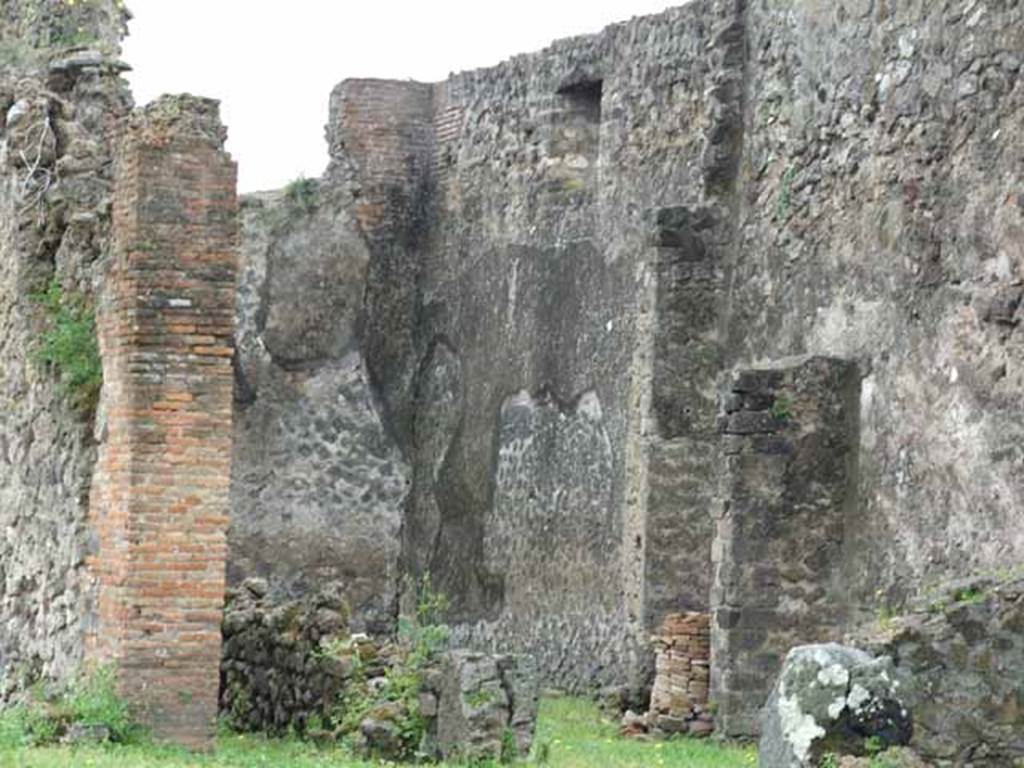
Notizie degli Scavi, 1910, pp. 439-453.
Between the said room and the tablinum, was a corridor (15), which then turns into a staircase (16), which descends into some rooms below.
A kind of passageway (17), connects with each of them, and with the peristyle 18, the tablinum, the corridor, the two side rooms and room 19.
Room (13), nothing is preserved of its wall decoration, if there were any; and it only showed remains of its black mosaic floor, with two white stripes around, and which perhaps had some kind of decoration in its centre. It opened towards the peristyle almost in all its width, with threshold of lava.
Room 14 had a signinum floor, (rows of small groups of five white tesserae arranged in a cross), and the walls showed evanescent remains of painted decoration. To the right of the west wall was a recess for the end of a bed, and at the top of the same wall the remains of a window facing the western vicolo.
The passage (17) had a mosaic floor, in which were inlaid small pieces of coloured marble.
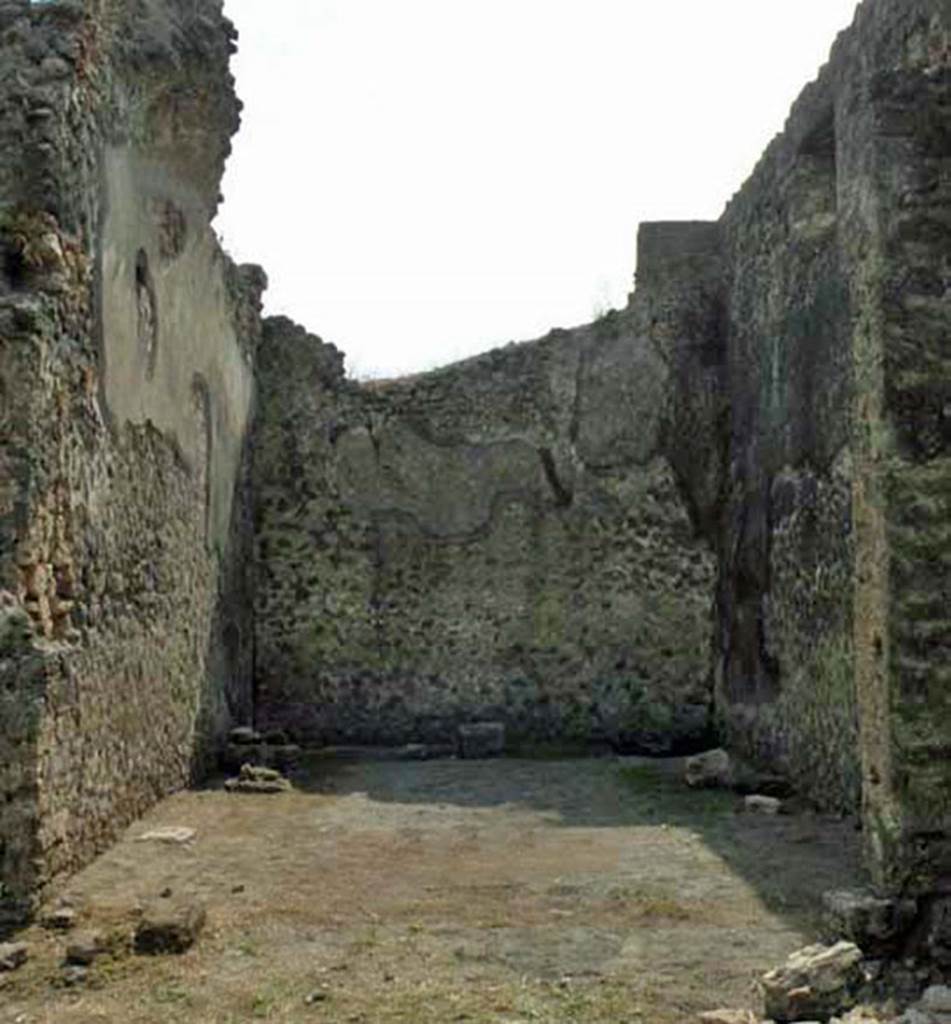
VII.6.3 Pompeii. December 2007. Triclinium 19, looking south.
Notizie degli Scavi, 1910, pp. 439-453
Room 19 opened exactly facing the southern entrance to the other room 14, on passageway 17. It was a large room conserving traces of a great vaulted roof at the top of the eastern wall, with the walls unadorned, with the floor of opus segmentatum, having in the middle a large rectangle formed by pieces of marble variously cut (squares, rectangles, diamonds, hexes), tightly joined together, and in bulk. Around that rectangle remained the space for three beds, which clearly proved that it was a triclinium, in which the dishes arrived by the stairway 16 from the kitchen below. That the walls were devoid of painted decoration was something that could be proved, or that the room was in repair (and in several places of this house, deposits of building materials were found), or that the walls were decorated with upholstery. Even the large triclinium of the house called “of the golden cupids”, had unadorned walls, so that one could make the same hypothesis also for this triclinium. Its entrance doorway was almost as wide as the room itself, and it had wooden doorposts.
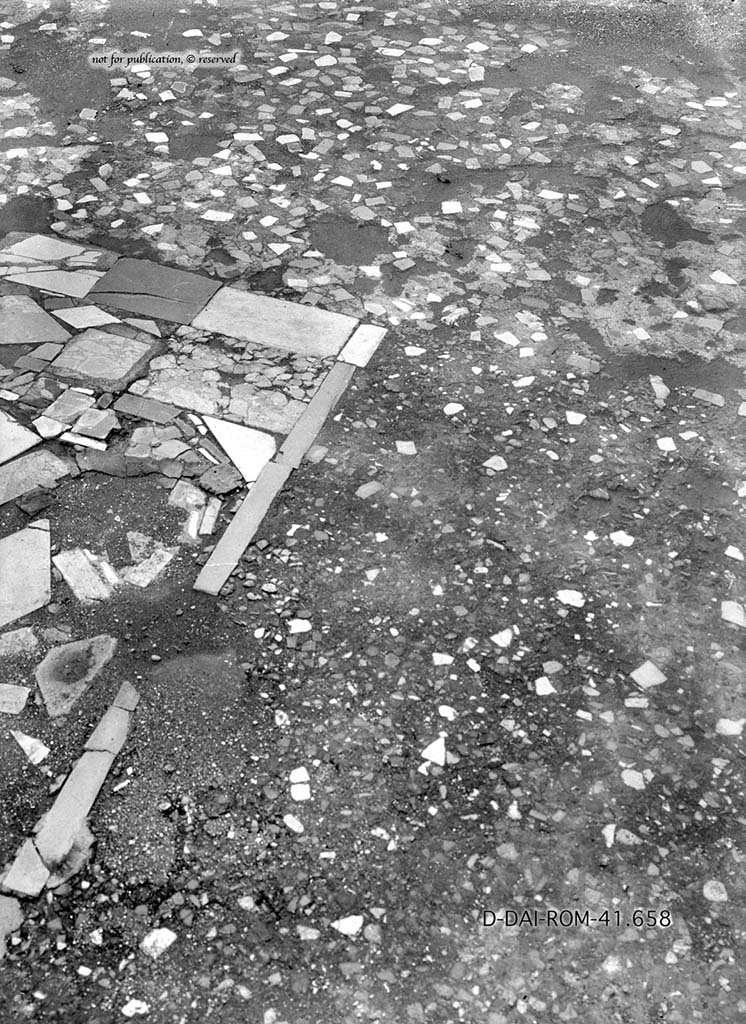
VII.6.3
Pompeii. c.1930. Triclinium 19, flooring in central area, near
table.
DAIR 41.658. Photo © Deutsches Archäologisches Institut,
Abteilung Rom, Arkiv.
See Pernice, E. 1938. Pavimente und Figürliche Mosaiken:
Die Hellenistische Kunst in Pompeji, Band VI. Berlin:
de Gruyter, (p.58-59, and tav. 23,2
above.)
According to PPM –
“The
photo shows an area of the flooring, and part of the carpet of square,
hexagonal and diamond-shaped tiles, and polychrome marble flakes inserted into
the cocciopesto, in the area of the table.”
(La foto mostra uno scorcio del pavimento con parte del
tappeto di piastrelle quadrate, esagonali, romboidali e di scaglie marmoree
policrome inserito nel cocciopesto, in correspondenza della mensa).
See Carratelli,
G. P., 1990-2003. Pompei: Pitture e
Mosaici. VII,7, Roma: Istituto della enciclopedia italiana, (p. 175.)
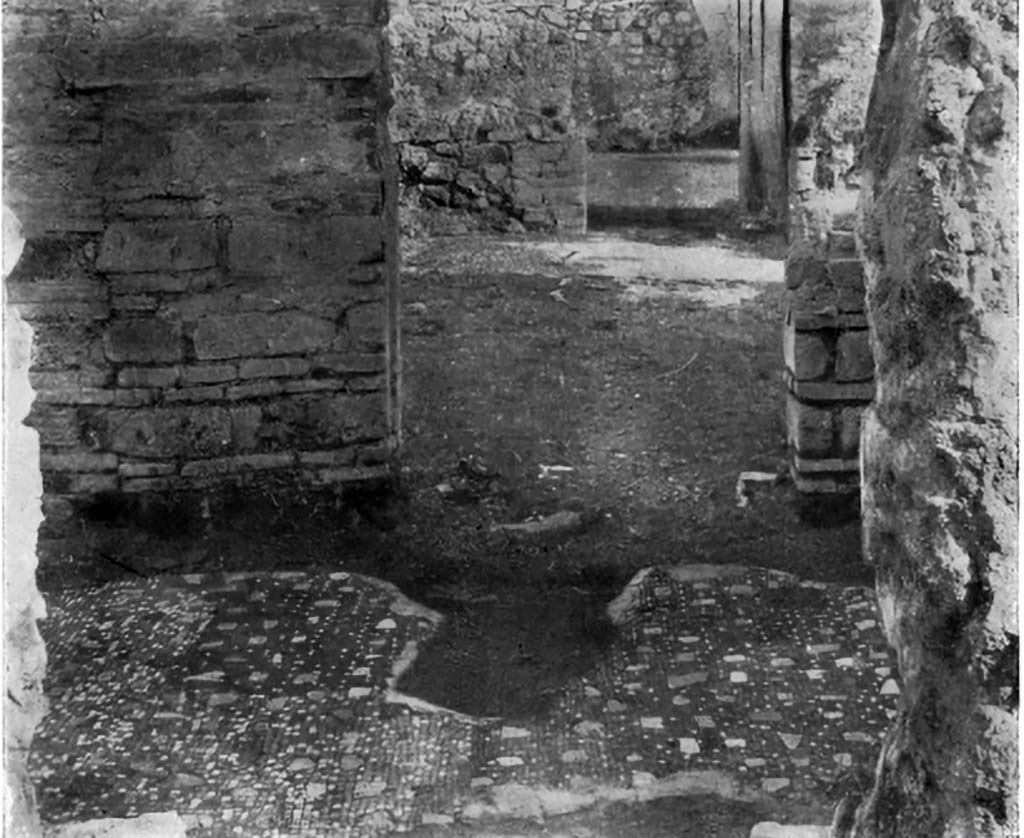
VII.6.3 Pompeii. c.1930.
Looking east from corridor 17, across flooring of corridor 15, through doorway into tablinum 12 and across towards doorway to room 13.
The doorway to Room 14, and corridor 15 are on the left.
The doorway to Room 19, and stairway 16 would be on the right.
According to Blake,
Only one other pavement employs limestone pieces alone to give colour to a black background.
In a corridor of VII.6.3 (pl.13, fig.4 above), the irregular pieces of coloured limestone have been retained, although the fine tesserae of the background
(0.7cm to 1cm) have been almost entirely replaced by coarser (1cm to 1.3cm).
See Blake, M., (1930). The pavements of the Roman Buildings of the Republic and Early Empire. Rome, MAAR, 8, (p.61, & pl.13, fig.4).
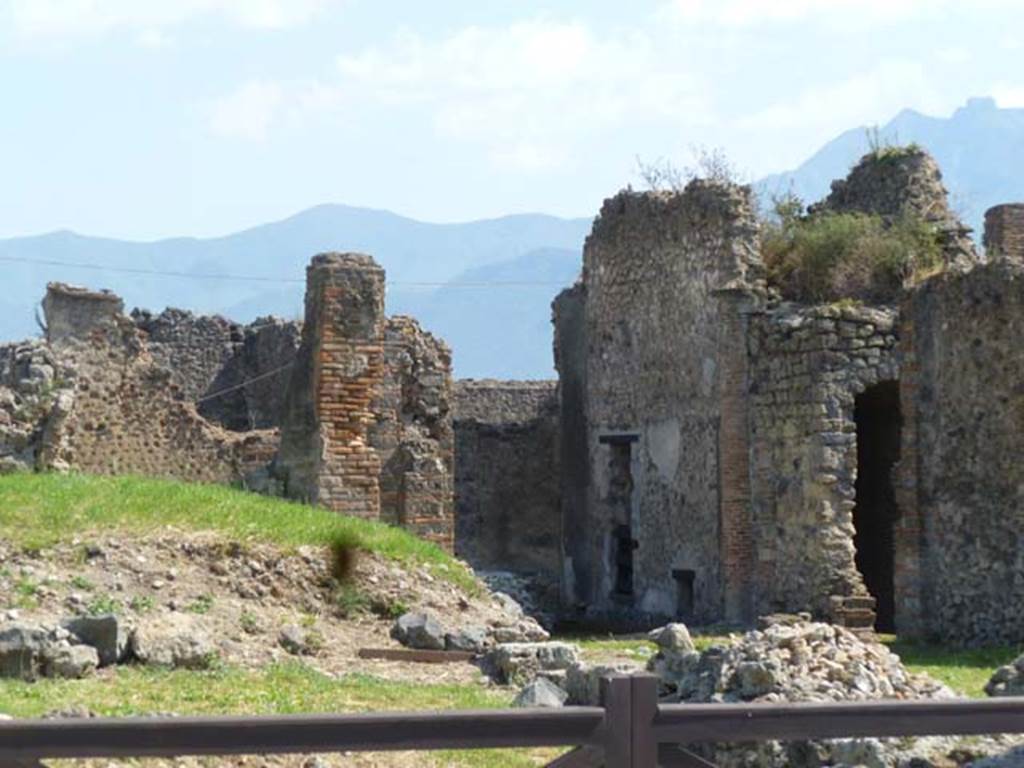
VII.6.3 Pompeii. May 2011. Looking south-west towards rear of VII.6.3, and the rooms on its west side. Photo courtesy of Michael Binns.
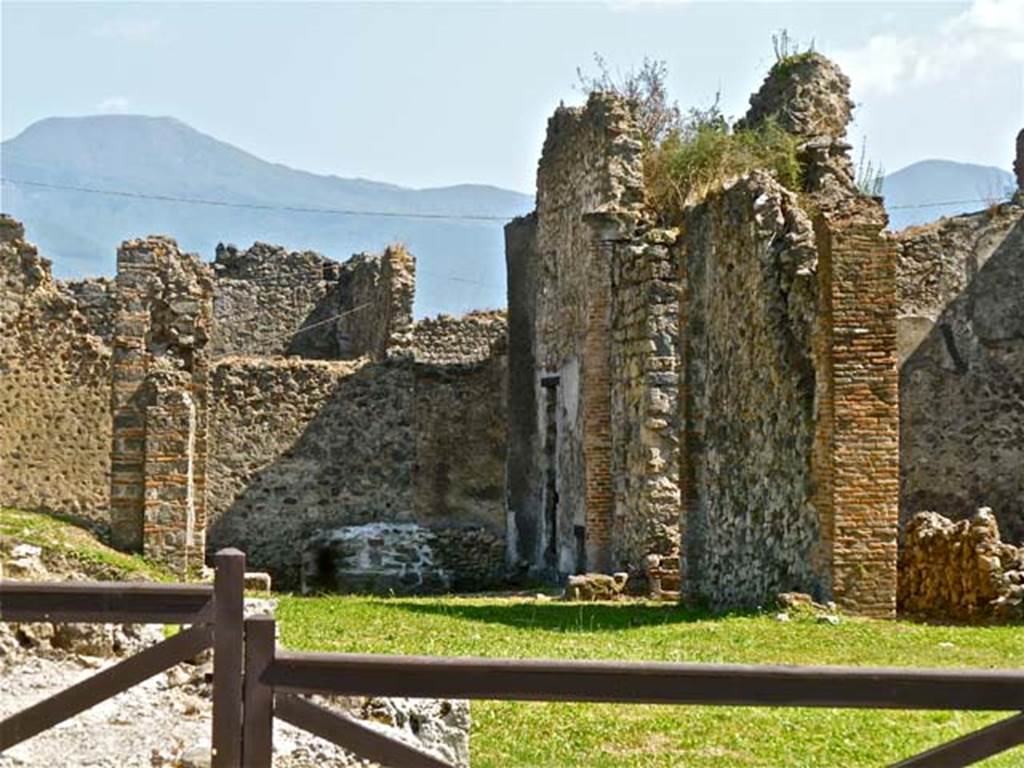
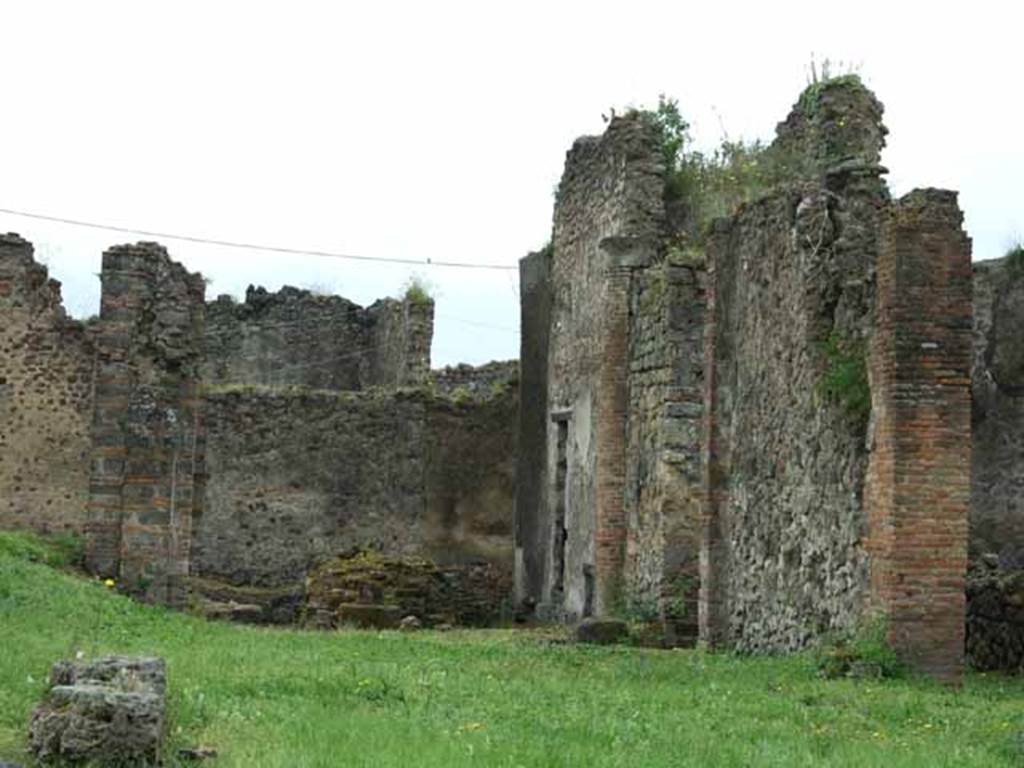
VII.6.3 Pompeii. May 2011. Looking south across tablinum towards rear. Photo courtesy of Michael Binns.
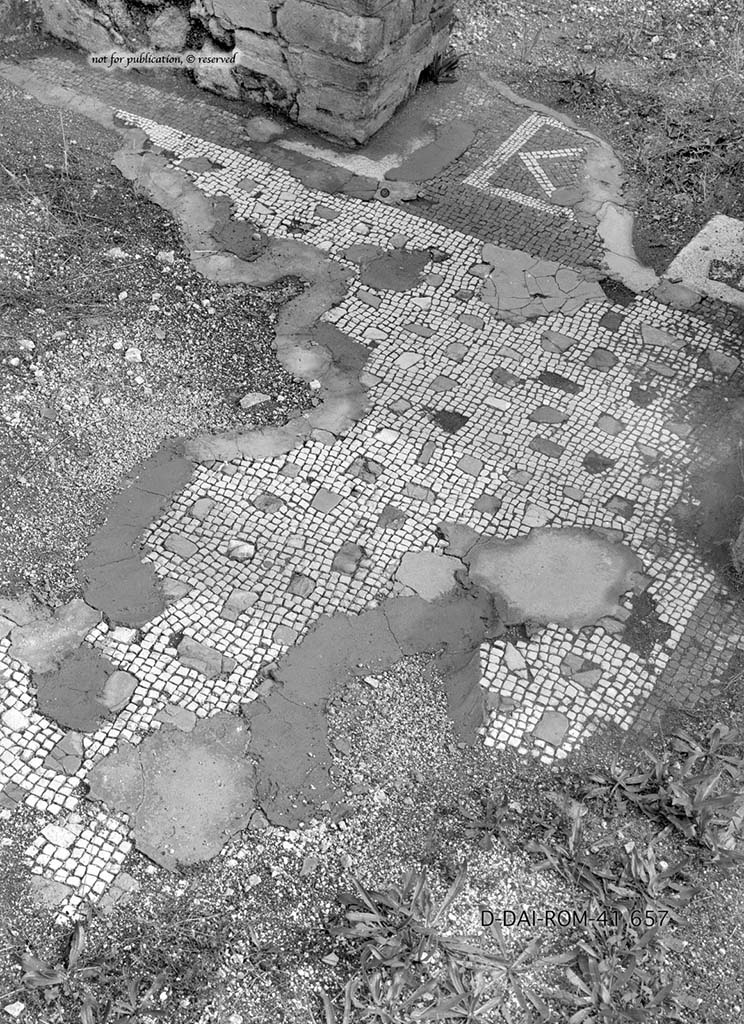
VII.6.3
Pompeii. c.1930. Room 12, flooring in tablinum.
DAIR 41.657. Photo © Deutsches Archäologisches Institut,
Abteilung Rom, Arkiv.
See Pernice, E.
1938. Pavimente und Figürliche Mosaiken: Die Hellenistische
Kunst in Pompeji, Band VI. Berlin:
de Gruyter, (p.58-59, and taf. 21,1 above).
According
to PPM –
"The room, restored after
the 62 earthquake, preserved
the primitive phase of the floor in white tiles with inserts
of yellow limestone, red, green, white and dark blue, and with a black
border."
(“La stanza, restaurata dopo il terremoto del 62,
conservava della fase primitiva il pavimento in tessere bianche con crustae di
calcare giallo, rosso, verde, bianco e blu scuro, e bordo nero.”)
See Carratelli,
G. P., 1990-2003. Pompei: Pitture e
Mosaici. VII,7, Roma: Istituto della enciclopedia italiana, (p. 174.)
According to Jashemski – “The garden at the rear of the house had a portico on the north and part of the east sides.
By the time of the eruption, two of the original columns on the north side had been reinforced with pillars, the third one replaced with a pillar.
They were connected by a low masonry wall with the entrance to the garden on the north.
A water channel of Nucerian tufa outlined the garden, collecting the water from the roof which was carried by two large terracotta pipes built in the north-west and south-east corners. The water was presumably stored in a cistern.”
See Jashemski, W. F., 1993. The Gardens of Pompeii, Volume II: Appendices. New York: Caratzas. (p.184).
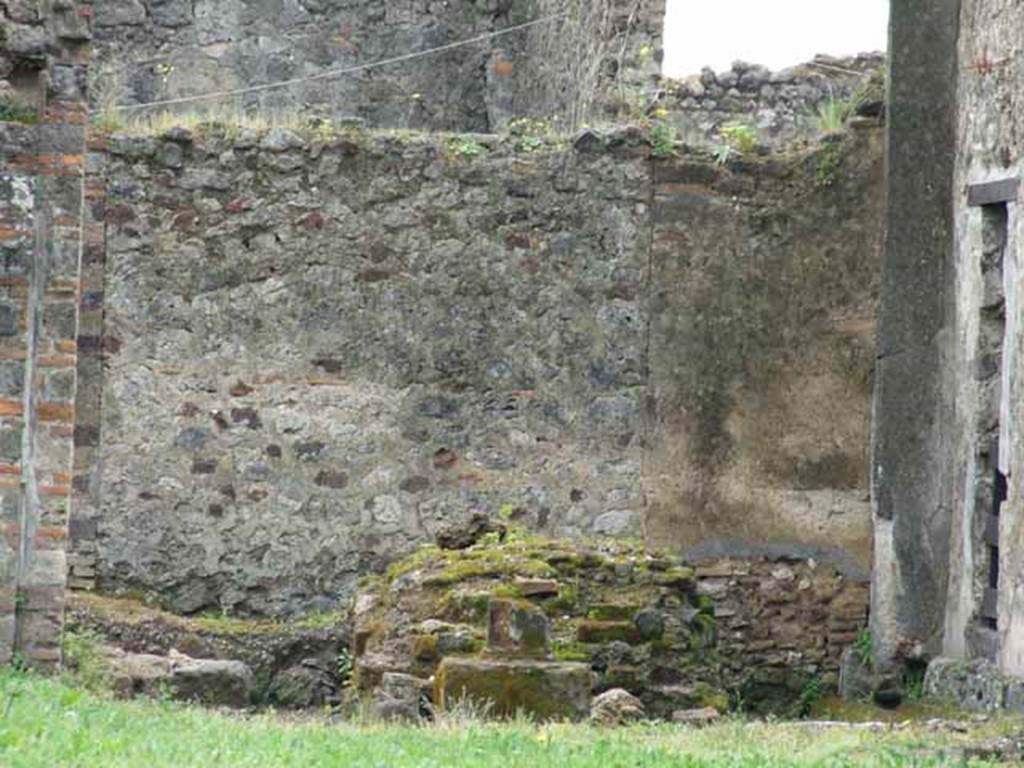
The altar on its north side can be seen.
According to Boyce, the sacrarium was found in a small room opening off the south side of the peristyle, only the solid podium remains.
The podium was coated with grey stucco on its sides and paved on top with pounded sherds.
In front of the base stood the remains of a small altar of tufa in the form of a rectangular pillar upon a base; the whole covered with red stucco.
See Boyce G. K., 1937. Corpus of the Lararia of Pompeii. Rome: MAAR 14. (p. 67, no.286).
Looking towards the south wall, in which a large doorway, previously walled-up in ancient times, had mainly linked to the house at VII.6.38.
Notizie degli Scavi, 1910, pp. 439-453.
The peristyle 18 had a portico only on the northern and eastern sides, portico originally formed by three columns to the north and two to the east, repeating twice that corner, of which however the two of the first side to the right, “h and k”, were transformed latterly into pillars. Of them, the one on the left, ends on the same side, with the column with which it is joined, forming that type of rectangular pillar with a semi-column at one end, characteristic in Hellenistic and Hellenistic-Roman architecture. The columns are made from broken tiles, and the pillars with tiles and stones cut into small parallelepipeds. The two pillars “h and k”, are contemporary to the other two, ”l (L) and m”, like those, having wooden jambs on the inner sides. At the corner column “u” corresponds in the neighbouring wall a semi-column “o”, on the other, which follows on the same eastern side “p”, a pillar “q”, which, being much taller than the semi-column “o”, which, complete in height, also gives us the height of the columns of the incomplete portico on top, it proves that on the portico, at least on the eastern side, there was not a terrace, but a roof, at whose height came the pillar “q”. On the semi-column was the remains of a pillar, which had to reach the greater height of the roof. The columns were of Doric style and covered with white stucco; with a high zoccolo/plinth, of purple/peacock blue. Between them there was a low masonry pluteus.
Space 20, at the bottom of the east portico, had been changed into a storeroom/cupboard/apotheca, which was found full of building material. It communicated with the adjoining house VII.6.38 (XXXVIII) by a doorway in the south wall, which was then walled-up. However, a large doorway existing in the southern wall of the peristyle, and walled-up in a previous time, was the main doorway linking to the house at VII.6.38.
The walls of the portico preserved remains of very faded painted decoration. The portion of the eastern wall that constituted the bottom of the northern portico, was painted in the Second Style, in a very suitably chosen way, in that, while at the top you see the usual imitation of the marble slabs obtained with the painting alone, beneath these is a large painted arch, only partially preserved, which gave the illusion that this wing of the portico continued beyond. Of what was painted as the background of the arch, nothing is seen anymore. The western wall of the peristyle was painted in white.
To the left of it was a doorway with a lava threshold (Fig. 2 b), which gave light to the stairway 16. In its doorposts there were four corresponding recesses, probably to embed two crossbars of wood, which prevented the unwary from falling into the underground rooms. To the right a window opened at the level of the soil, another light for the stairs.
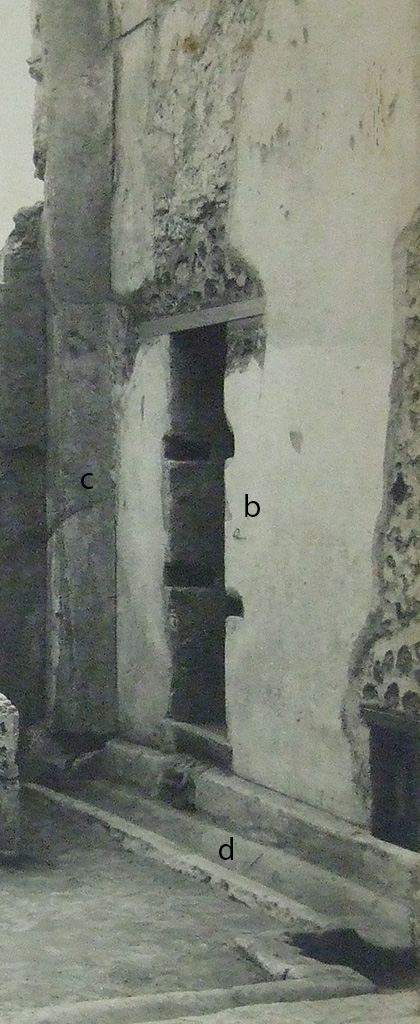
VII.6.3 Pompeii. Detail
from Notizie degli Scavi, 1910, fig.2, p.443.
Doorway with lava threshold and two crossbars of wood (fig.2 b).
On the right is the window at soil-level.
Notizie degli Scavi, 1910, pp. 439-453.
The peristyle area had a gutter around it (fig. 2 d) of Nucerian tufa, to collect the water from the roof and two large terracotta pipes walled into the north-west and south-west corners, water, which, coming from the upper floors, without doubt was going to feed an existing cistern in the earth, of which we will talk.
In the area, a little towards the west, was a masonry sacrarium (fig. 2 e) of which only the podium exists, rectangular in shape almost square, and with a step in front of it. On the four corners there are traces of four masonry columns, which supported a cover, which was most probably decorated with a pediment in each of the four sides, because they found remains of two gables of a different type and size, with celestial gable, which leaves us arguing that they were not two opposite sides, but of two nearby sides, forming the corner.
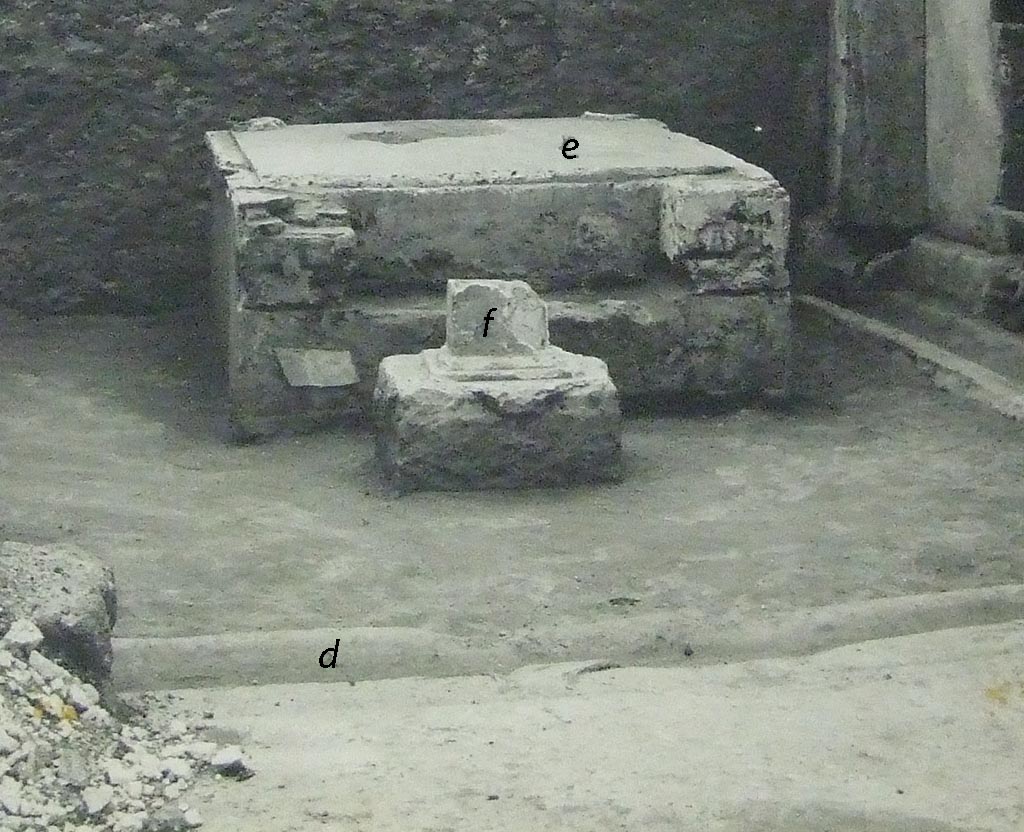
VII.6.3 Pompeii. Detail from Notizie degli Scavi, 1910, fig.2, p.443, showing sacrarium (2 e) and remains of small tufa altar (2 f).
Notizie degli Scavi, 1910, pp. 439-453.
Towards the rear was the trace of the base that supported some statuette, perhaps the main, while other minors could find a place on the whole podium. This was coated, in the sides, with rough plaster; it had a floor of cocciopesto and had mouldings. In front were the remains of a small tufa altar in the form of a pillar with rectangular body, placed above a zoccolo mainly of tufa, covered with plaster painted in red (Fig. 2 f). While the altar corresponded to the middle of the entrance to the area between pillars “h and k”, the aedicula was somewhat shifted to the right. Exploring the area's vegetal terrain, we have not found any empty roots.
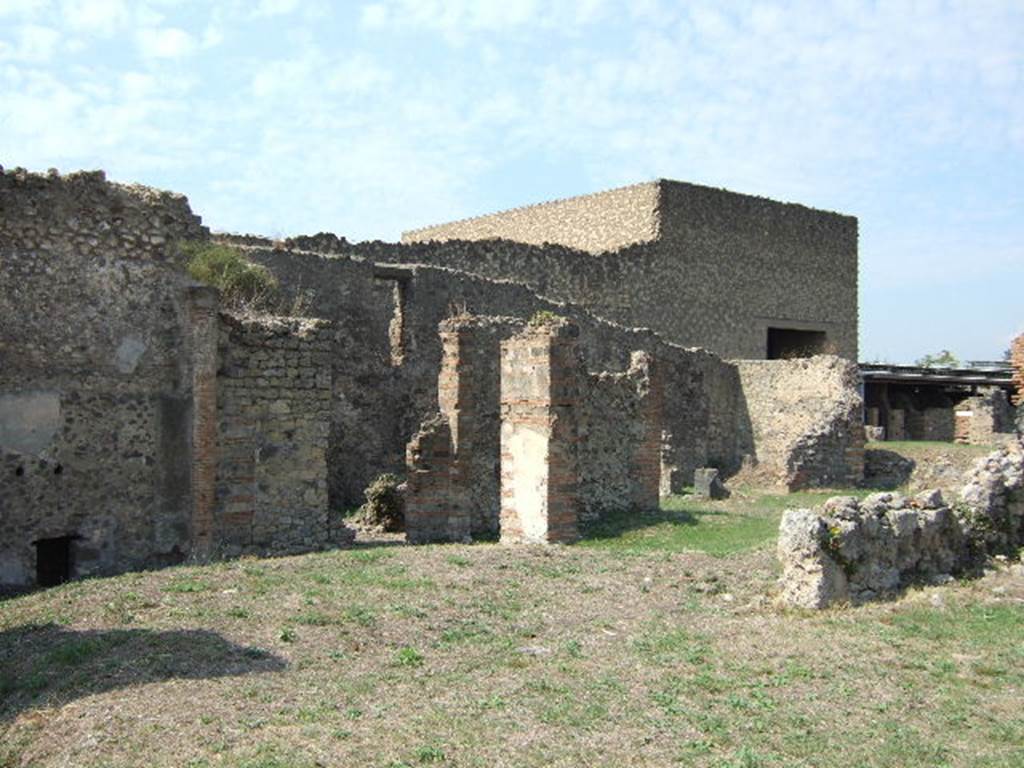
VII.6.3 Pompeii. Looking north-west from room 18 to tablinum 12,
corridors 17 and 15 and rooms 10 and 7.
The position of the temple Lararium shrine is approximately to the rear
of where the large shadow is shown on the left.
This area was devastated in the 1943 bombing.
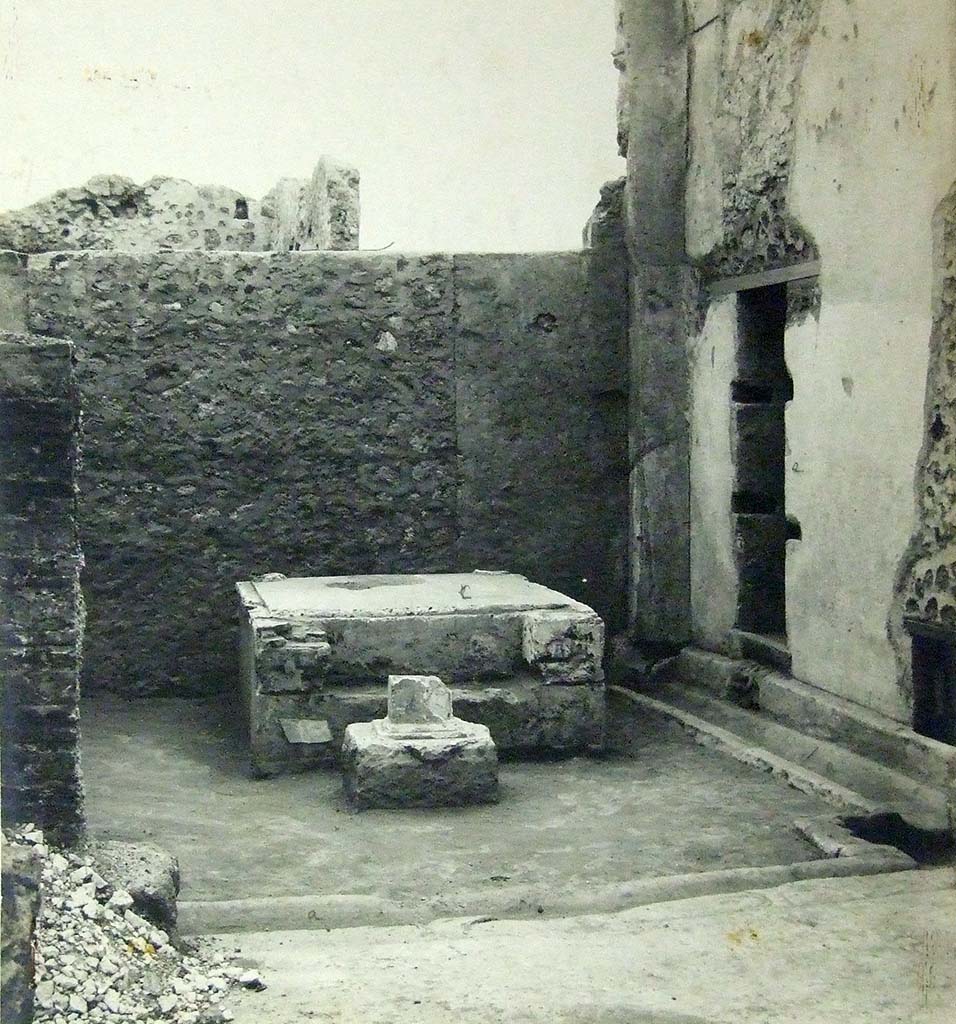
VII.6.3 Pompeii. 1910. Room 18, viridarium in south-west corner of the
peristyle.
Base of a Temple Lararium shrine (r) with a small altar in front.
According to Jashemski,
“Professor Richardson has shown that the well-known archaic statue of
Diana, (Mus. Naz. Inv. No. 6008) which was found at Pompeii in 1760, came from
the large and elegant shrine in the south-west part of the garden. There was a
tufa altar in front of the shrine”.
See Jashemski, W. F., 1993. The
Gardens of Pompeii, Volume II: Appendices. New York: Caratzas.
(p.184).
Photograph courtesy of Soprintendenza Speciale per i Beni Archeologici di
Napoli e Pompei.
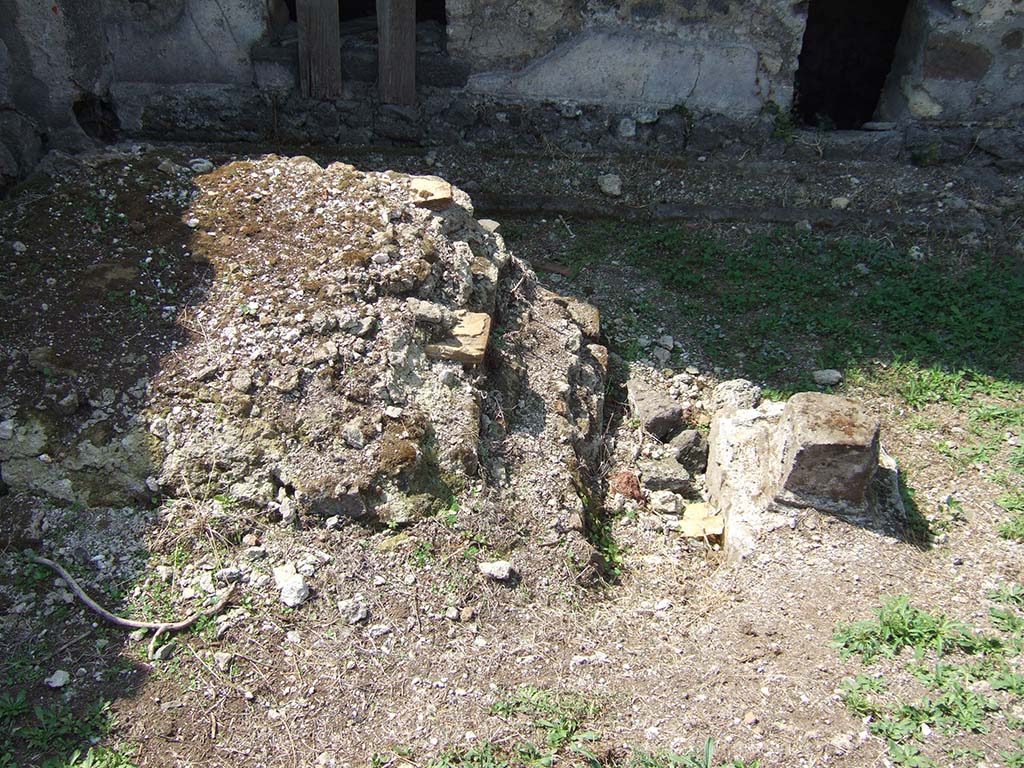
VII.6.3 Pompeii. September 2005. Room 18, viridarium in south-west corner
of the peristyle.
Remains of base (r) of a Temple Lararium shrine, on which the statue of
Diana was found, with the small altar in front.
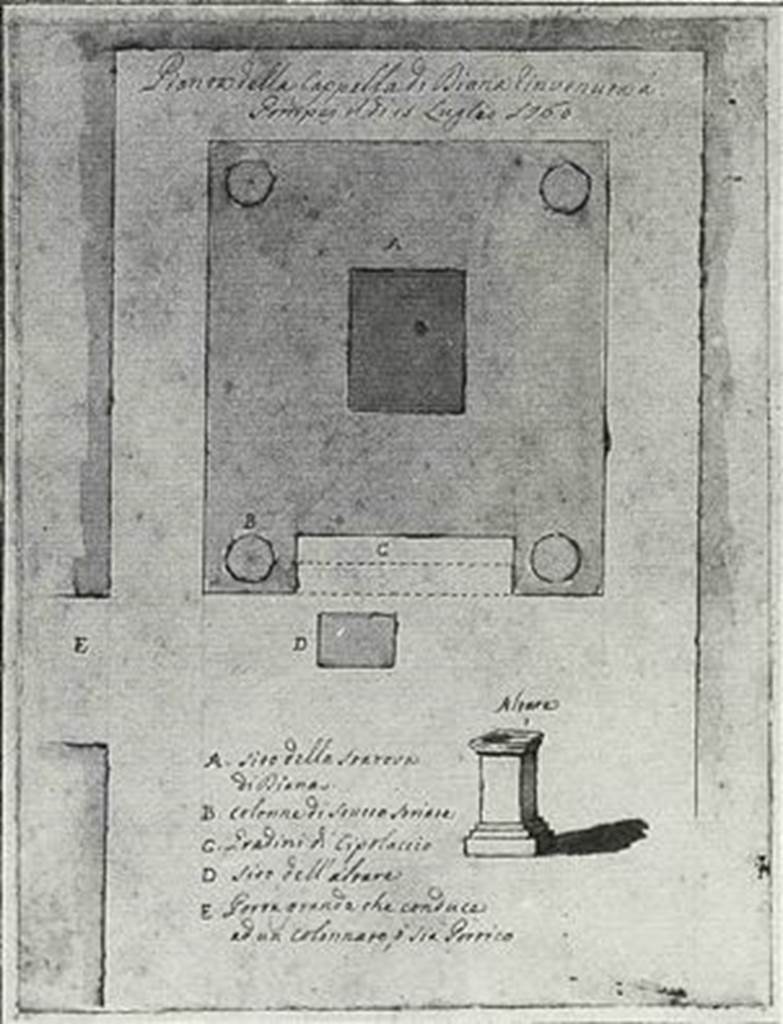
VII.6.3 Pompeii. July 1760 plan by Paderni showing a column in each
corner and two steps between the front two columns, behind the small altar.
The statue was in the centre of the base.
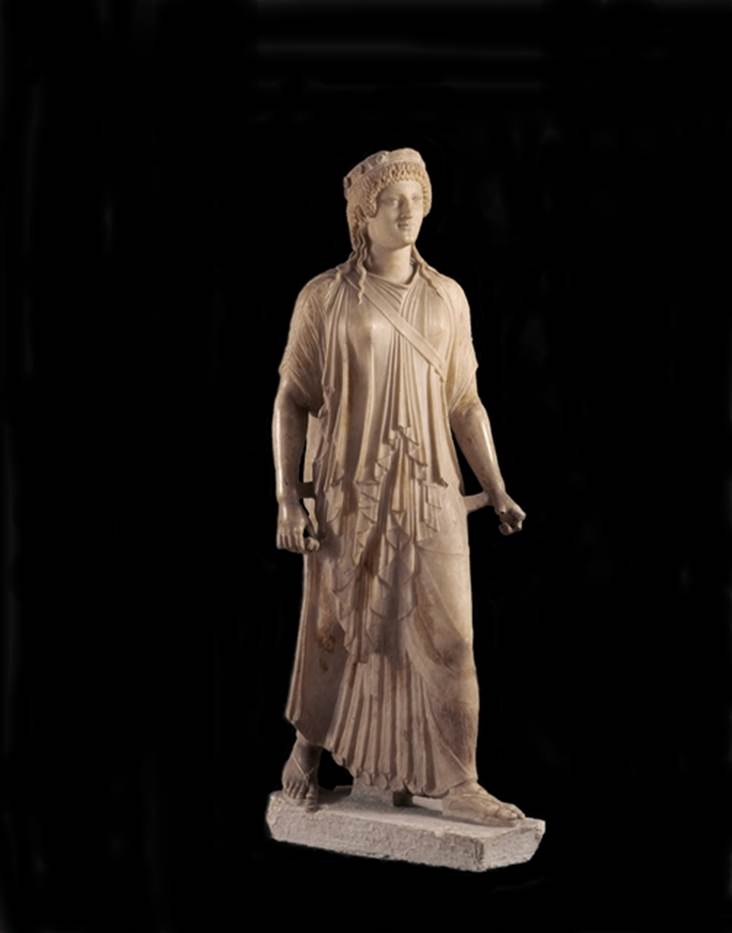
VII.6.3 Pompeii. Statue of Diana found in July 1760 on the base (r) of
the Temple Lararium shrine in viridarium 18.
PAH I, 1, 114 records – the marble statue, that shows Diana that came
from the Masseria Irace, has been removed.
add.140, 19th July “the marble and painted statuette of Diana, has come
from the excavations of the Masseria di Irace”.
Now in Naples Archaeological Museum. Inventory number 6008.
See Pagano, M. and Prisciandaro, R., 2006. Studio sulle provenienze degli oggetti rinvenuti negli
scavi borbonici del regno di Napoli. Naples: Nicola
Longobardi. (p.35)