VII.4.10 Pompeii. Casa di Bacco.
Direzione degli Scavi.
Linked to VII .4.8. Excavated 1824, 1826. Bombed in
1943.
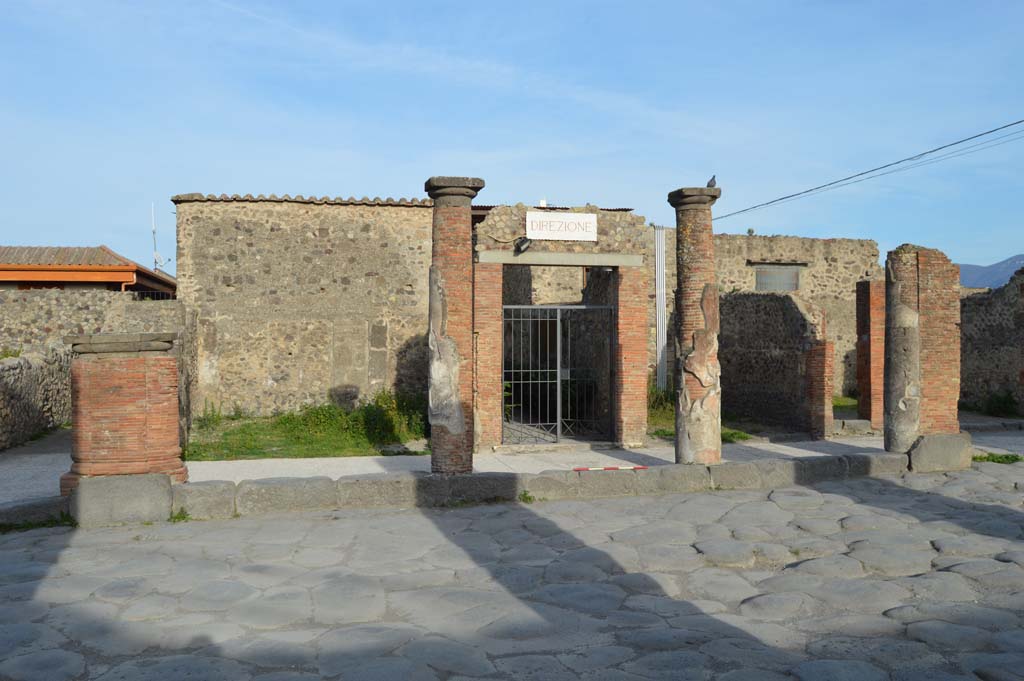
VII.4.10
Pompeii. March 2019. Looking east on Via del Foro towards entrance doorway.
Foto Taylor Lauritsen, ERC Grant 681269 DÉCOR.
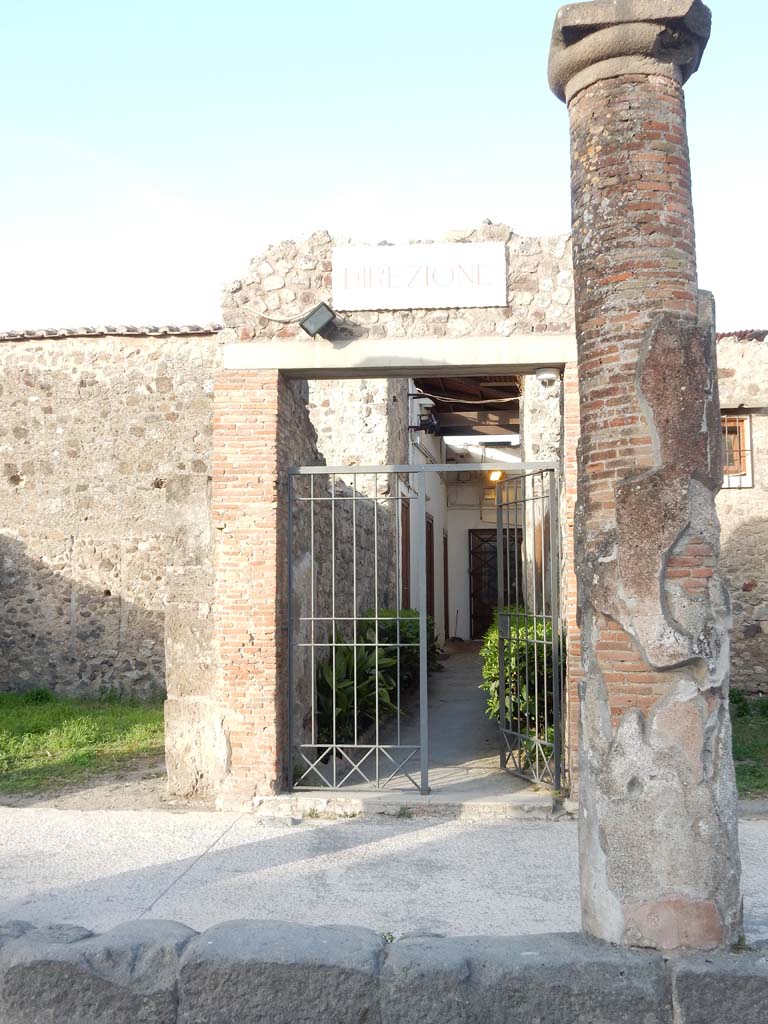
VII.4.10 Pompeii. June 2019.
Looking east across Via del Foro towards entrance doorway. Photo courtesy of Buzz Ferebee.
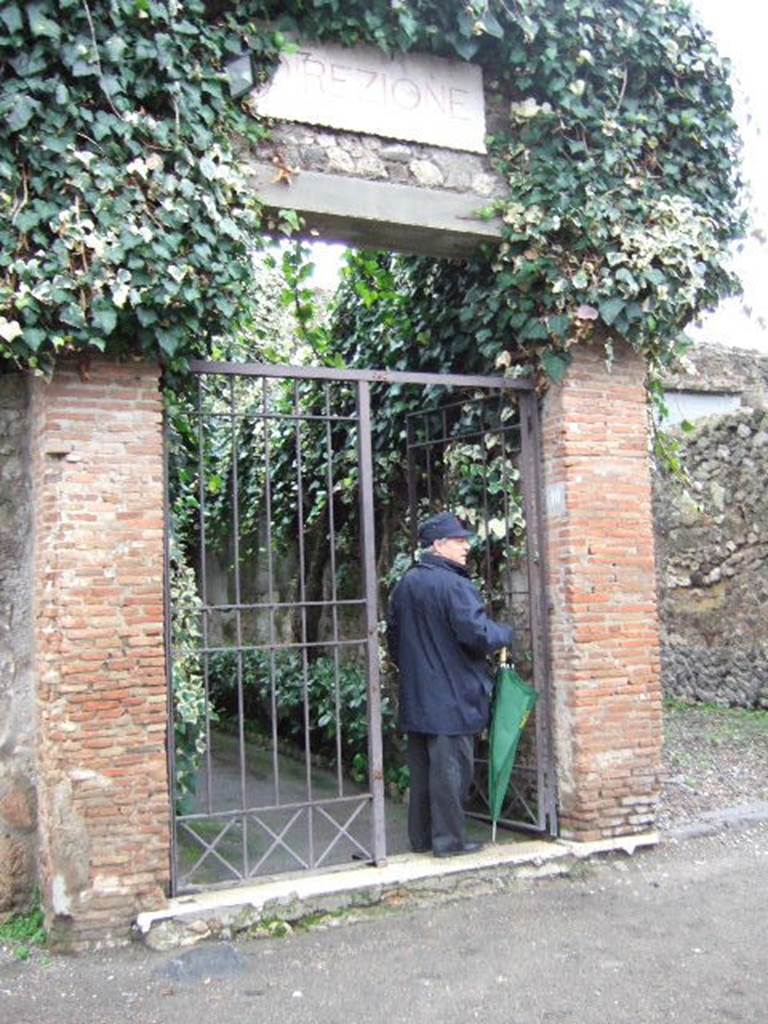
VII.4.10 Pompeii. December 2005. Entrance.
In August 1823, graffiti were found painted in black on the red plaster on the pilaster between VII.4.9 and VII.4.10 (on the left). They read –
Sabinum [CIL IV 514]
Pansam aed(ilem)
<E=S>u<h=LI>odus
rog(at) [CIL IV 515]
See Pagano, M. and Prisciandaro, R., 2006. Studio sulle provenienze degli oggetti rinvenuti negli scavi borbonici del regno di Napoli. Naples: Nicola Longobardi.
(p. 126)
According to Della Corte, he thought CIL IV 515 should have read – Euhodus rog(at)
See Della Corte,
M., 1965. Case ed Abitanti di Pompei.
Napoli: Fausto Fiorentino. (p. 146)
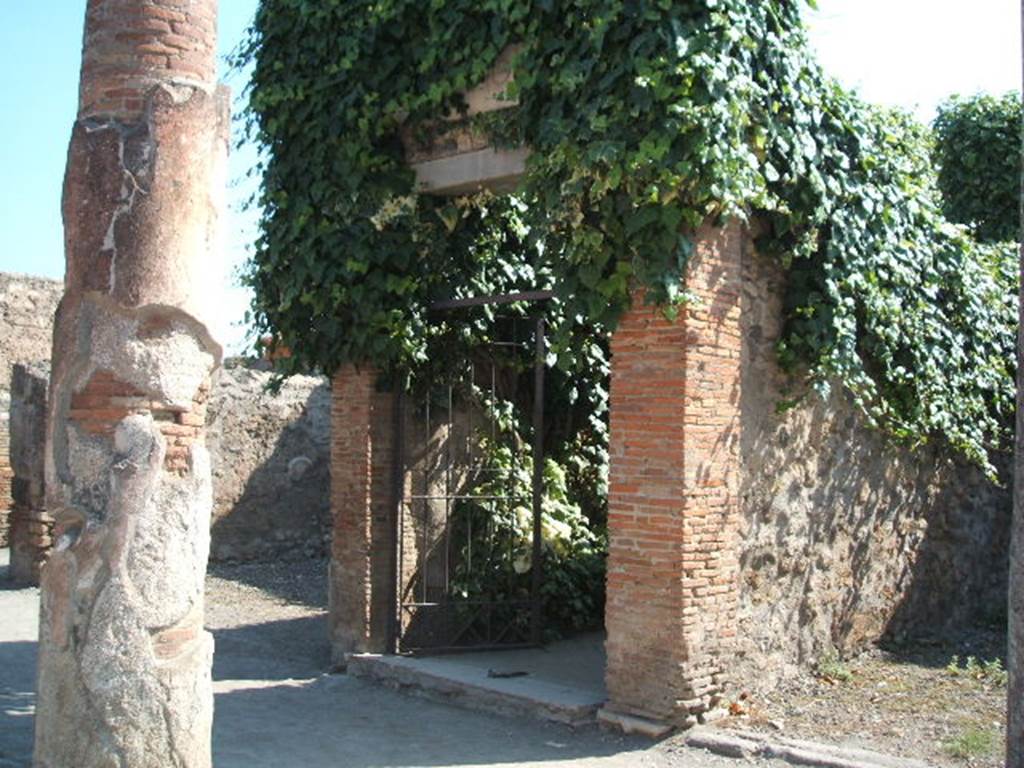
VII.4.10 Pompeii. September 2005. Entrance
According to Gell –
“Nearly opposite the entrance to the Baths, which occupies the centre of this street on the left-hand side, is a house on the right hand-side of more consequence than the rest. It has received the name of the House of Bacchus, from a large painting of the god yet existing on a wall opposite the entry.
Canals for the introduction of water are found in the Atrium, which has been surrounded by a small trough, or parterre of natural flowers, the side of which next the eye is painted blue, to represent water on which boats are floating. The wall behind this is painted with pillars, between which run balustrades of various forms, and upon these perch cranes and other birds, not badly painted, with a background of reeds or plants, and a sky visible behind. The effect must have been pretty when the whole was perfect. In the same house is the picture of a male and female sitting at the base of a pillar, attended by three cupids. In the background is a tree, with mountains in the distance. Nothing can exceed the grace of these figures in the original, and on that account, an outline of the picture has been, among others, selected for this work. See Plate XII (and see below).
In the same house is a pavement of coloured marbles, in the nature of opus Alexandrinum, which is pretty and is therefore given at the end of this work in Plate LXXXVIII.”
See Gell, W, 1832. Pompeiana: Vol 1. London: Jennings and Chaplin, (p.39-40)
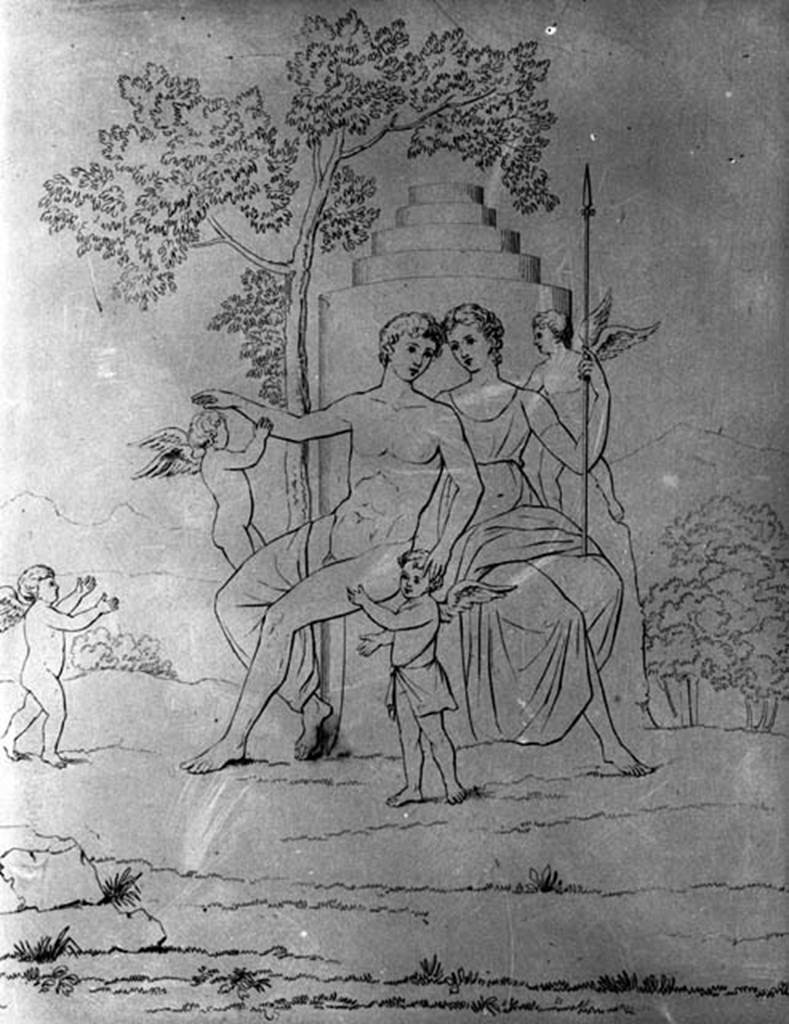
VII.4.10 Pompeii. W.14. Drawing of painting of Adonis and Venus with three cupids.
According to Bragantini, this was found in oecus (8), a room on the north of the entrance corridor.
See Gell, W, 1832. Pompeiana: Vol 2. London: Jennings and Chaplin. (p.66,
pl. XII)
See Helbig, W., 1868. Wandgemälde der vom Vesuv verschütteten Städte Campaniens. Leipzig: Breitkopf und Härtel. (339)
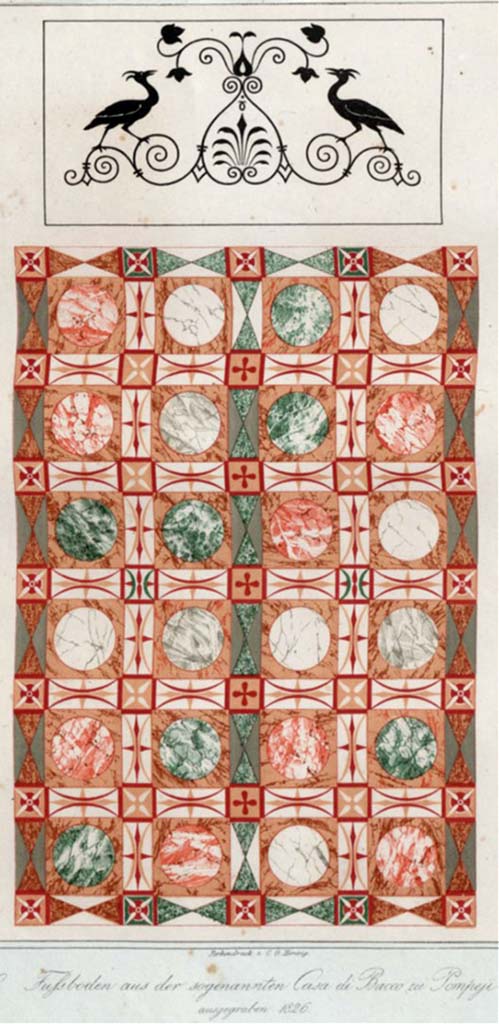
VII.4.10 Pompeii. c.1820’s.
Marble floor of this house, and picture (? threshold) of
cranes as drawn by Zahn.
See Zahn, W., 1828. Die
schönsten Ornamente und merkwürdigsten Gemälde aus Pompeji, Herkulanum und
Stabiae: I. Berlin: Reimer. (Pl.87)
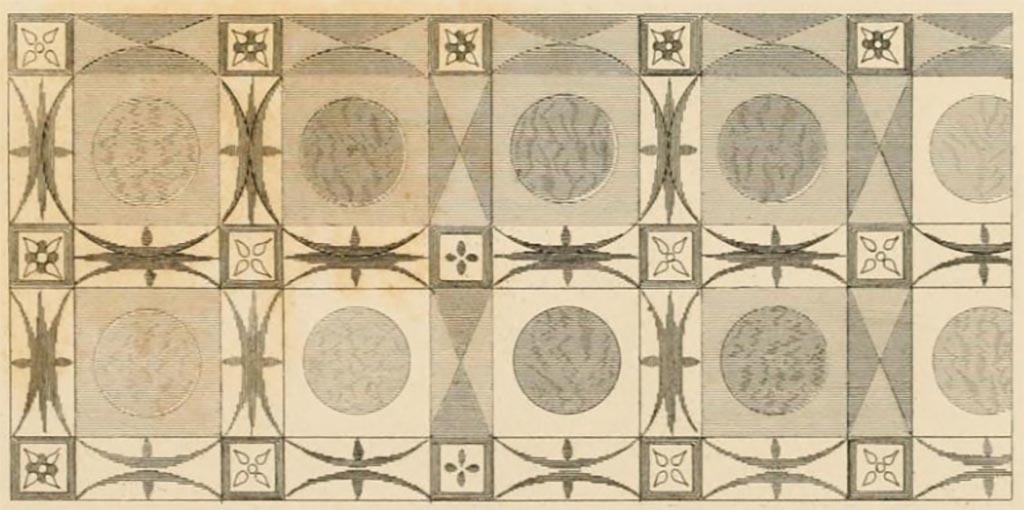
VII.4.10 Pompeii. 1832. Drawing by Gell of marble pavement.
According to Gell: The marble pavement is pretty, but it is not easy to discover by what rule the colours were distributed.
See Gell, W,
1832. Pompeiana: Vol 2. London:
Jennings and Chaplin. Plate LXXXVIII. Appendices, p.164
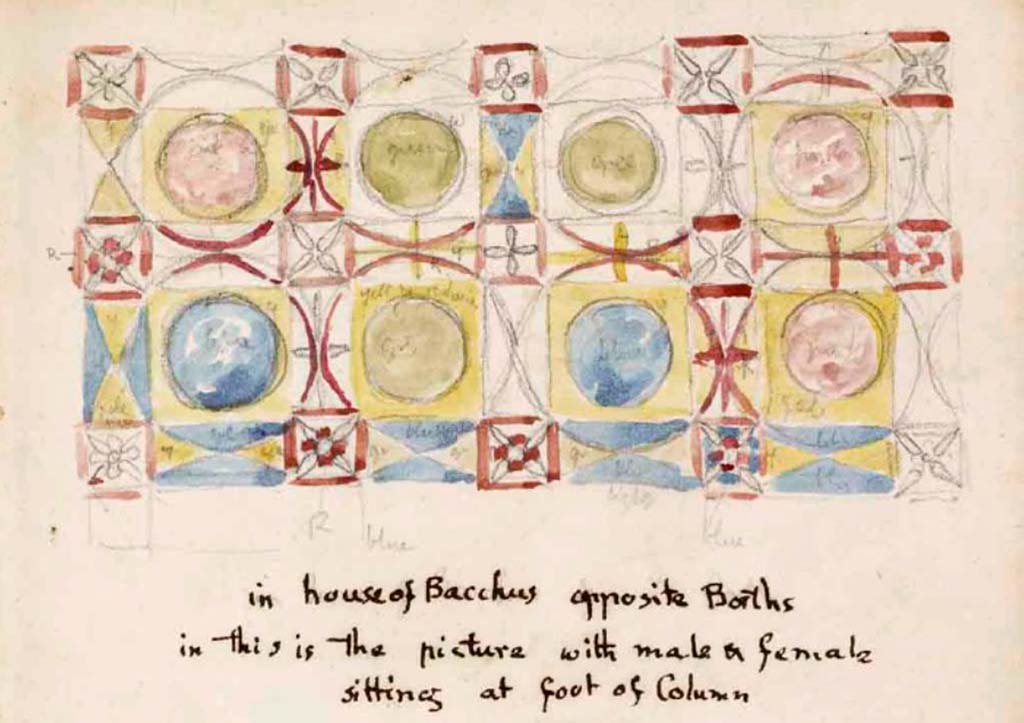
VII.4.10 Pompeii. c.1830. Drawing by Gell from his sketchbook.
See Gell, W. Sketchbook of Pompeii, c.1830.
See book from Van Der Poel Campanian Collection on Getty website http://hdl.handle.net/10020/2002m16b425
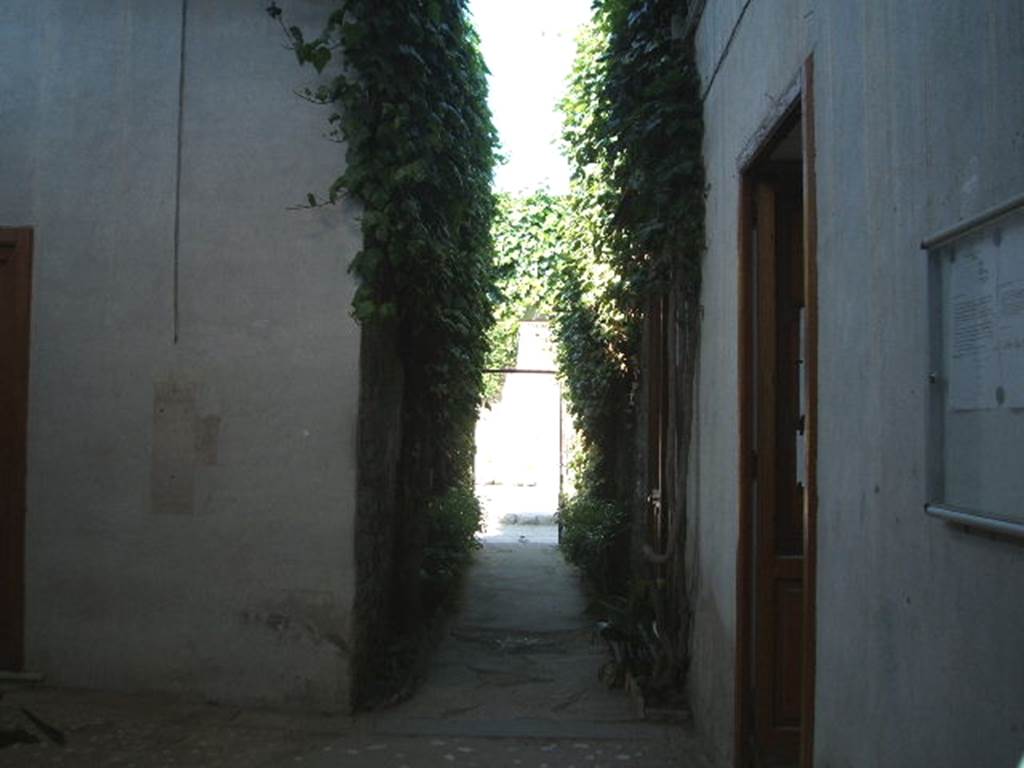
VII.4.10 Pompeii. September 2005. Looking west towards entrance, along long entrance corridor or fauces.
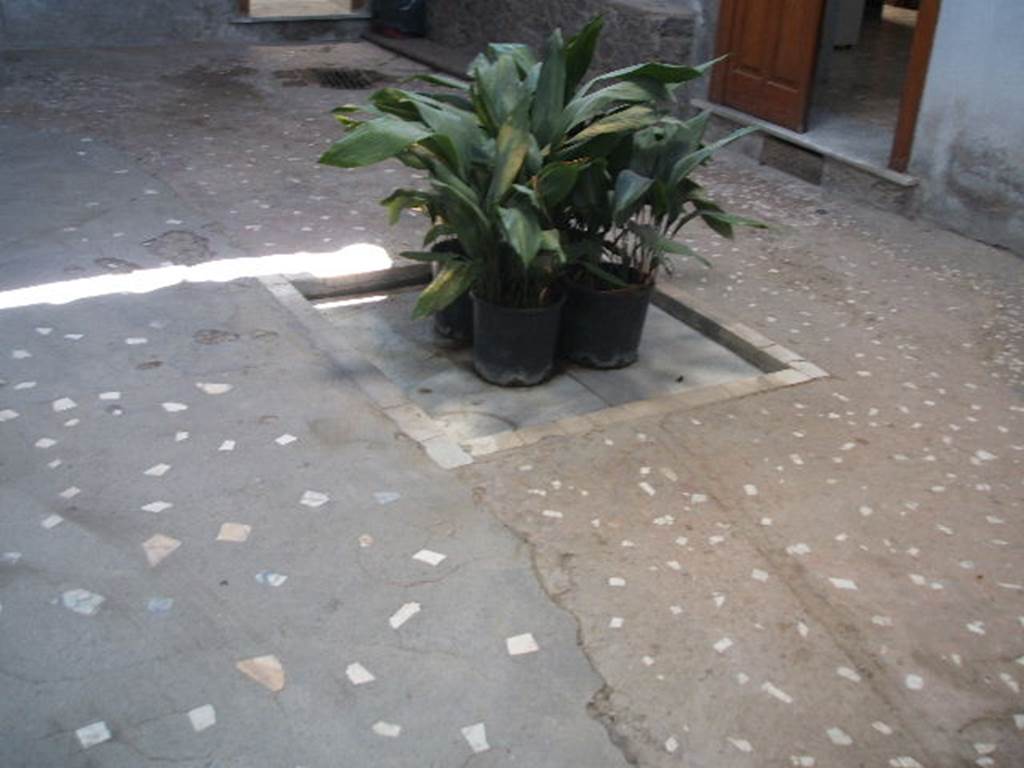
VII.4.10 Pompeii. September 2005. Impluvium in atrium.
This house took its name from a life-size painting of a sitting Bacchus with a panther at his feet, which decorated the atrium. (Helbig 391)
In the exedra nearby were another three paintings, found August 1826 –
Venus and Adonis (Helbig 339), Cimon and Pero (Helbig 1376), and Hector, Andromache and Astyanax (Helbig 1314).
A beautiful marble floor was transported to the museum on 22nd July 1828.
See Breton,
Ernest. 1870. Pompeia, Guide de visite a Pompei, 3rd ed. Paris, Guerin.
See Helbig, W., 1868. Wandgemälde der vom Vesuv verschütteten Städte Campaniens. Leipzig: Breitkopf und Härtel.
See Kuivalainen, I., 2021. The Portrayal of Pompeian Bacchus. Commentationes Humanarum Litterarum 140. Helsinki: Finnish Society of Sciences and Letters, (p.120, C21).
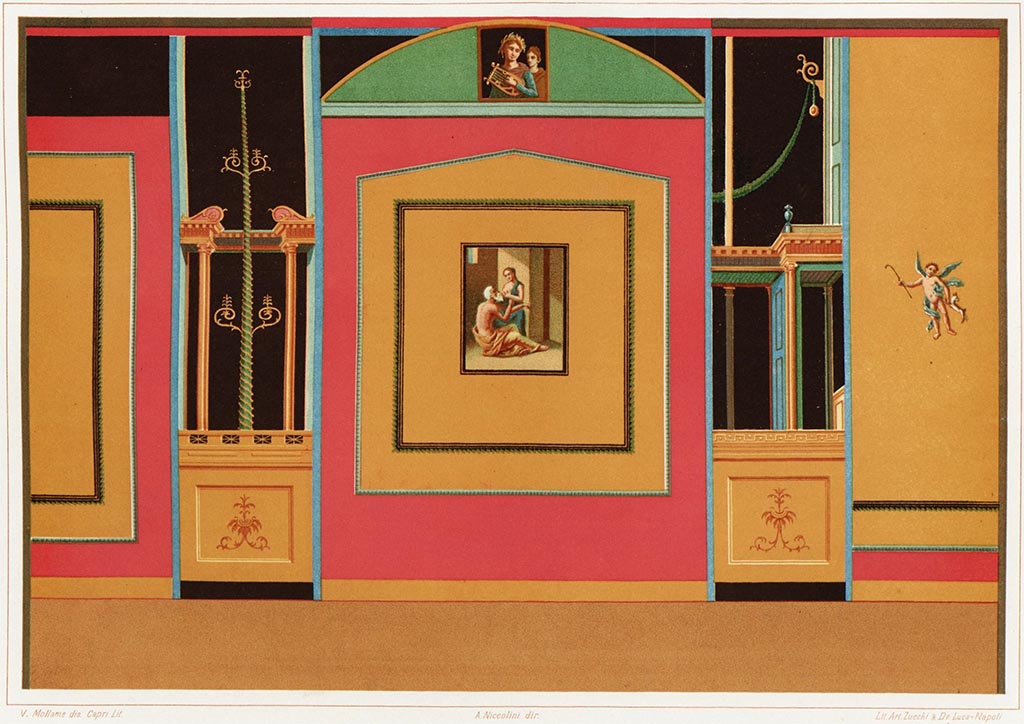
See Niccolini, F., 1890. Le Case ed i Monumenti
di Pompei: Book 3, (Tav. XXIX but shown as Tav. XXVIX.)
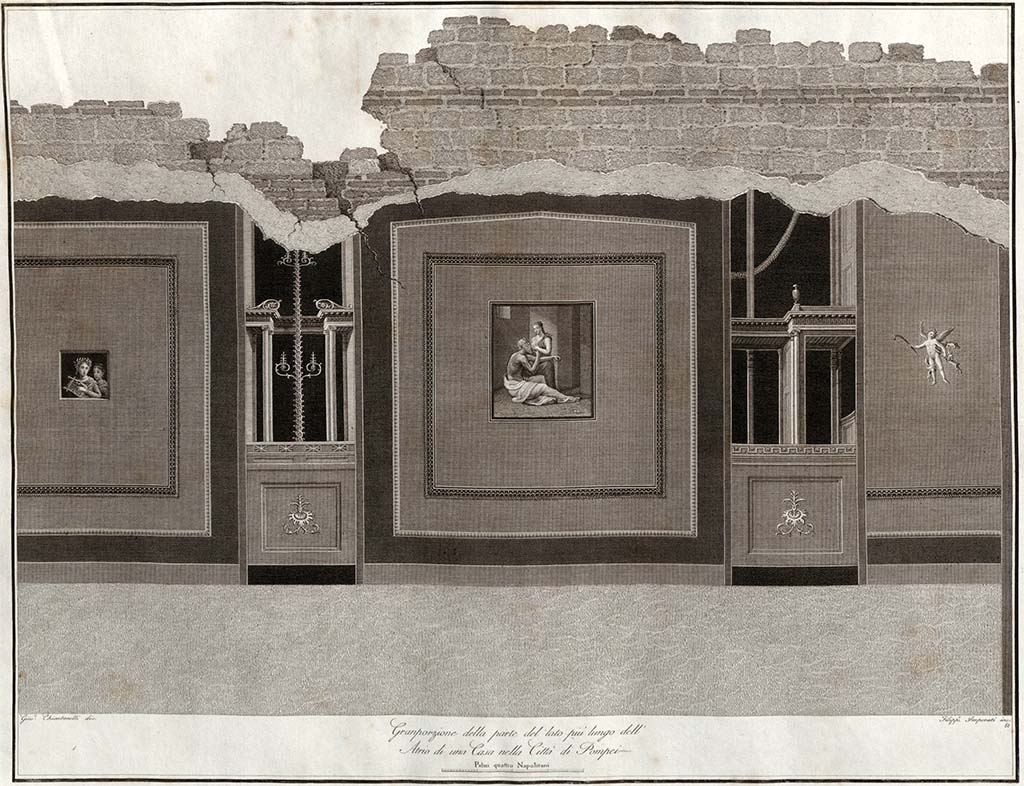
VII.4.10 Pompeii. 1838.
Painting by Giuseppe Chiantarelli of wall of a long wall of an atrium with the painting of Cimon and Pero in centre.
See Gli ornati delle pareti ed i pavimenti delle
stanze dell'antica Pompei incisi in rame: 1838, pl. 61.
(Note: This can
also be seen in Gli ornati delle pareti
ed i pavimenti delle stanze dell'antica Pompei incisi in rame: 1796,
no.3).
According to Helbig 1868 p. 307 no. 1376 -
“Careli in the Relazione dei lavori dell' acc. ercol. eseguiti nell' a. 1829 p. 26 claimed that at the time he read this report there were two paintings in Naples which depicted Cimon being suckled by Pero. He described one as coming from Pompeii, the other from Herculaneum.
As far as my research has gone, I have only been able to find one painting in the museum that supposedly came from Pompeii and depicted this scene.
It is the painting I listed under no. 1376. The painting found in the Casa di Bacco (XVIII) was in any case different from this painting, of which Fiorelli P. a. II p. 169 (11 Aug. 1826) says "pare rappresenti la Carità romana".
The picture No. 1376 was already known in 1796, in which the Ornati delle pareti di Pompei appeared, while the Casa di Bacco was only excavated in 1826. The ambiguous way in which the excavation report described the representation of the painting makes it probable that the painting in the Casa di Bacco was already considerably destroyed when it was discovered. Presumably it was left to perish on the spot, like the other paintings in this house.
I have been unable to find any trace of the Herculaneum painting mentioned by Carelli.”
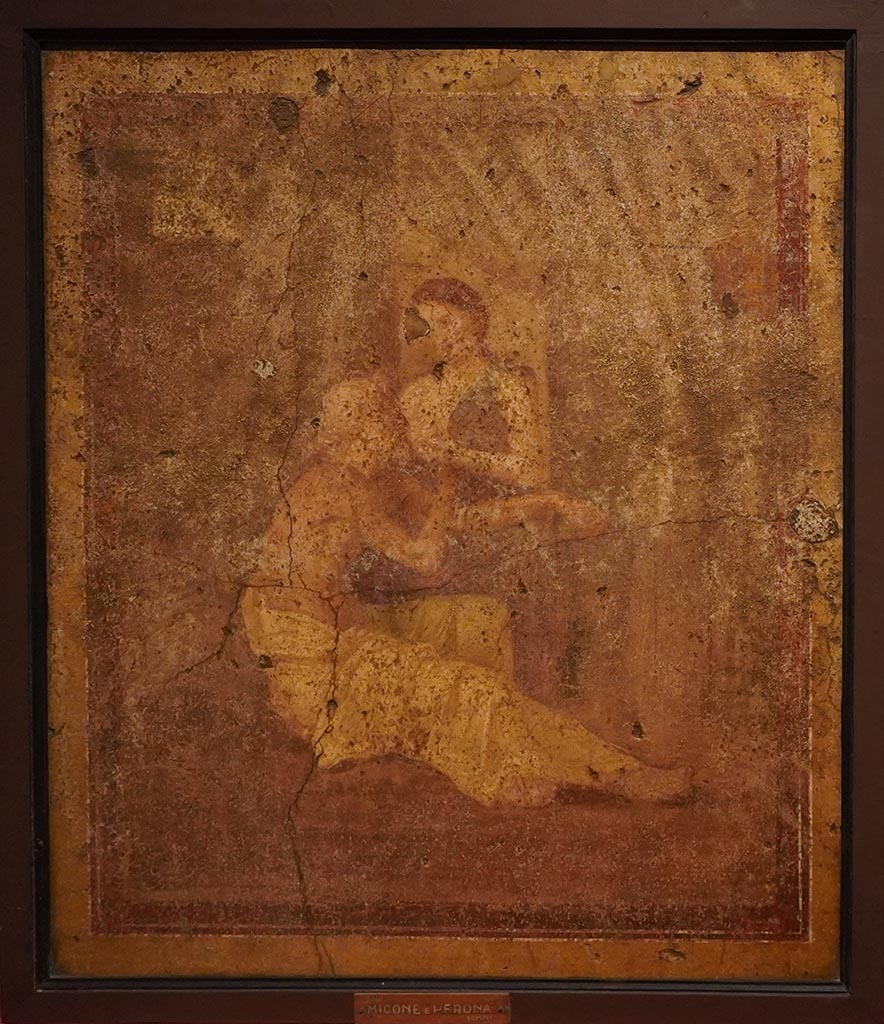
VII.4.10 Pompeii? Painting of Micone e Perona from Pompei, possibly this house.
Now in Naples Archaeological Museum. Inventory number unclear, possibly 9040.
Our thanks to Rachel Lowder for helping with this.
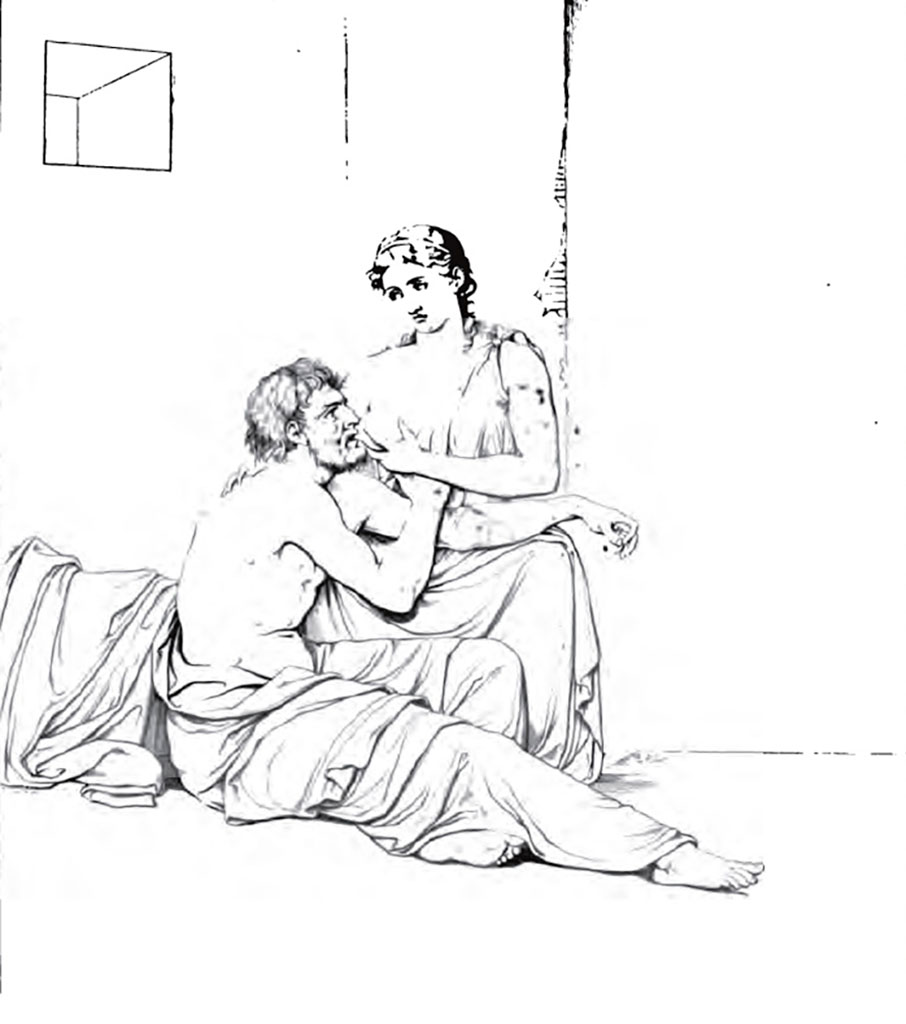
VII.4.10 Pompeii. 1824. Atrium. Drawing of original painting of Pero (or Perona) and Cimon (or Micone).
Pero is presenting her breast to her aged father Cimon, condemned to die of hunger in prison.
The Roman Charity (or Carità Romana) is the exemplary story of a daughter, Pero, who secretly breastfeeds her father, Cimon, after he is incarcerated and sentenced to death by starvation.
She is found out by a jailer, but her act of selflessness impresses officials and wins her father's release.
See Helbig, W.,
1868. Wandgemälde der vom Vesuv
verschütteten Städte Campaniens. Leipzig: Breitkopf und Härtel. (p. 307,
1376).
See Real Museo Borbonico, 1824, Volume I,
Table 5.
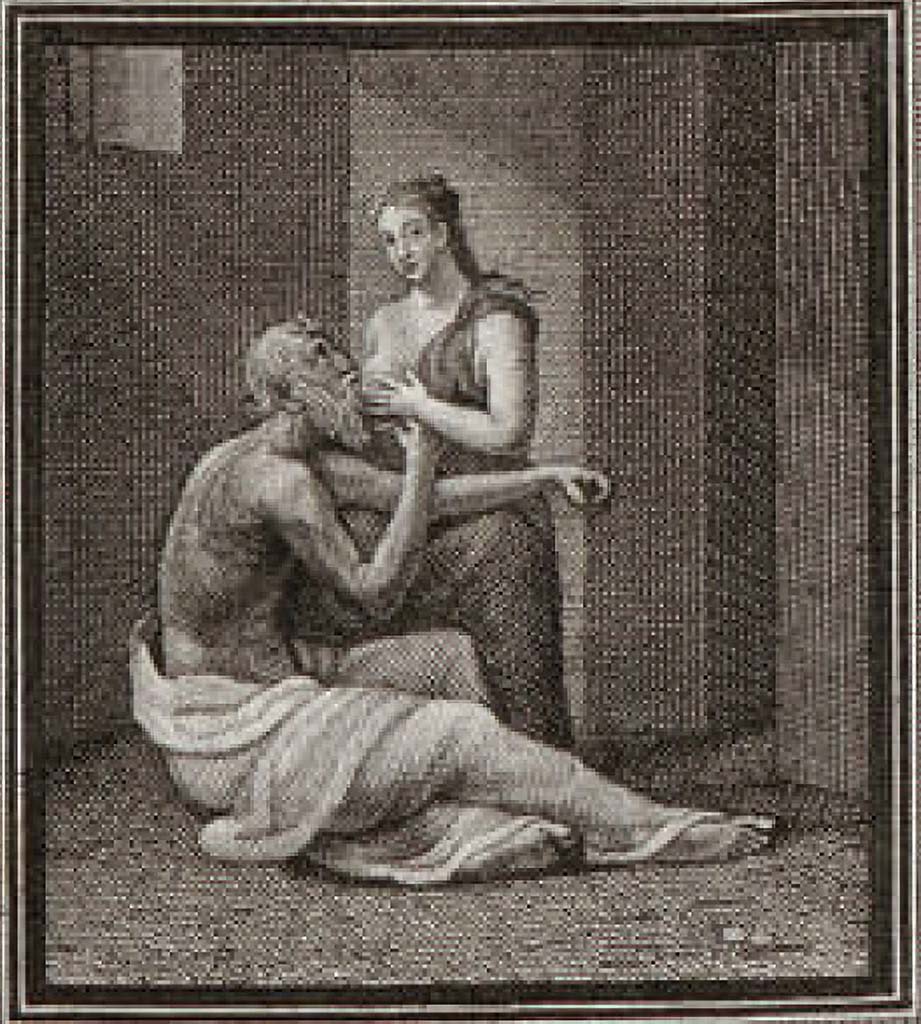
VII.4.10 Pompeii. 1838. Painting of Cimon and Pero in centre of atrium wall as outlined by Giuseppe Chiantarelli.
See Gli ornati delle pareti ed i pavimenti delle
stanze dell'antica Pompei incisi in rame: 1838, pl. 61.
![VII.4.10 Pompeii. c.1828. Drawing by Zahn from an unknown room.
According to Zahn this shows Bacchus and Ariadne with Akratus.
See Zahn W. Neu entdeckte Wandgemälde in Pompeji gezeichnet von W. Zahn [ca. 1828], taf. 35.
See Helbig, W., 1868. Wandgemälde der vom Vesuv verschütteten Städte Campaniens. Leipzig: Breitkopf und Härtel, (p.100, no.402)
Kuivalainen comments –
“A young Bacchus is depicted with Ariadne or a maenad, a boy, and statues, the larger being a bearded Bacchus. The divinity is depicted twice in two iconographic variations. Instead of a drinking panther there is now a boy, probably identifiable as Comus.” (Note 404).
(Note 404 says – Comus has no specific iconography but is depicted as a wreathed boy.)
See Kuivalainen, I., 2021. The Portrayal of Pompeian Bacchus. Commentationes Humanarum Litterarum 140. Helsinki: Finnish Society of Sciences and Letters, (p.126-7, D4).](7%2004%2010_files/image022.jpg)
VII.4.10 Pompeii. c.1828. Drawing by Zahn from an unknown room.
According to Zahn this shows Bacchus and Ariadne with Akratos.
See Zahn W. Neu
entdeckte Wandgemälde in Pompeji gezeichnet von W. Zahn [ca. 1828], taf. 35.
See Helbig, W.,
1868. Wandgemälde der vom Vesuv verschütteten Städte Campaniens. Leipzig:
Breitkopf und Härtel, (p.100, no.402)
Kuivalainen comments –
“A young Bacchus is depicted with Ariadne or a maenad, a boy, and statues, the larger being a bearded Bacchus. The divinity is depicted twice in two iconographic variations. Instead of a drinking panther there is now a boy, probably identifiable as Comus.” (Note 404).
(Note 404 says – Comus has no specific iconography but is depicted as a wreathed boy.)
See Kuivalainen, I., 2021. The Portrayal of Pompeian Bacchus. Commentationes Humanarum Litterarum 140. Helsinki: Finnish Society of Sciences and Letters, (p.126-7, D4).