VI.16.36
Pompeii. Casa di Q. Poppaeus Sabinus.
Linked to VI.16.37. Excavated 1904.
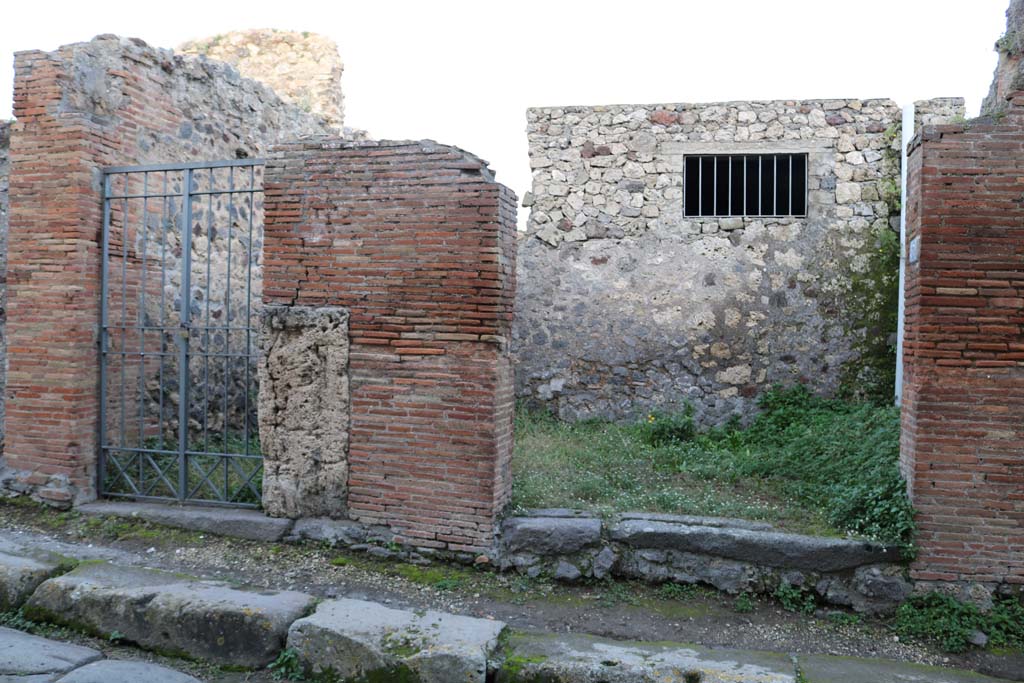
VI.16.36 Pompeii, on left. December 2018. Entrance doorways
on east side of Vicolo dei Vettii. Photo courtesy of Aude Durand.
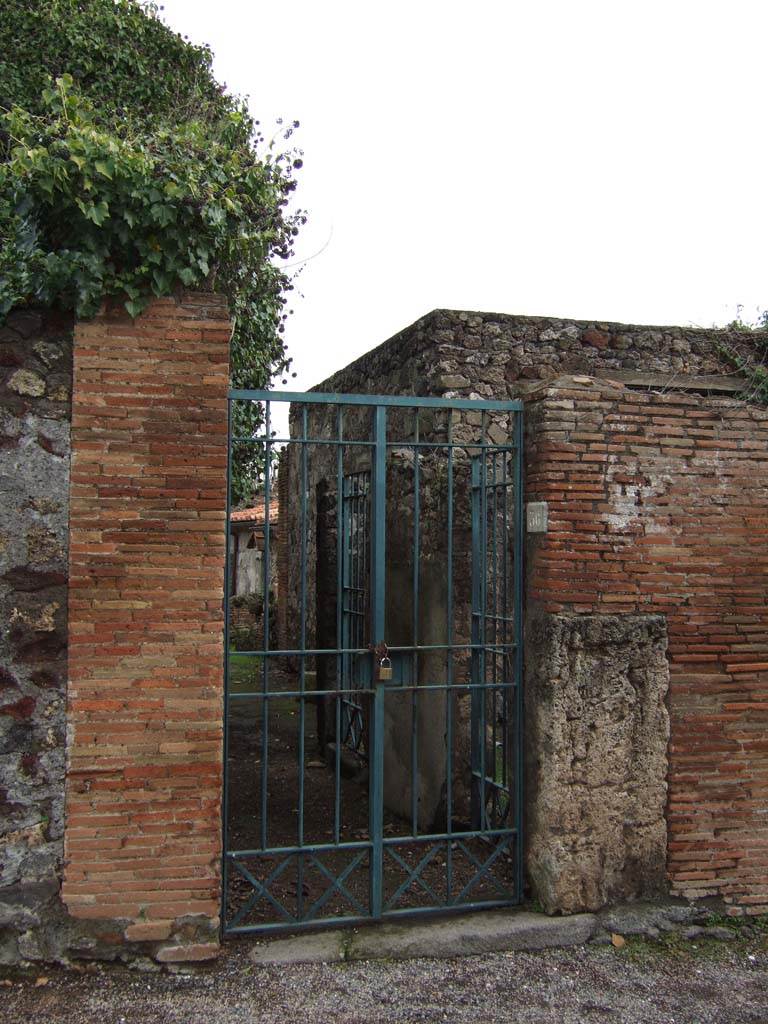
VI.16.36 Pompeii. December 2005. Entrance doorway.
According to NdS, this doorway was found with a lava threshold with holes for the door-frame and bolts.
Found here on 25th April 1904 was a bronze bell with iron clapper.
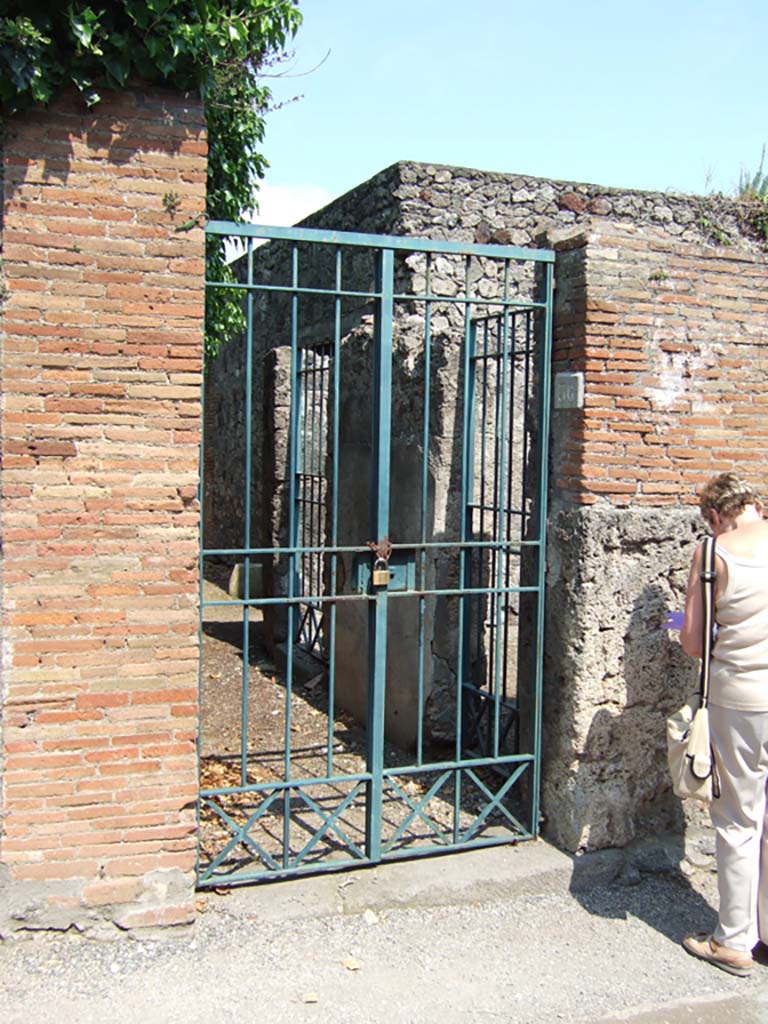
VI.16.36 Pompeii. May 2006.
Entrance doorway and south side of entrance corridor A, with two doorways linking to VI.16.37.
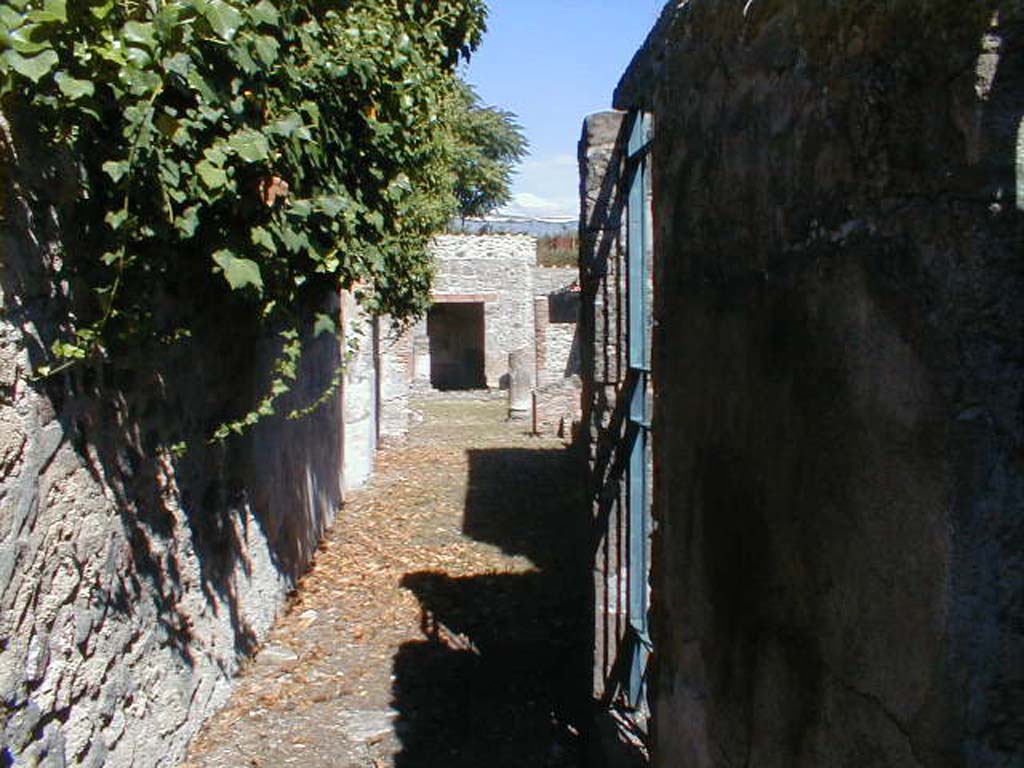
VI.16.36 Pompeii. September 2004. Looking east across the rustic fauces A, from entrance doorway.
Found on 2nd May 1904 in this corridor was an amphora with an epigraph written in black:
TT
CCCC
See Notizie degli Scavi di Antichità, 1908,
(p.363)
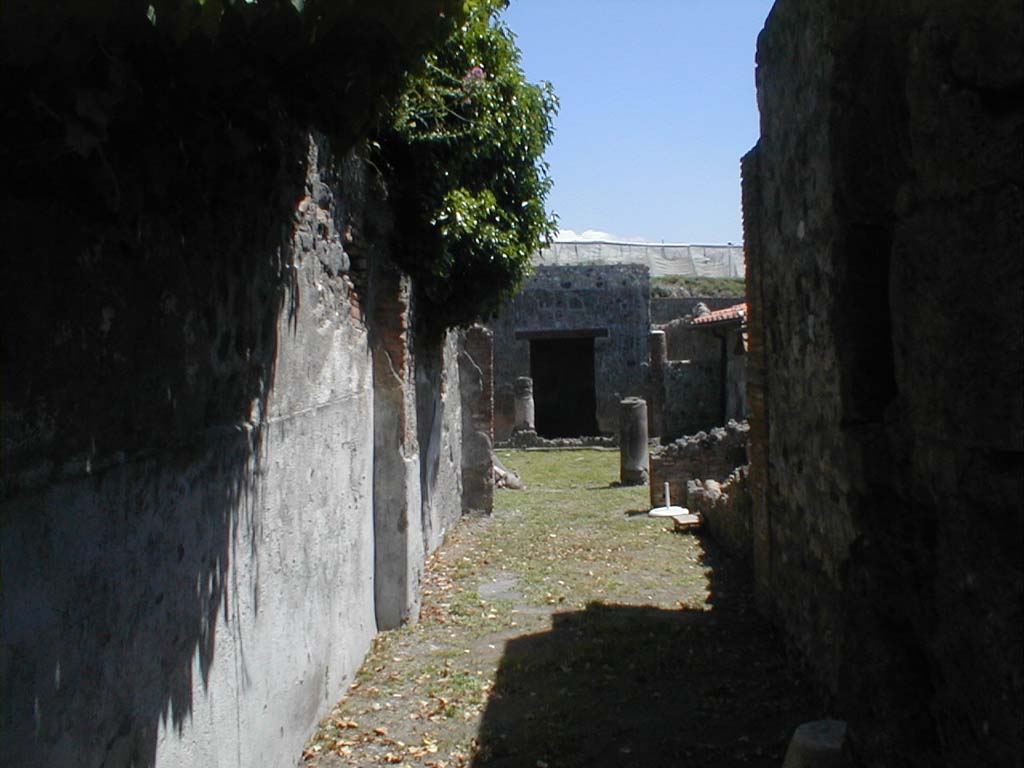
VI.16.36 Pompeii. May 2005. Looking east from entrance.
According to Garcia y Garcia, -
because of the night bombardment of 16 September 1943, this house suffered the destruction of the western ala of the portico and of 3 adjoining rooms.
This caused the loss of wall paintings in the IV style.
At the moment of Garcia’s control for the RICA maps in January 1983, the house was in the course of restoration.
See Garcia y
Garcia, L., 2006. Danni di guerra a Pompei. Rome: L’Erma di Bretschneider. (p.96).
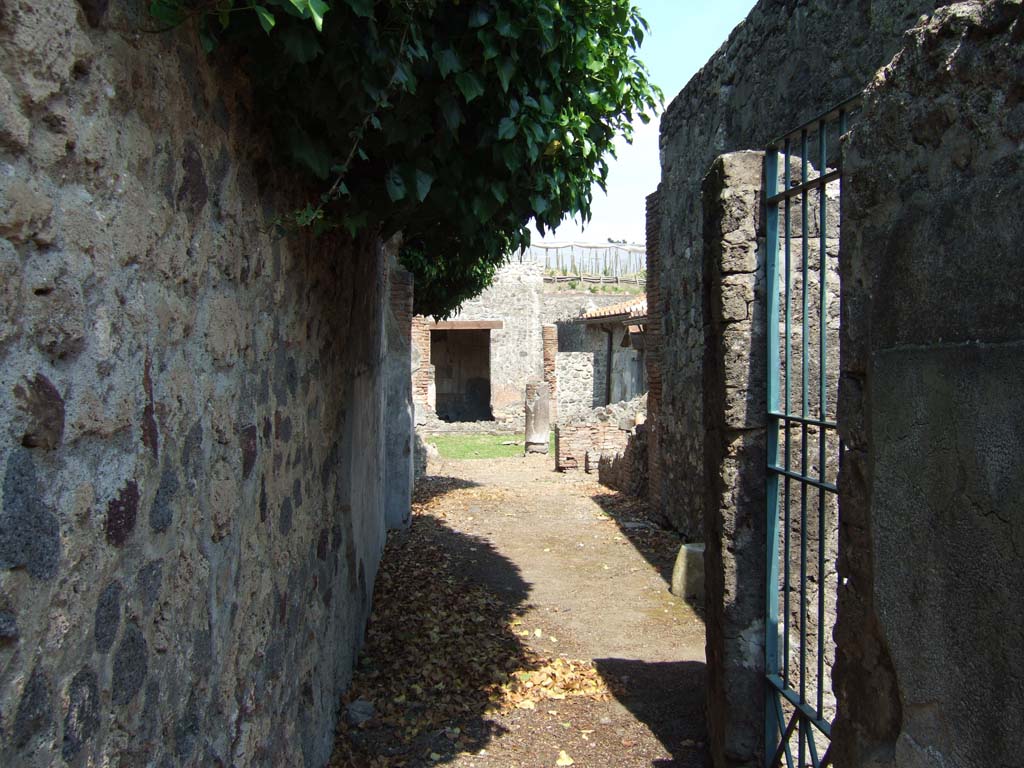
VI.16.36 Pompeii. May 2006. Looking east from entrance corridor A.
On the right of the entrance corridor A is the doorway leading to corridor (a) in shop B.
On the east side of this doorway, corridor A widens into room C and room D, ahead.
On the south side of these two rooms would be room E, behind the doorway to corridor (a), and at the far end of the photo on the right, the low walls of room F can be seen.
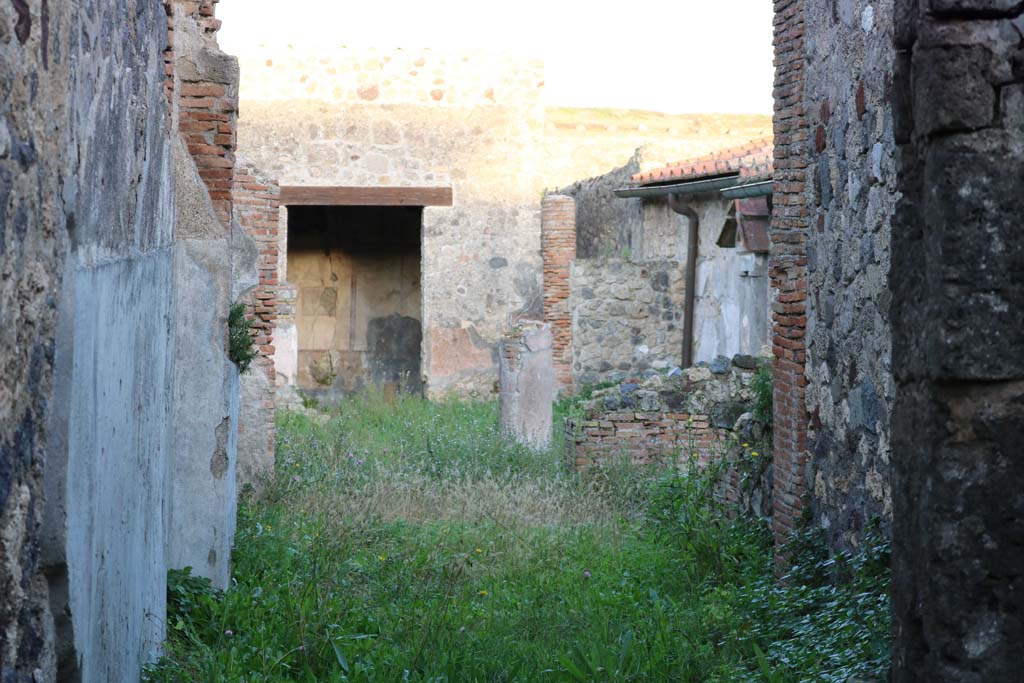
VI.16.36 Pompeii. December 2018.
Looking east towards
peristyle G, and doorway to triclinium H on its east side, centre left. Photo courtesy of Aude Durand.
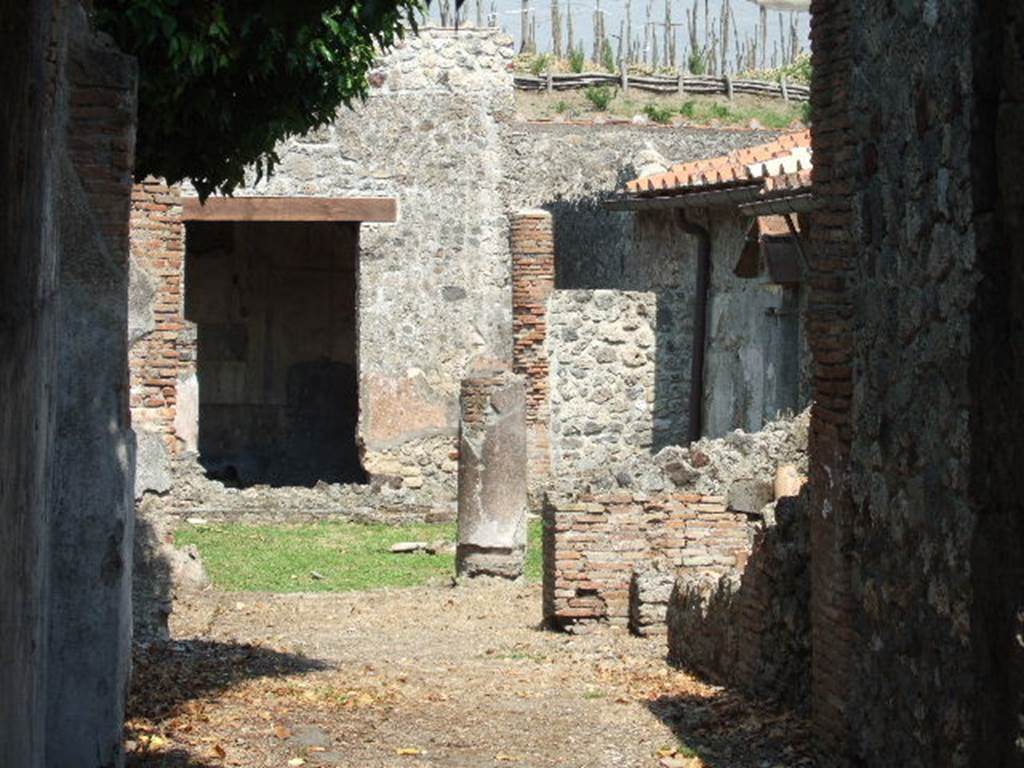
VI.16.36 Pompeii. December 2007. Looking east towards peristyle G, and doorway to triclinium H on its east side, on left.
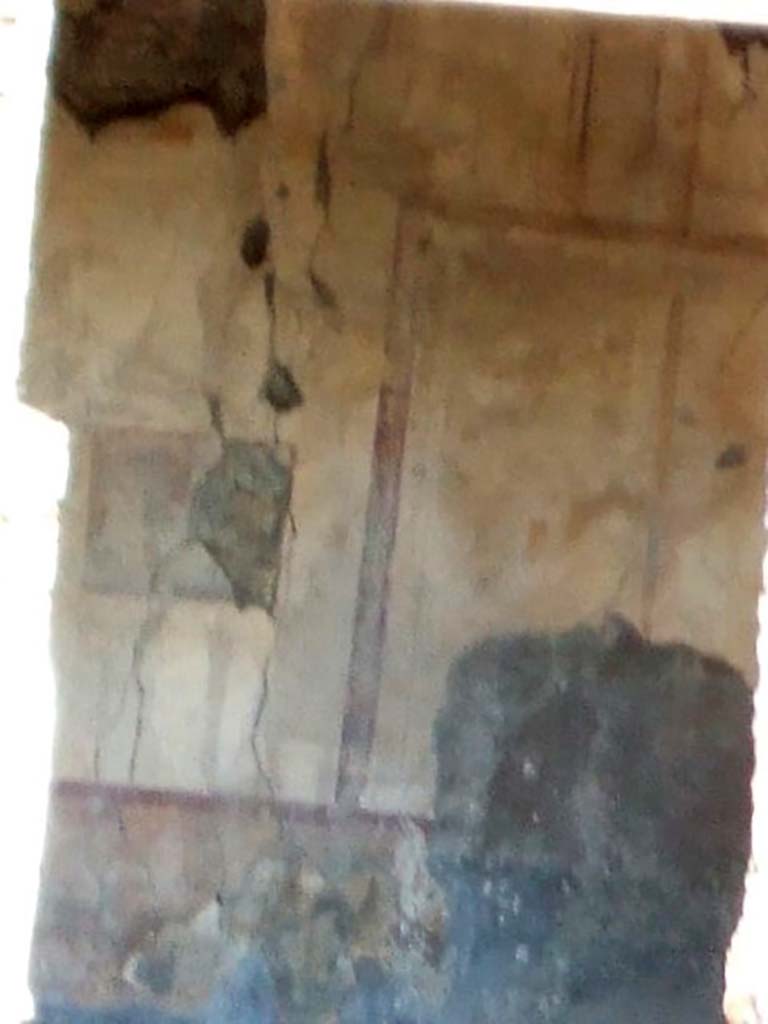
VI.16.36 Pompeii. December 2007. East wall of triclinium H.
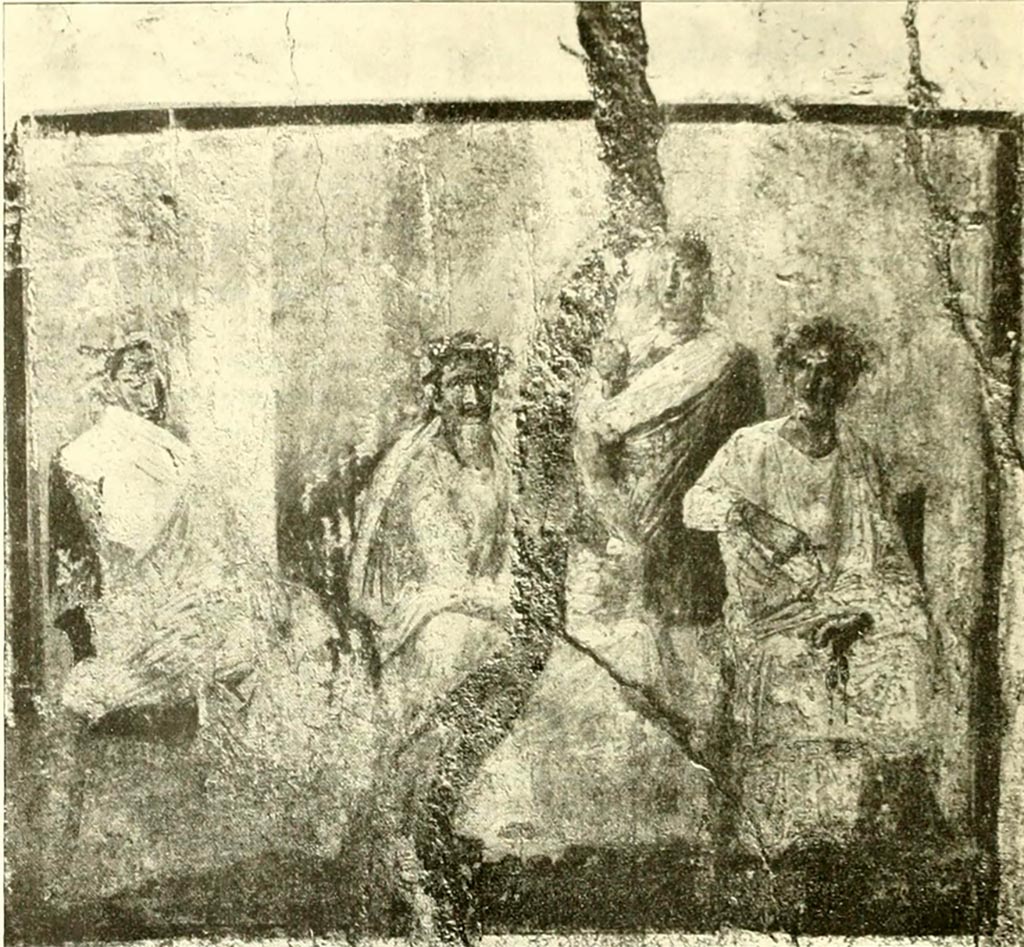
VI.16.36 Pompeii. 1908 photograph of painting of a contest of four poets found in the triclinium H.
According to Sogliano this is undoubtedly a poetic audition.
Of the four men, three are seated and one is standing and seems to be reciting.
According to Richardson, this is a painting of the contest of four poets.
See Richardson, L., 2000. A Catalog of Identifiable Figure Painters of Ancient Pompeii,
Herculaneum. Baltimore: John
Hopkins. (p.45).
See Notizie degli Scavi di Antichità, 1908,
p. 366, fig. 3.
VI.16.36 Pompeii.
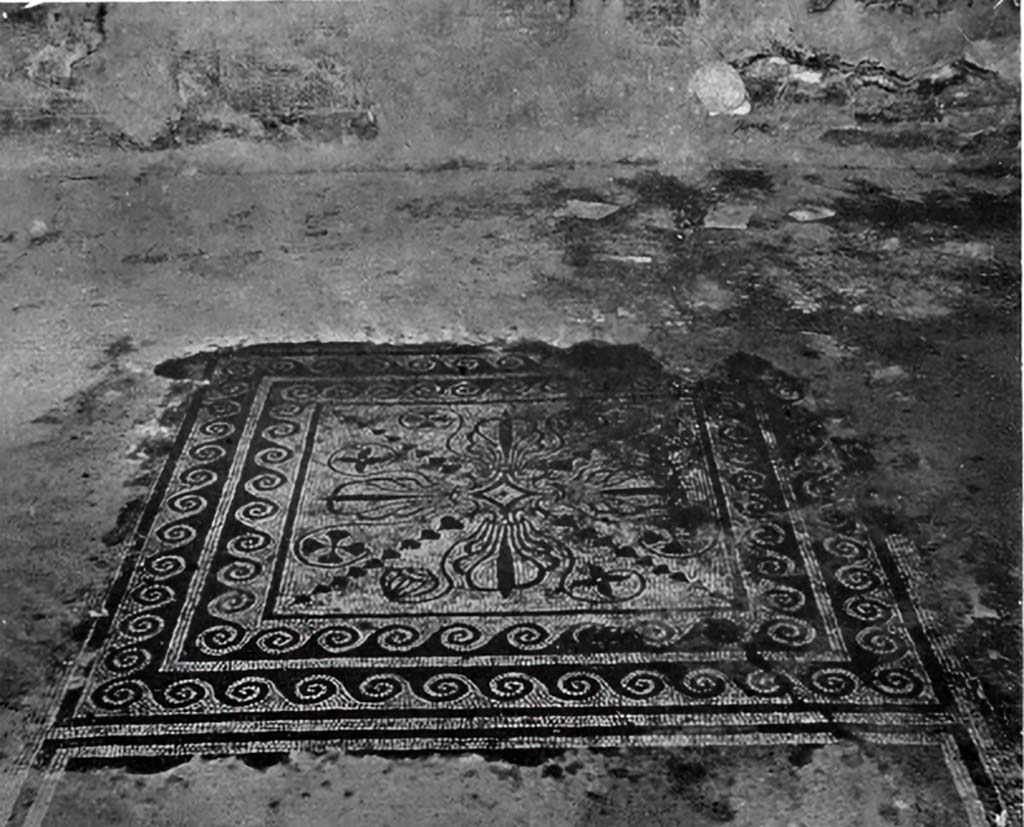
c.1930. Triclinium H, central emblema in flooring.
See Blake, M., (1930). The pavements of the Roman Buildings of the Republic and Early Empire. Rome, MAAR, 8, (p. 90, 114 & Pl.34, tav.3).
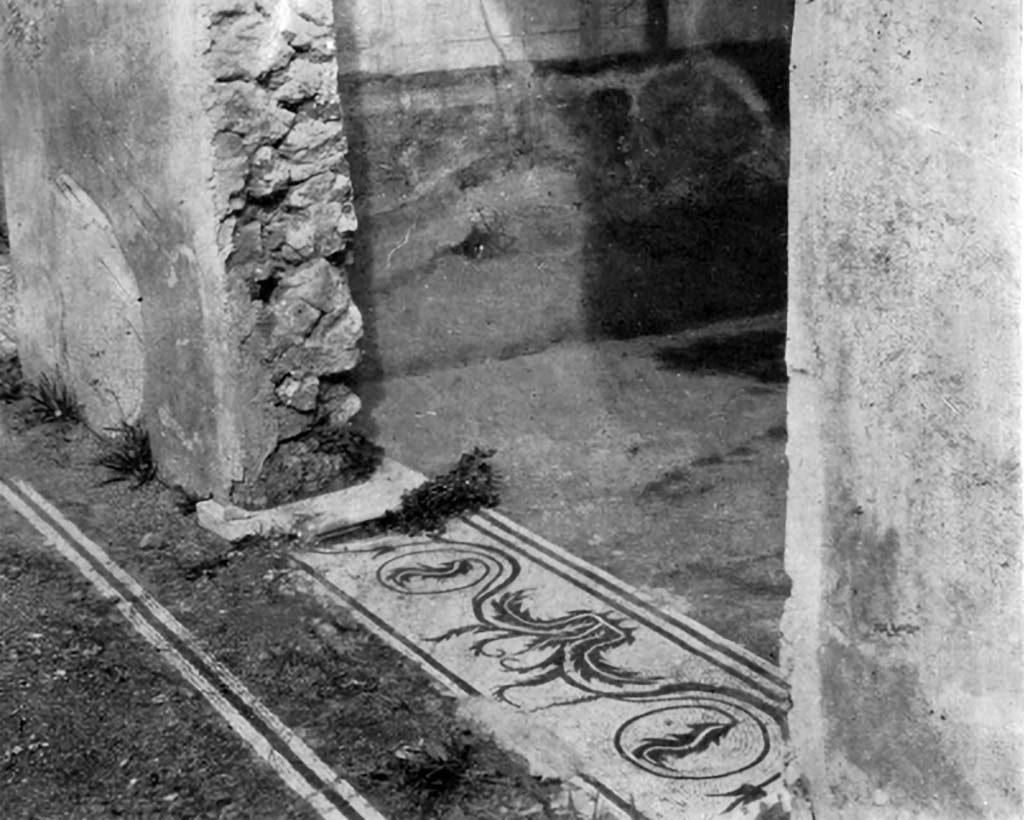
VI.16.36 Pompeii. c.1930. Triclinium H, looking north across
threshold of doorway with a black and white mosaic.
See Blake, M., (1930). The pavements of the Roman Buildings of the Republic and Early Empire. Rome, MAAR, 8, (p.90, & Pl.34,
tav.4).
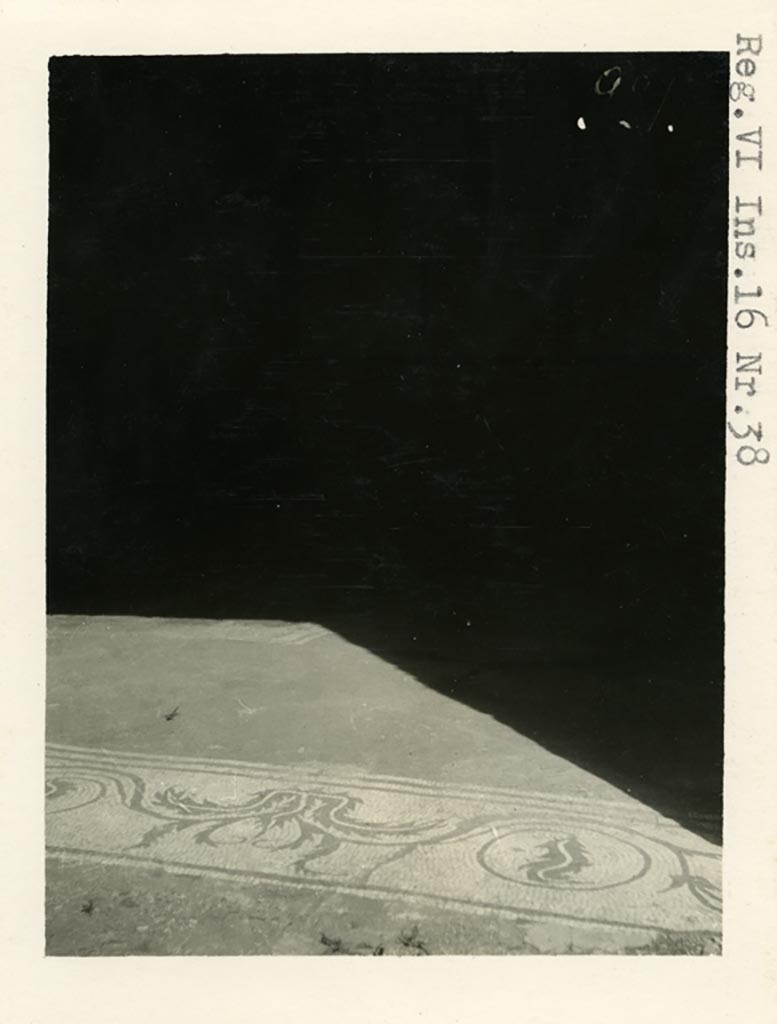
VI.16.36 Pompeii but shown as VI.16.38 on photo. Pre-1937-39. Triclinium H, threshold.
Photo courtesy of American Academy in Rome, Photographic Archive. Warsher collection no. 921.
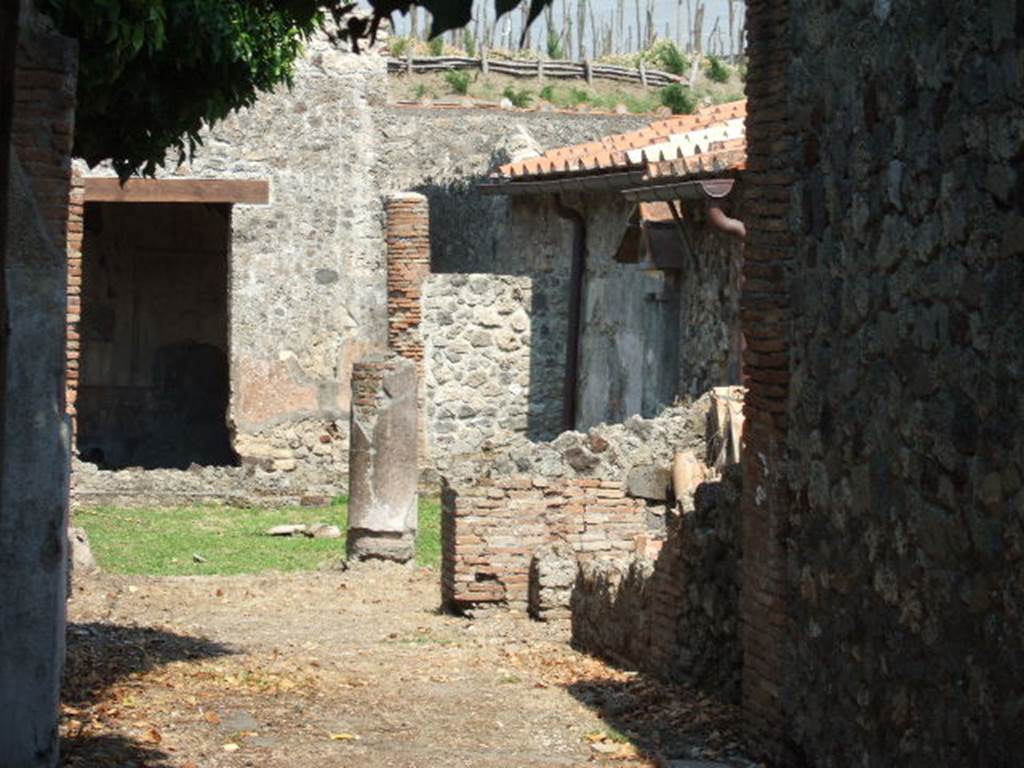
VI.16.36 Pompeii. December 2007. Looking south-east towards peristyle G.
According to Jashemski, the garden toward the rear of the house, was enclosed on the east, north and west by a portico supported by nine columns, including the two columns which are partly walled in, at the south end of the east and west walls.
The columns were connected by a low masonry wall, with a space in the top for plantings.
This wall, which was very low on the west, formed a step to permit entrance to the garden.
The low wall was interrupted on the south end of the east side by the mouth of the cistern.
There was a gutter at the edge of the garden on the east, north and west.
Standing against the south wall of the garden was an aedicula shrine.
In front of the aedicula was a rectangular white marble table (0.75m high) with a travertine support.
See Sogliano, Notizie degli Scavi di Antichità, 1908,
pp. 364 and fig 1 (plan) on p.360.
See Jashemski, W. F., 1993. The Gardens of Pompeii, Volume II: Appendices. New York: Caratzas. (p.164).
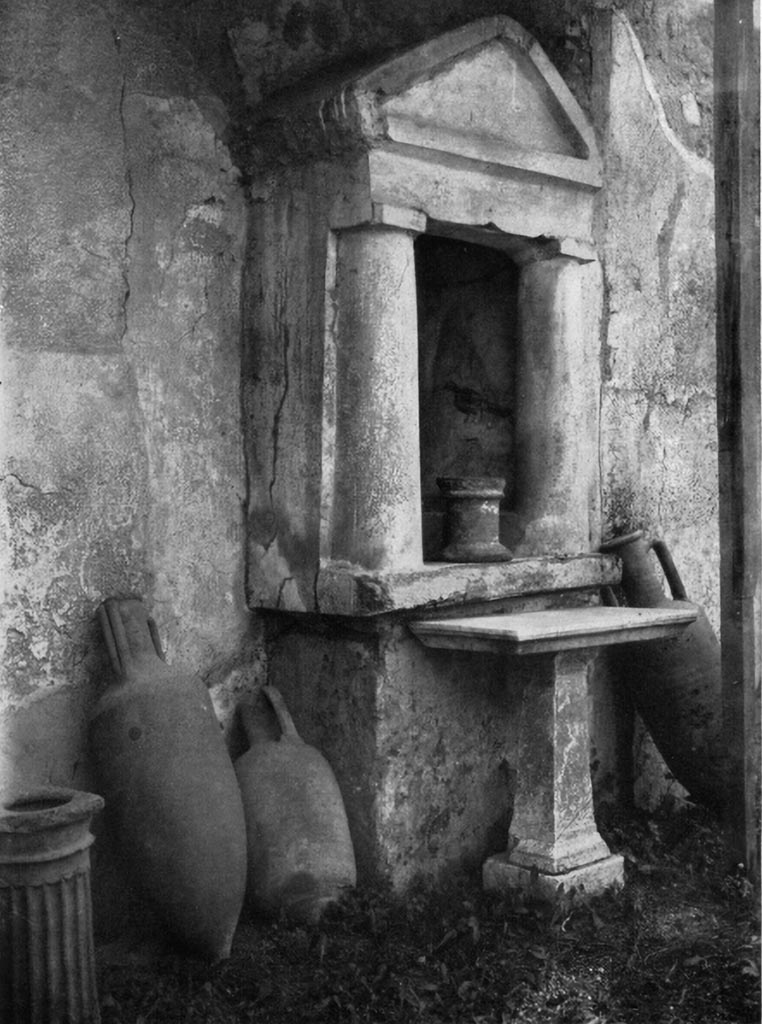
VI.16.36 Pompeii. Photo by Tatiana Warscher (c.1930s). Lararium (b) on south wall of peristyle.
According to Boyce, against the south wall of the peristyle stood an aedicula of unusually heavy proportions.
Above a rectangular podium and before a rectangular niche cut into the walls, stood two thick and heavy columns.
The inside walls of the niche were coated with white stucco and upon each painted a large bird holding something in its beak.
Above them were garlands.
On the ground in front of the aedicula stood a table of white marble with travertine support.
Within the shrine were found two large terracotta lamps.
See Boyce G. K., 1937. Corpus of the Lararia of Pompeii. Rome: MAAR 14. (P.59, no.229, and Pl.33,2).
See Fröhlich, T., 1991. Lararien und Fassadenbilder in den Vesuvstädten. Mainz: von Zabern. (L76, Picture 39,3, painting in niche very faded).
See Giacobello,
F., 2008. Larari Pompeiani: Iconografia e
culto dei Lari in ambito domestico. Milano: LED Edizioni. (p.278).
See Notizie degli Scavi di Antichità, 1908, p. 364. (Note that Boyce quotes p.264 in error).
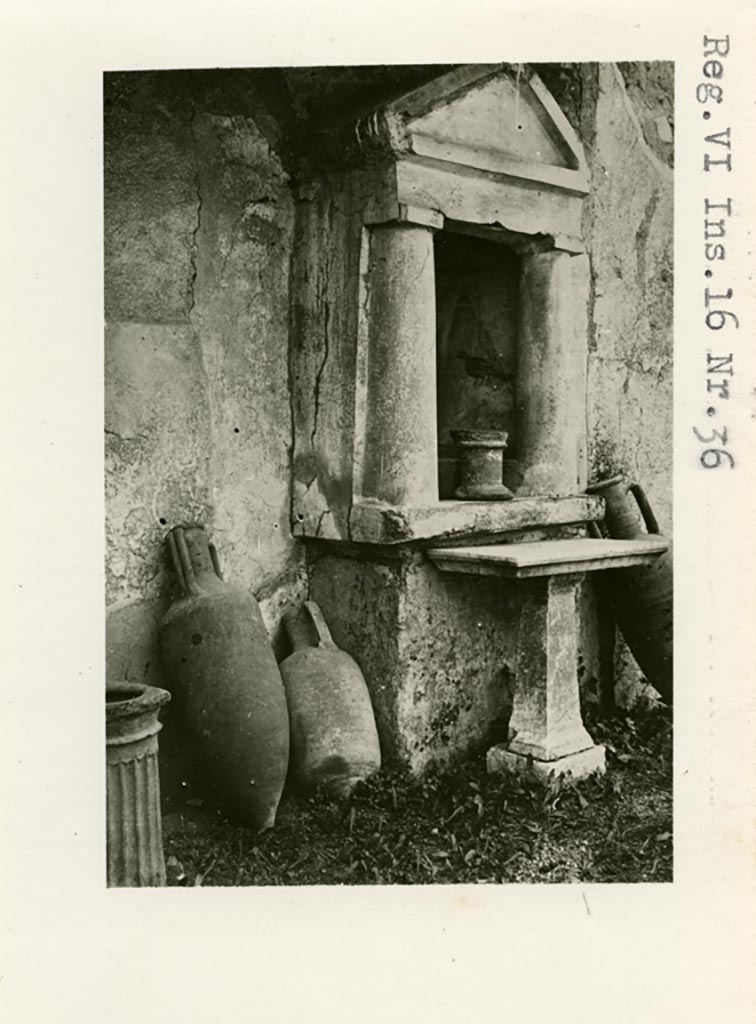
VI.16.36 Pompeii. Pre-1937-39. Lararium (b) on south wall of peristyle.
Photo courtesy of American Academy in Rome, Photographic Archive. Warsher collection no. 963.
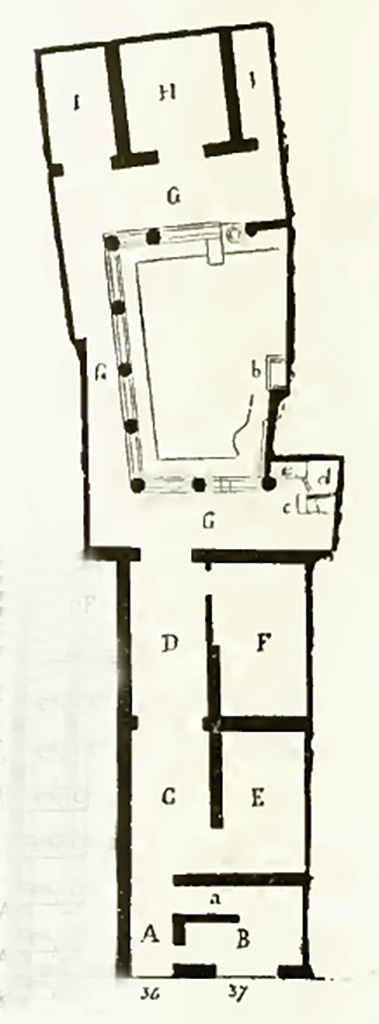
VI.16.36 Pompeii.
1908 NdS excavation plan.
See Notizie degli Scavi di Antichità, 1908,
p. 360, fig. 1.
Room A was the entrance fauces or corridor, with doorway to room B, on its south side.
Room B was a shop (VI.16.37) entered from a doorway on the right of the fauces A and through a corridor (a).
Rooms C and D were straight ahead from the entrance corridor and were separated by two pilasters.
The north wall of the rooms C and D had a high dado (laterizio) and was faced with white plaster above.
The opposite wall, the south wall, was only preserved on the lower part, but contained two doorways to rooms E and F.
Rooms E and F were rustic rooms and had the usual high dado (laterizio) in the walls.
Immediately to the right of the doorway into room F was seen part of a low hollow in the wall, perhaps for the bed recess?
Peristyle G was entered from room D.
The peristyle had walls coated with rustic white plaster with a high dado of plaster (intonaco laterizio).
The pretty flooring was of Opus signinum.
The aedicula lararium (b) was found against the south wall of the peristyle.
At the extreme right of the west portico were three masonry steps (c) the beginning of the stairs that led to the upper floor.
Also found here was a sloping floor (e) to the south which was embedded with pieces of tiles and with a border of roof tiles.
A tub (d) (fusorium) no doubt collected the water that flowed from the sloping floor.
Room H was positioned in the centre of the east wall.
On both sides of the doorway, in the floor, were two supports, one marble, the other travertine, providing support for the doorframe, jambs and hinges.
The threshold was a beautiful mosaic. In black on a white background were a group of leaves from which extended two scrolls.
The room was almost square and was noted above all else for its beautiful mosaic floor, which revealed its use as a triclinium.
The centre square of the mosaic, in black on a white background, showed pretty floral motifs framed by a double row of linked motifs.
While the part in front of the square offered a black mosaic without any ornament at all, the rear part and the sides of the same square had a simple cocciopesto.
It was clear that the square indicated the place of the table, and the cocciopesto that of the beds, and these combined with the paintings of the audition of the poets, and the banqueting scene, confirmed to Sogliano that this room was the triclinium.
The walls were on a white background except the dado which was black with panels of various types and decorations.
Each of the walls was divided into five panels in the main part, of which the central panel had a rectangular frame, and each of the side panels had a garland.
The frieze, hardly preserved, had a white background.
The painting on the east wall was described as a contest of four poets (height 0.39m width 0.47m).
The painting on the north wall was badly damaged (height 0.41m width 0.44m) but showed a banqueting scene.
Of the painting on the south wall, unfortunately nothing remained other than the lower right corner.
Room I was noted for the beauty of its mosaic entrance threshold.
It showed a braid placed lengthways, on white background and made with blue, white, red, green and black tesserae.
It revolved around a large meander, edged in black, and decorated inside with rows of black triangles, all on a white background.
The doorjambs were painted in yellow with a black plinth.
Near to the one on the left, in the threshold, was embedded a piece of grey marble with the imprint of an iron hinge.
The room had flooring of gravel and the preserved walls were divided into large yellow panels, two in the east wall, and three in each of the side walls.
The panels were separated by broad black bands, showing one of the usual candelabra, yellow with floral motif.
A flying figure was preserved in its entirety, to the left of the south wall.
The only paintings preserved from the centre of the panels were two to the left of the same south wall.
The first was of a swan, the second a sphinx, both flying to the right.
Room J was in the form of a narrow corridor but was an apotheca, as evidenced by the traces of shelving.
See Notizie degli Scavi di Antichità, 1908,
(p.363-368)
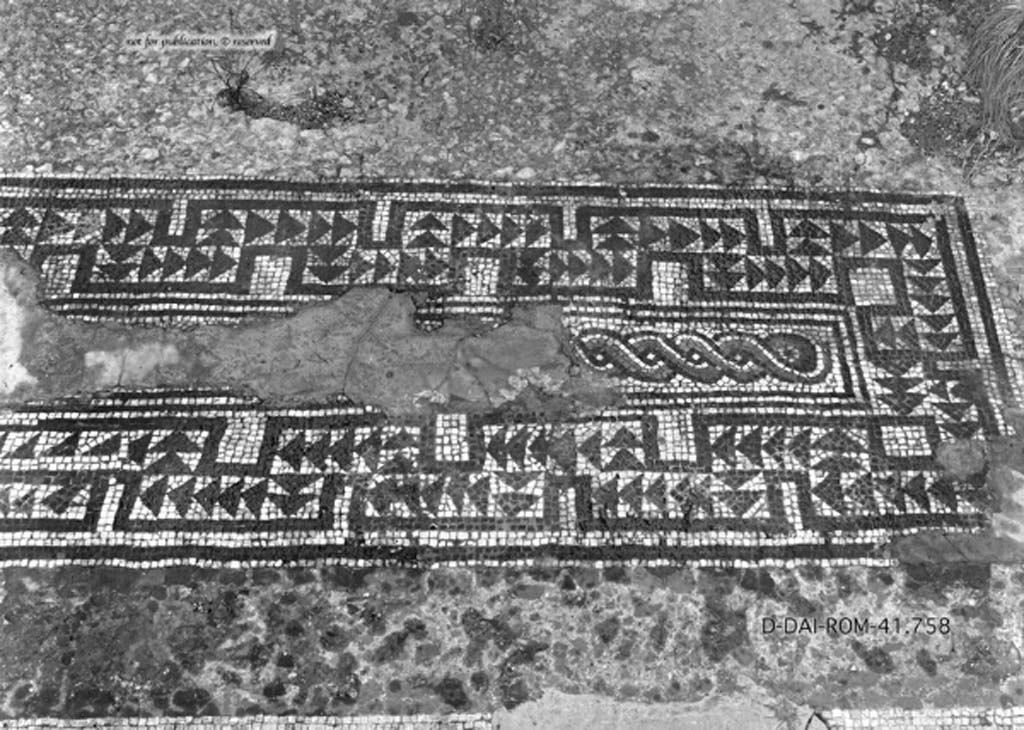
VI.16.36/37
Pompeii. c.1930. Room I, cubiculum. Mosaic
entrance threshold of cubiculum, as described in NdS, above.
DAIR
41.758. Photo © Deutsches Archäologisches Institut, Abteilung Rom, Arkiv.
See Pernice, E.
1938. Pavimente und Figürliche Mosaiken: Die Hellenistische Kunst in
Pompeji, Band VI. Berlin: de Gruyter, (taf. 46.3.)