VI.13.8 Pompeii. Rear entrance of VI.13.6. Excavated 1833, 1837, 1846, 1873.
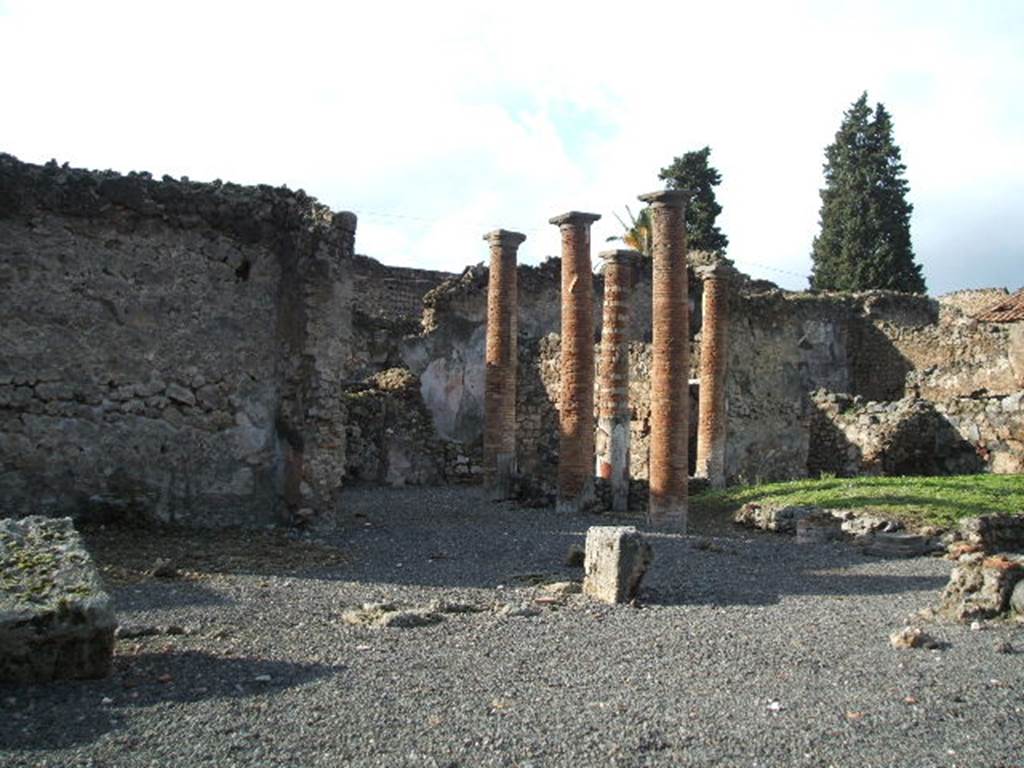
VI.13.8 Pompeii. December 2004. Looking towards west side of peristyle, from rear entrance of VI.13.6.
According to Della Corte, found in a cubicle to the left of the peristyle, was the famous graffito:
Semper M(arcu’)
Terentius Eudoxsus usus (supstenet) amicos
Et tenet et
tutat, supstenet omne modu [CIL IV
4456]
According to Epigraphik-Datenbank Clauss/Slaby (See www.manfredclauss.de), it read –
Semper M(arcus)
Terentius Eudoxsus unus amicos
et tenet et tutat
su{p}stenet omne(m) modu(m) [CIL IV
4456]
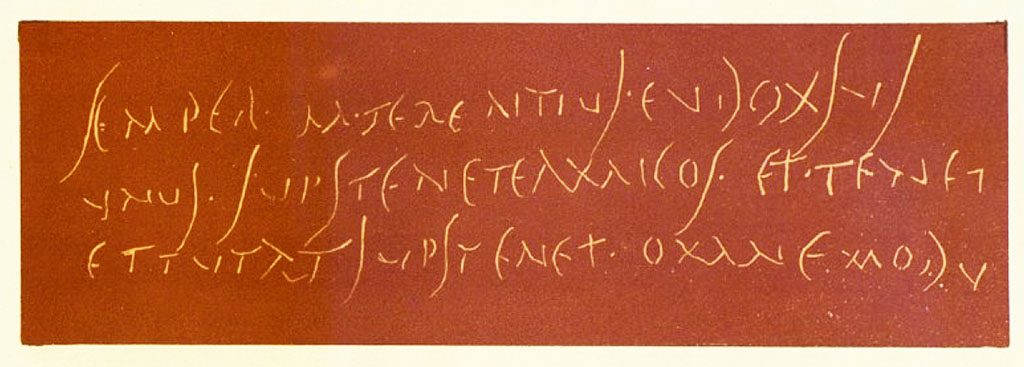
VI.13.6 Pompeii. 1874. Cubicle to the left of the peristyle. Drawing of graffito as published by Presuhn.
See Presuhn, E. Pompei les dernières fouilles de 1874-75 ,
La Troisième Ile pl. III.
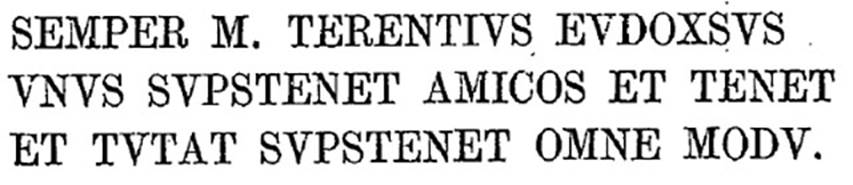
VI.13.6 Pompeii. 1874. Cubicle to the left of the peristyle. Text of graffito as published by Presuhn.
SEMPER M. TERENTIVS EVDOXSVS
VSVS SVPSTENET AMICOS ET TENET
ET TVTAT SVPSTENET
OMNE MODV
See Presuhn, E. Pompei les dernières fouilles de 1874-75 , La Troisième Ile pl. III.
According to Berry, this translated as –
Only Marcus Terentius Eudoxsus always supports his friends - he keeps them and protects them and supports them in every way. [CIL IV 4456]
See Berry, J., 2007. The Complete Pompeii. London, Thames & Hudson, (p.103).
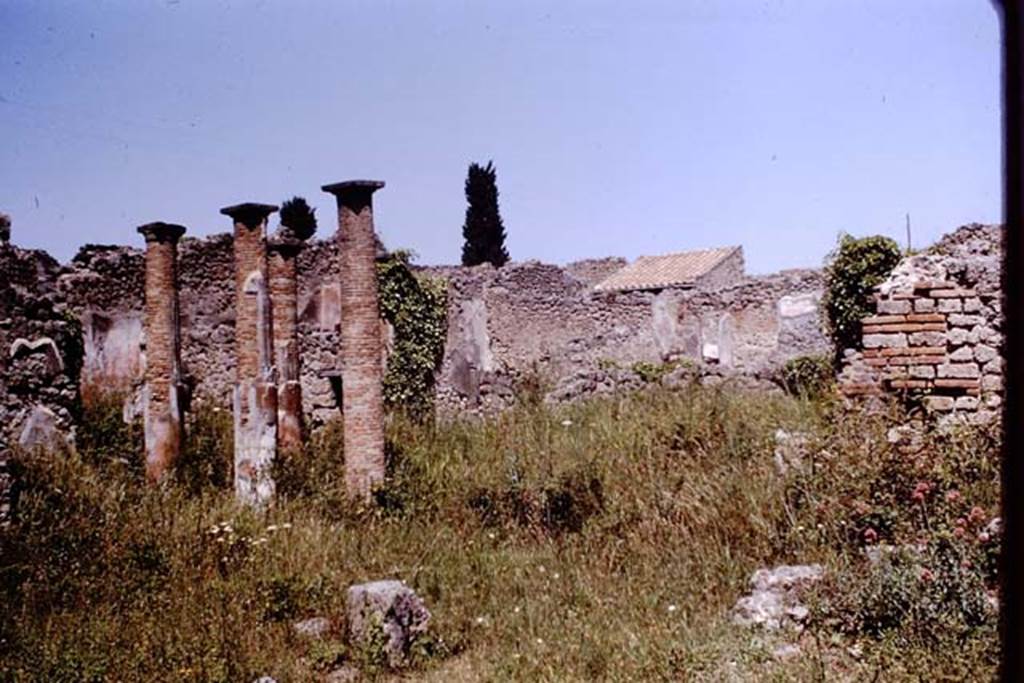
VI.13.6/8/9 Pompeii. 1964. Looking north-west across peristyle area. Photo by Stanley A. Jashemski.
Source: The Wilhelmina and Stanley A. Jashemski archive in the University of Maryland Library, Special Collections (See collection page) and made available under the Creative Commons Attribution-Non Commercial License v.4. See Licence and use details.
J64f1090
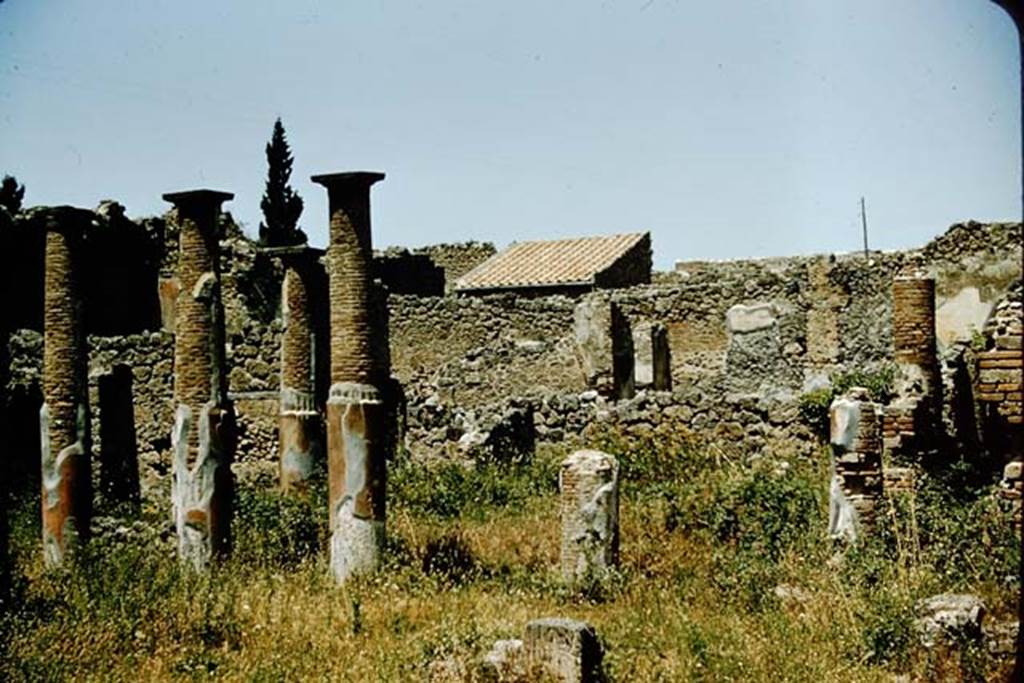
VI.13.6/8/9 Pompeii. 1957. Looking north-west across peristyle. Photo by Stanley A. Jashemski.
Source: The Wilhelmina and Stanley A. Jashemski archive in the University of Maryland Library, Special Collections (See collection page) and made available under the Creative Commons Attribution-Non Commercial License v.4. See Licence and use details.
J57f0036
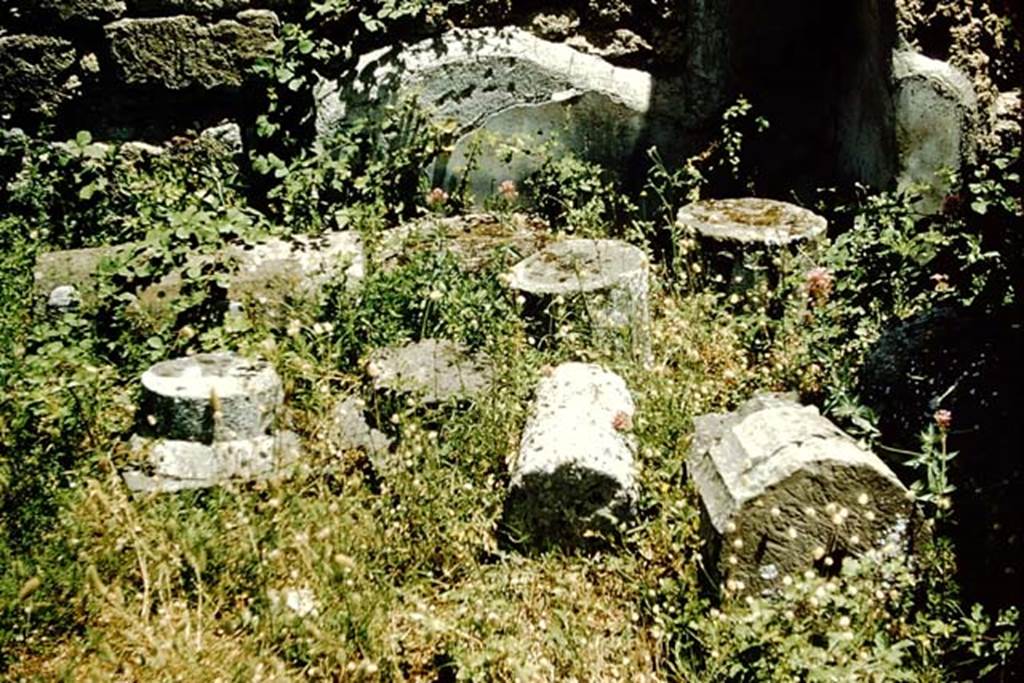
VI.13.6/8/9 Pompeii. 1957. Broken columns in peristyle area. Photo by Stanley A. Jashemski.
Source: The Wilhelmina and Stanley A. Jashemski archive in the University of Maryland Library, Special Collections (See collection page) and made available under the Creative Commons Attribution-Non Commercial License v.4. See Licence and use details.
J57f0104.
![VI.13.8 Pompeii. December 2004. Looking south-west from rear entrance, towards atrium. According to Garcia y Garcia, in 1943 a bomb destroyed the rear entrance. The three nearby rooms on the south-east side of the peristyle were destroyed as well as a good part of the east wall. See Garcia y Garcia, L., 2006. Danni di guerra a Pompei. Rome: L’Erma di Bretschneider. (p.86-87)
According to Della Corte, the peristyle was transformed into a weaving workshop, probably after the earthquake of 62AD. The workers took time to scratch their names in the portico. The names of seven men were found - Vesbius or Vesbius Tamudianus, Felix, Ephesus, Xanthus, Successus, Faustus, and Florus: The names of eleven women were found - Vitalis, Florentina, Amaryllis, Ianuaria, Heracla, Maria, Lalage, Damalis, ….rusa, .a., Baptis, and Doris. Della Corte noted that two of the names were Jewish – that of Maria, and Vesbius Tamudianus.
See Della Corte, M., 1965. Case ed Abitanti di Pompei. Napoli: Fausto Fiorentino. (p.121) [CIL IV (1493-1509]
According to Epigraphik-Datenbank Clauss/Slaby (See www.manfredclauss.de), these read as –
Vesbius Tamudianus [CIL IV 1493]
Pottttas
X [CIL IV 1494]
Vesbius [CIL IV 1495]
Quibusos [CIL IV 1496]
Felix [CIL IV 1497]
Felix [CIL IV 1498]
Nero Poppaeeses istis [CIL IV 1499]
Cum [CIL IV 1500]
Vibius [CIL IV 1501]
Mamoe [CIL IV 1502]
Ephesus
Fututor [CIL IV 1503]
Felix [CIL IV 1504]
Xanthus [CIL IV 1505]
Successus [CIL IV 1506]
Maria pe(nsi) stamen [CIL IV 1507]
Nua[3]
Procu/lus hoc [CIL IV 1508]
Faustus Felix F[l]oru(s) [CIL IV 1509]](6%2013%2008_files/image014.jpg)
VI.13.8 Pompeii. December 2004. Looking south-west from rear entrance, towards atrium.
According to Garcia y Garcia, in 1943 a bomb destroyed the rear entrance.
The three nearby rooms on the south-east side of the peristyle were destroyed as well as a good part of the east wall.
See Garcia y
Garcia, L., 2006. Danni di guerra a Pompei. Rome: L’Erma di Bretschneider. (p.86-87)
According to Della Corte, the peristyle was transformed into a weaving workshop, probably after the earthquake of 62AD.
The workers took time to scratch their names in the portico.
The names of seven men were found - Vesbius or Vesbius Tamudianus, Felix, Ephesus, Xanthus, Successus, Faustus, and Florus:
The names of eleven women were found - Vitalis, Florentina, Amaryllis, Ianuaria, Heracla, Maria, Lalage, Damalis, ….rusa, .a., Baptis, and Doris.
Della Corte noted that two of the names were Jewish – that of Maria, and Vesbius Tamudianus.
See Della Corte,
M., 1965. Case ed Abitanti di Pompei.
Napoli: Fausto Fiorentino. (p.121) [CIL IV (1493-1509]
According to Epigraphik-Datenbank Clauss/Slaby (See www.manfredclauss.de), these read as –
Vesbius
Tamudianus [CIL IV 1493]
Pottttas
X [CIL IV 1494]
Vesbius [CIL IV 1495]
Quibusos [CIL IV 1496]
Felix [CIL IV 1497]
Felix [CIL IV 1498]
Nero Poppaeeses
istis [CIL IV 1499]
Cum [CIL IV 1500]
Vibius [CIL IV 1501]
Mamoe [CIL IV 1502]
Ephesus
Fututor [CIL IV 1503]
Felix [CIL IV 1504]
Xanthus [CIL IV 1505]
Successus [CIL IV 1506]
Maria pe(nsi)
stamen [CIL IV 1507]
Nua[3]
Procu
lus hoc [CIL IV 1508]
Faustus Felix
F[l]oru(s) [CIL IV 1509]