V.4.c Pompeii. House of M. Samellius Modestus or Casa degli Ori.
Excavated 1902-3.
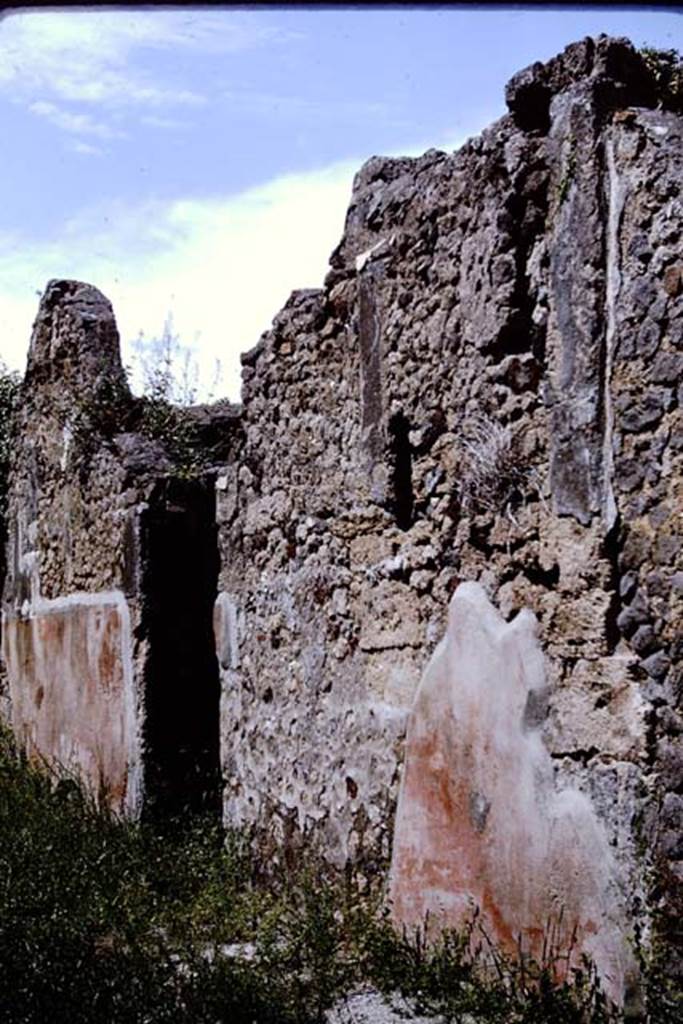
V.4.c Pompeii. 1964. Front street wall and entrance doorway with painted plaster, on the east side of Vicolo di Lucrezio Frontone.
Photo by Stanley A. Jashemski.
Source: The Wilhelmina and Stanley A. Jashemski archive in the University of Maryland Library, Special Collections (See collection page) and made available under the Creative Commons Attribution-Non Commercial License v.4. See Licence and use details.
J64f1227
![V.4.c Pompeii. March 2009. Entrance. According to Cooley, the following graffito was found here -
I beg you to elect Cn. Helvius Sabinus and M. Samellius Modestus aediles, worthy of public office. [CIL IV 6628] See Cooley, A. and M.G.L., 2004. Pompeii : A Sourcebook. London : Routledge. (p.124, F70) According to Epigraphik-Datenbank Clauss/Slaby (See www.manfredclauss.de) it read -
Cn(aeum) Helvium Sabinum et
M(arcum) Samellium Modestum aed(iles) d(ignos) r(ei) p(ublicae) o(ro) v(os) f(aciatis) [CIL IV 6628]
According to Della Corte, CIL IV 6627 was found on the north side (left) of the entrance. See Della Corte, M., 1965. Case ed Abitanti di Pompei. Napoli: Fausto Fiorentino. (p.109). According to Epigraphik-Datenbank Clauss/Slaby (See www.manfredclauss.de), it read -
M(arcum) Samellium Modestum, aed(ilem)
v(iis) a(edibus) s(acris) p(ublicis) p(rocurandis) d(ignum) r(ei) p(ublicae) Vicini rogant [CIL IV 6627]](5%2004%20c_files/image005.jpg)
V.4.c Pompeii. March 2009. Entrance doorway, looking east.
According to Cooley, the following graffito was found here -
I beg you to elect Cn. Helvius Sabinus and M. Samellius Modestus aediles, worthy of public office. [CIL IV 6628]
See Cooley, A. and M.G.L., 2004. Pompeii: A Sourcebook. London: Routledge. (p.124, F70)
According to Epigraphik-Datenbank Clauss/Slaby (See www.manfredclauss.de) it read -
Cn(aeum)
Helvium Sabinum et
M(arcum)
Samellium Modestum aed(iles) d(ignos) r(ei) p(ublicae) o(ro) v(os)
f(aciatis) [CIL IV 6628]
According to Della Corte, CIL IV 6627 was found on the north side (left) of the entrance.
See Della Corte, M., 1965. Case ed Abitanti di Pompei. Napoli: Fausto Fiorentino. (p.109)
According to Epigraphik-Datenbank Clauss/Slaby (See www.manfredclauss.de), it read -
M(arcum) Samellium
Modestum, aed(ilem)
v(iis) a(edibus)
s(acris) p(ublicis) p(rocurandis) d(ignum) r(ei) p(ublicae) Vicini rogant [CIL IV 6627]
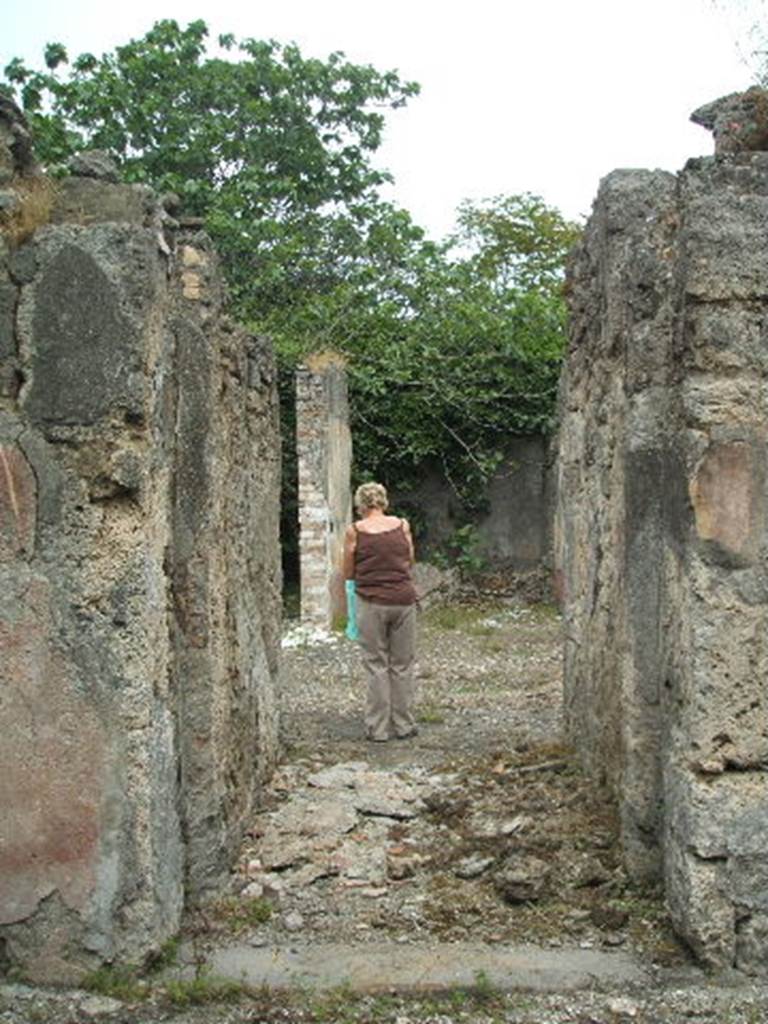
V.4.c Pompeii. May 2005. Entrance doorway, with remains of stucco fallen from wall.
According to Sogliano, the threshold of the entrance doorway was made of lava.
This had the usual groove for the doorposts and with hinges of iron, remains of which were seen to the left, and with holes for the door bolts.
Immediately behind the doorpost, in both walls of the fauces or corridor (andron), could be seen two large vertical recesses.
These recesses would have housed the four folding shutters when they were open, two shutters on each side.
The entrance fauces or corridor (andron) was decorated in red plaster, divided into panels.
In the middle of each panel was a rectangular painting on a black background, with the representation of various types of birds, leaning towards the earth and pecking.
In three of the panels the bird was pecking at some fruit, but in the fourth (south, to the right), it was pecking a butterfly or other insect.
The base of the corridor wall was black, and the floor was of opus signinum/cocciopesto.
See Notizie degli Scavi di Antichità, 1905, p.130
According to Peterse, a setback can be observed in both walls of the fauces, closest to the street.
This indicates a demarcation of the entrance-way.
This would have been between the vestibulum facing the street, and the fauces belonging to the house interior.
See Peterse, K: in Dobbins, J. J. and Foss, P. W., 2008. The World of Pompeii. Oxford: Routledge. (p.378)
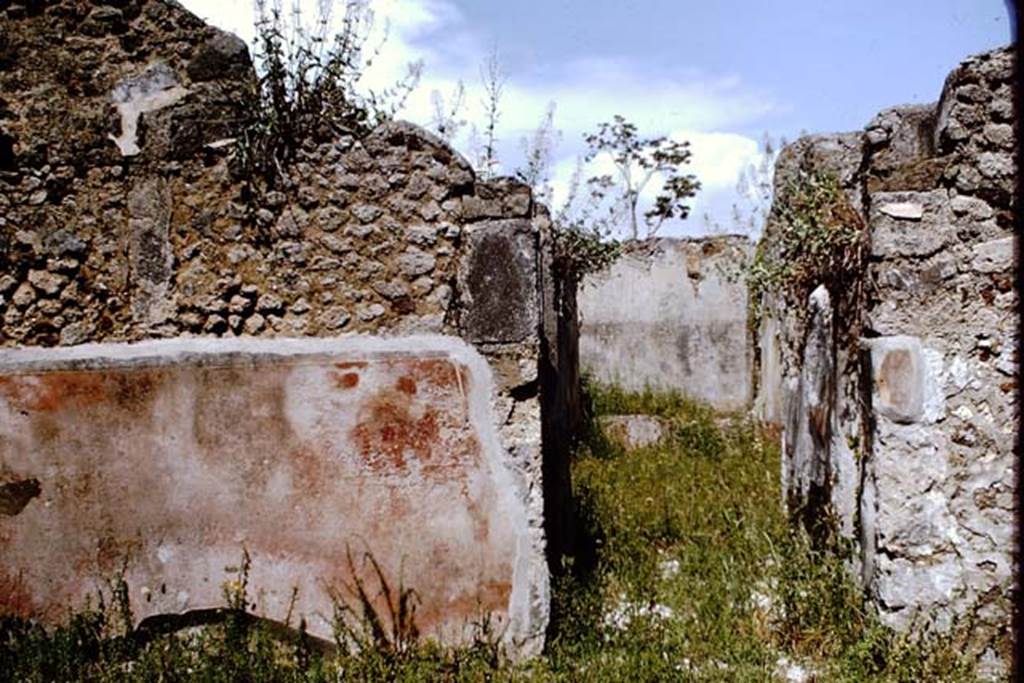
V.4.c Pompeii. 1964. Looking east to entrance doorway. Photo by Stanley A. Jashemski.
Source: The Wilhelmina and Stanley A. Jashemski archive in the University of Maryland Library, Special Collections (See collection page) and made available under the Creative Commons Attribution-Non Commercial License v.4. See Licence and use details.
J64f1228
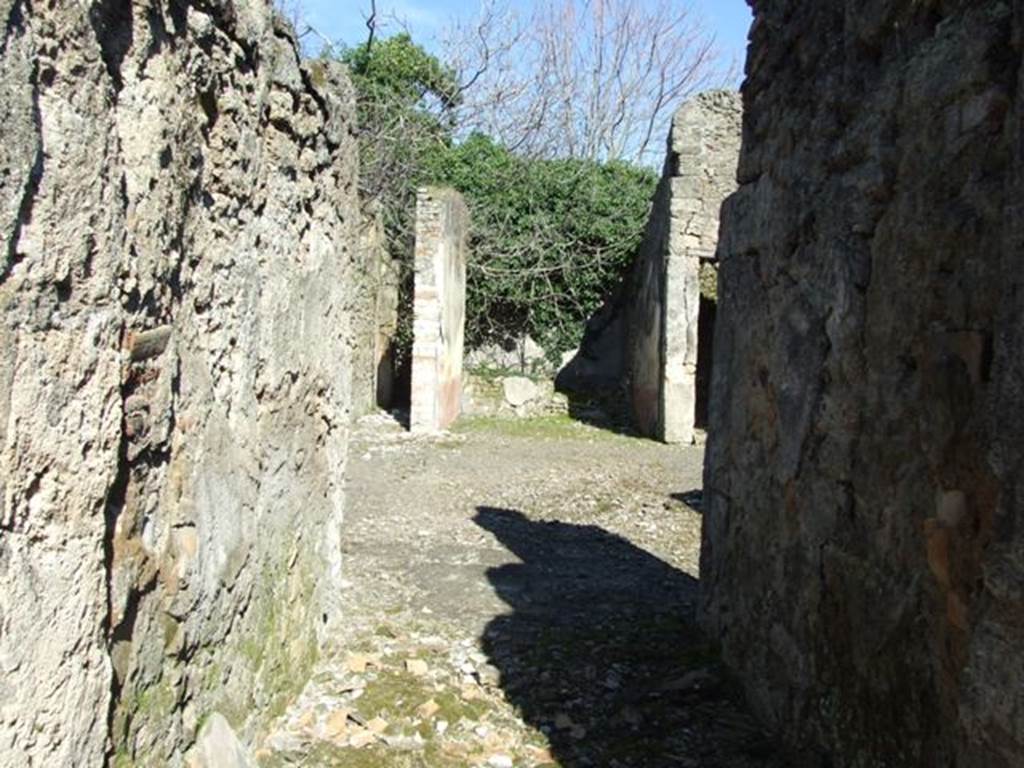
V.4.c Pompeii. March 2009. Looking east across room A, the fauces, towards atrium and tablinum.
According to NdS, (1902) –
In the
house in Reg. V that had its doorway opposite to the one at V.3.11 (therefore
V.4.c), I verify that on the 1st May, an important discovery was
made of 4 skeletons with the following objects –
Large gold
bracelet in the shape of facing serpents;
Two gold
rings set with stone;
A pair of
earrings;
One aureus
of Nero, and two of Domitian;
29 silver
coins, silver bronze mirror
The death
of the unfortunates would have seemed to have been from the fire that caused
the floor of the upper room, where they had taken refuge, to collapse, and
whose violence had partly burnt their bones and left traces on the paintings on
the walls.
The house,
to judge from the part excavated up until now, will not have been very large,
nor as beautiful as the one opposite to it (V.3.11).
However, it
had in the tablinum fairly good paintings showing the four seasons (Autumn
completely disappeared, and in the atrium was a painting of Mercury with purse
and staff/caduceus, very similar to the one existing in the thermopolium
V.4.6-7 (see Notizie1899, p. 343) however, “ours” had a large serpent
curled/tangled at his feet.
R.PARIBENI.
See Notizie degli Scavi di Antichità, 1902, (p.276).
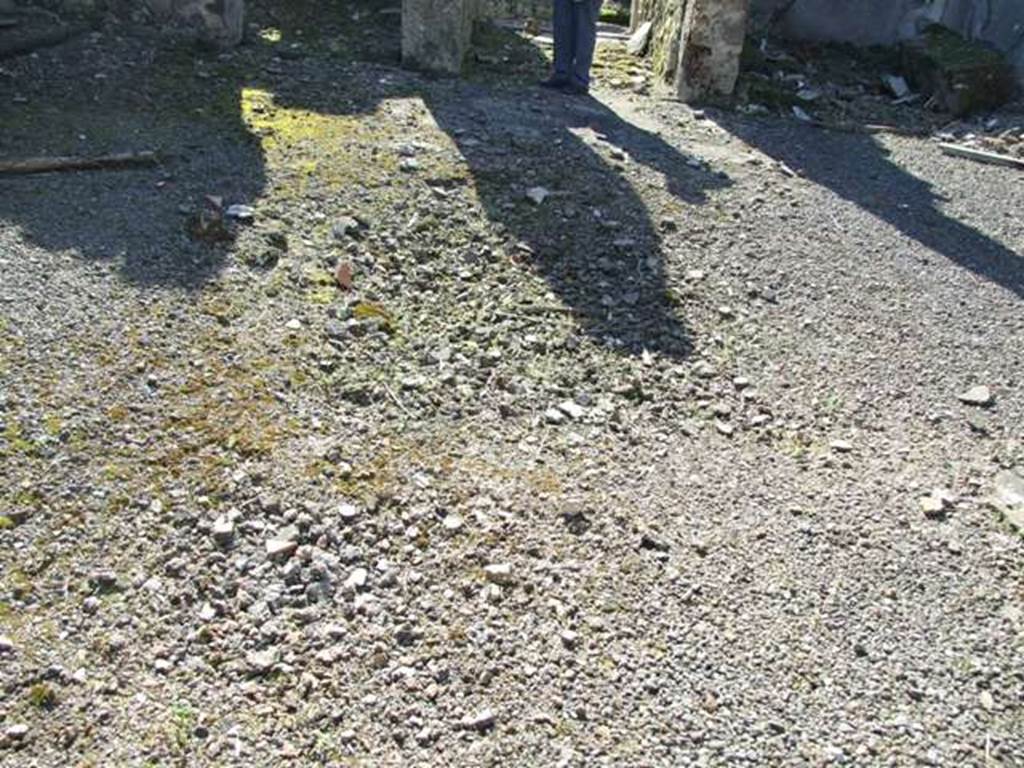
V.4.c Pompeii. March 2009. Room B, the atrium, looking west across site of impluvium.
Upon excavation, at the head of the impluvium on the east side, a marble table (a) was discovered.
It was supported by a marble statuette of an animal, perhaps a leopard with eyes of glass paste.
It was crouching on its hind legs, in profile to the right and with the head in front.
On the south side, slightly to the rear of the table, was a terracotta puteal (b).
Found in the area of the puteal, was a lead funnel to pour water collected through a water-pipe into the adjacent tank.
Also found at the impluvium on April 29th, 1902 was one of the usual cylindrical lead water-tanks.
Two bronze basins, one with traces of silver-plating, a casserole with similar traces, and a swollen belly-jug, were also found.
In the soil of the atrium, between 2nd and 6th June 1902, money and other objects were listed in NdS, 1902, (p.379).
See Notizie degli Scavi di Antichità, 1905, (p.130)
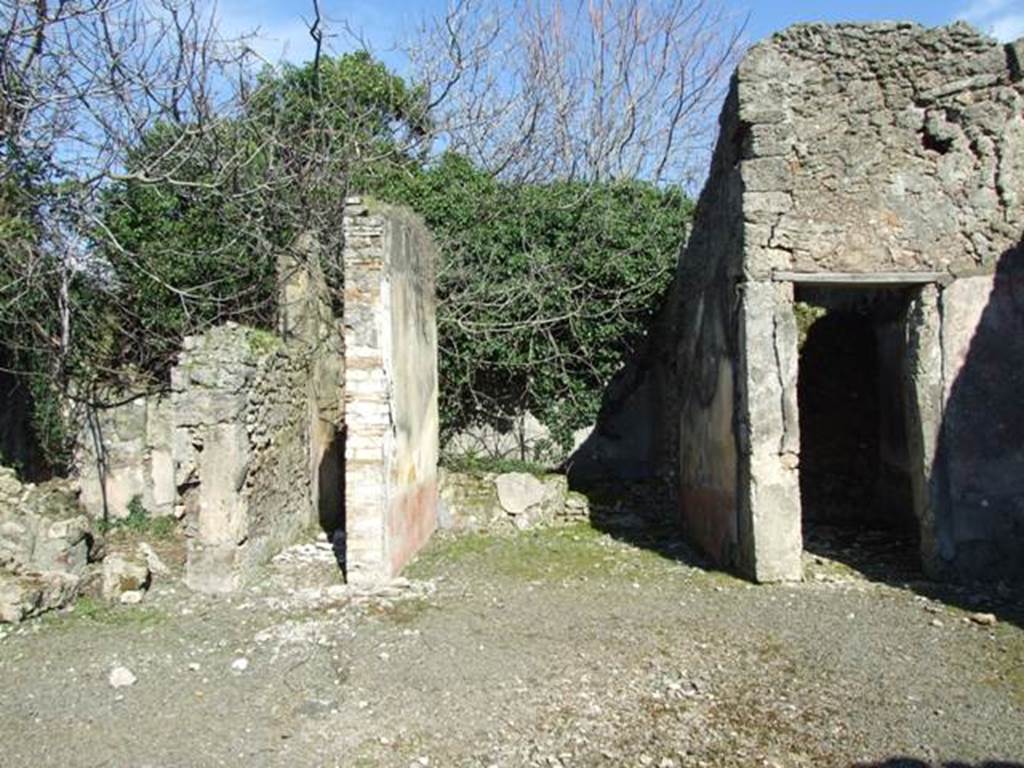
V.4.c Pompeii. March 2009. Room B, the atrium, looking east.
Looking across atrium to doorways to room F, on left, room J, corridor to garden, room G, tablinum, and room H, cubiculum.
When excavated the atrium had flooring similar to that of the fauces, opus signinum/cocciopesto.
According
to Paribeni in V.4.c Pompeii (described as second house after that of Lucrezio
Frontone); Found on 15th March 1902, between the upper layers of a
room near the tablinum, was an oxidised statuette (100mm high) of a bearded and
crowned Hercules, leaning with the weight of his body on his right leg, since
the left leg was slightly bent. In his right hand he held the club pointing
downwards, and in his left hand he held the apples of the Hesperides; the
lion’s skin was hanging on his left forearm. If he was beardless, he would have
very closely resembled the Hercules Righetti of the Vatican Rotunda.
Also found
were – a bronze cylindrical bell with an iron ringer/clapper. An oxidised
medium and small bronze coin. A glass bottle with a spherical belly.
Found on
the 24th March in the same place was a terracotta single-burner
lamp, with a ring handle.
See Notizie degli Scavi di Antichità, 1902, (p.213)
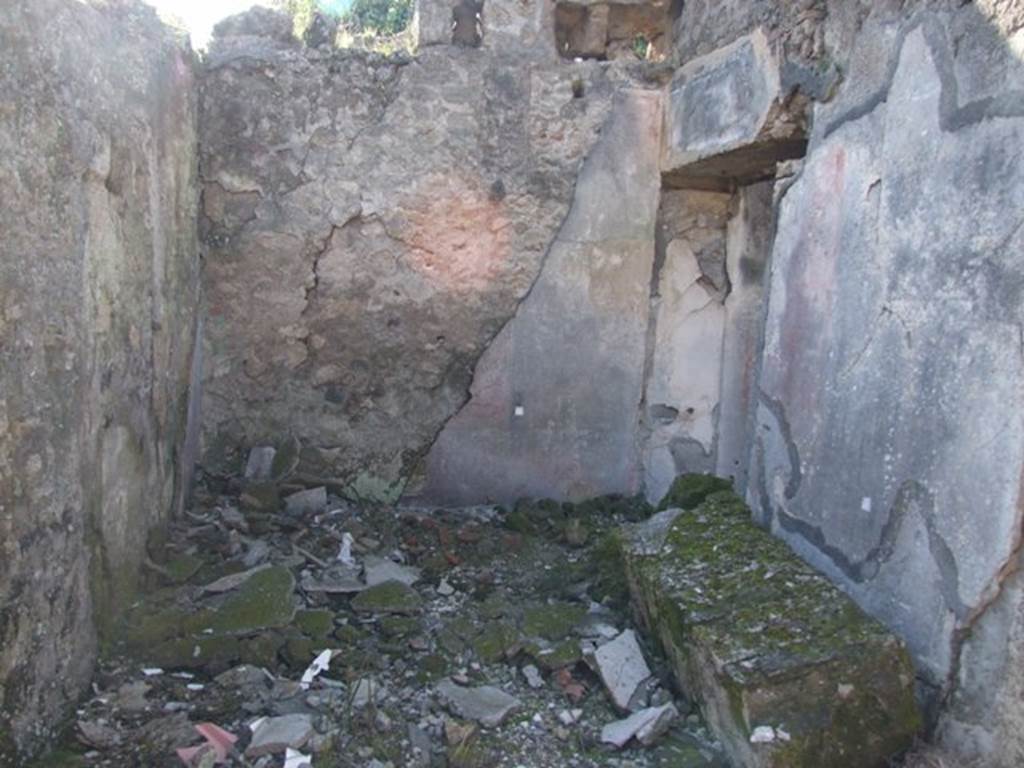
V.4.c Pompeii. March 2009. Room C, anteroom on north side of entrance corridor.
Looking west into anteroom to large triclinium (doorway on right), in north-west corner of atrium.
When discovered, each painted wall of room C was divided into three panels, the centre panel was red, and the side panels were black.
There were also two horizontal bands, adorned with stylized flowers.
These separated the panels from the base of the walls which were painted red, without decoration.
In the horizontal bands, decorative objects were suspended from white ribbons, a tambourine in the centre, and two pan-pipes at the sides.
The holes for the beams at the top of the west wall (just visible in photo) showed that the room had been covered by an upper floor.
In this room C, on the 1st May 1902, four skeletons with gold and silver coins and other precious objects, were found, described in NdS, 1902, (page 276 and 372).
See Notizie degli Scavi di Antichità, 1905, (p.131-2).
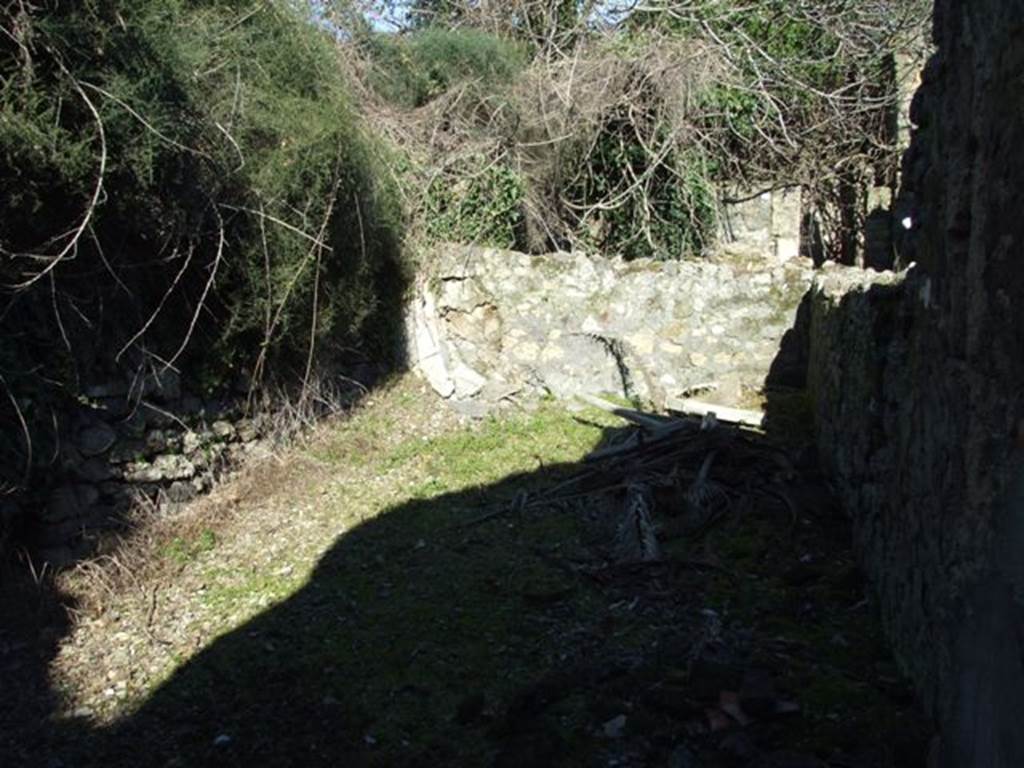
V.4.c Pompeii. March 2009. Room D, large triclinium, looking east.
The triclinium D was notable for the beautiful opus signinum floor.
Although this was decorated in simple parallel rows of white marble stones, it formed a large rectangle in its centre.
This rectangle was also formed with white tesserae, the larger two-thirds showing a rhomboid-meshed netting design.
The other third with a combination of motifs.
See the drawing of the floor of the room D on the room Plan.
See Notizie degli Scavi di Antichità, 1905, (p.129, and 132).
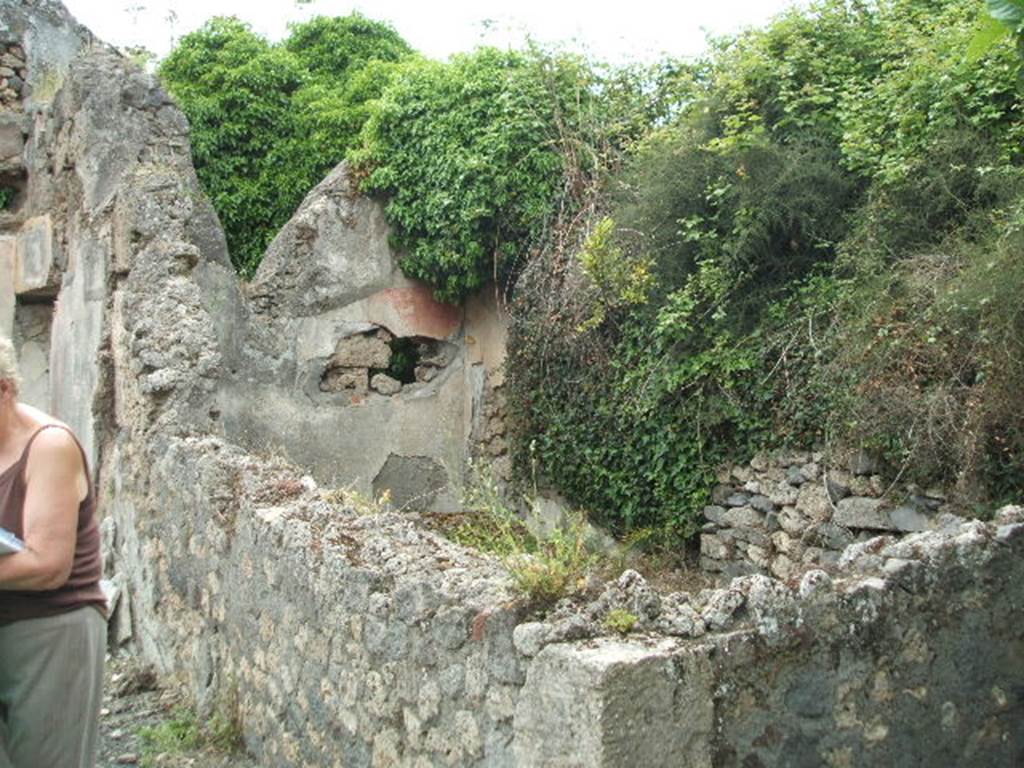
V.4.c Pompeii. May 2005. Room D, large triclinium, looking west from atrium.
The west wall still shows some of the painted decoration, this would have had three painted panels.
The centre panel was yellow, the sides red, separated by black bands.
The base of the wall was black decorated with plant motifs.
The east wall was similar.
The north and south walls were different with alternative black and red painted panels.
However, in the north wall towards the right, the remains of a yellow panel could be seen.
The decoration thus changed in the eastern end of the room, as well as the design in the rectangle in the floor.
This easily clarified this room as being a triclinium, with the couches being placed in the eastern end.
In the eastern side of the north wall, a hollow for a couch could have been seen.
See Notizie degli Scavi di Antichità, 1905, (p.132).
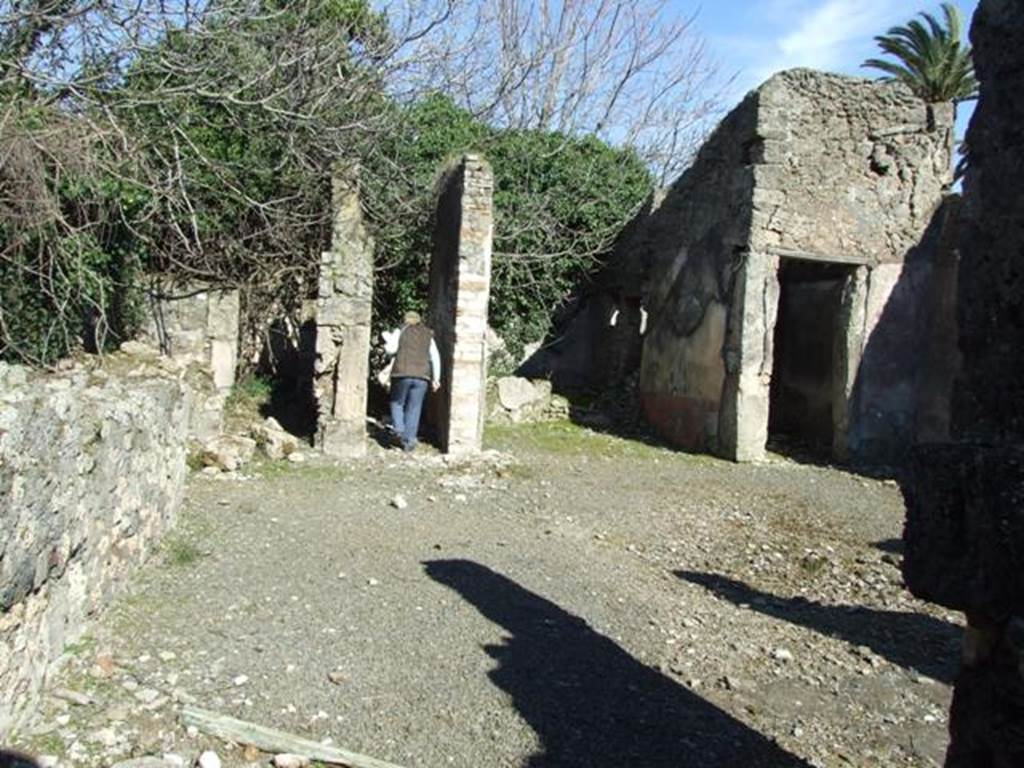
V.4.c Pompeii. March 2009. Looking east across north side of atrium, room B.
On the right of the photo, on the south side of the doorway of room H, a painting of Mercury was found in a large red panel.
He was turned slightly to the right, standing, naked except for a long pink cloak, and helmet.
His boots were almost faded but without doubt were winged.
In his left he held the staff against his corresponding shoulder, and with his right hand he held the purse.
On the ground at his feet, was the omphalos with the serpent around it.
See Notizie degli Scavi di Antichità, 1905, (p.131).
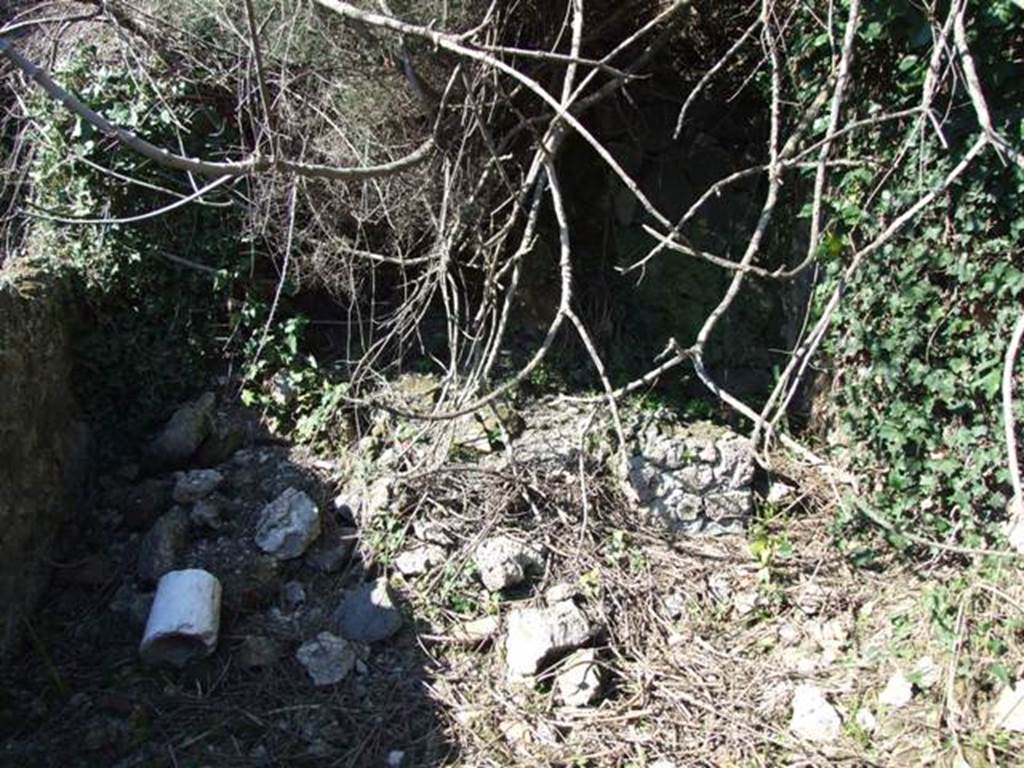
V.4.c Pompeii. March 2009. Room E, ala on north side of atrium.
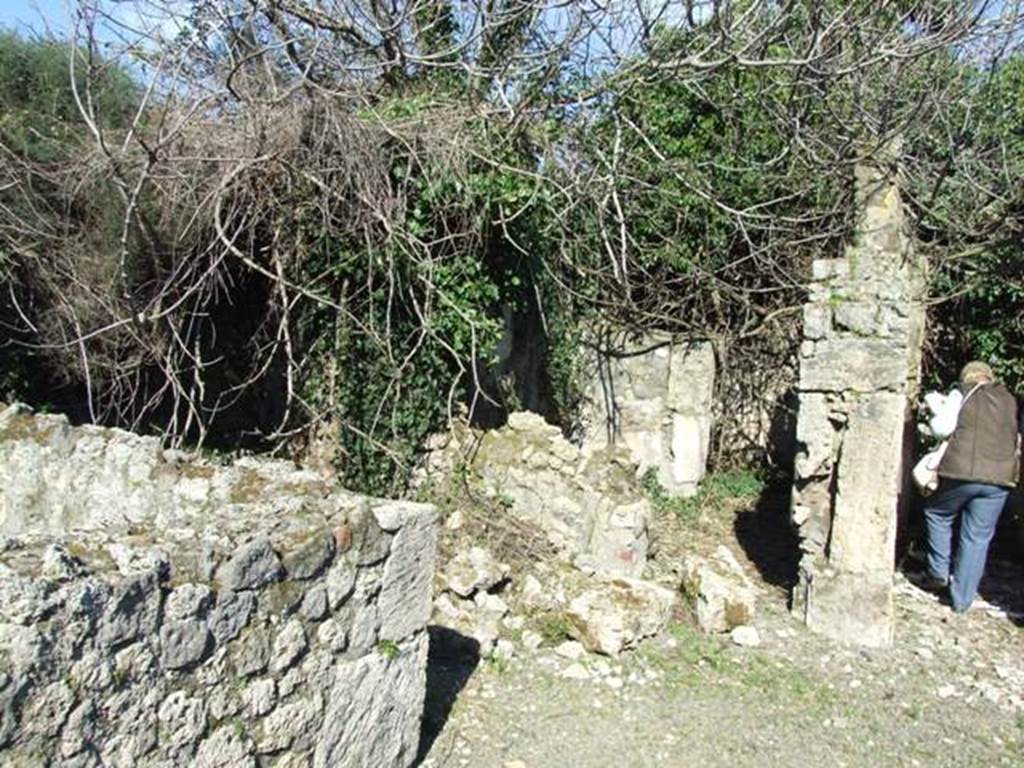
V.4.c Pompeii. March 2009. Ruined doorway of room F, cubiculum or rustic room in the north-east corner of atrium B.
Looking east from restored wall of triclinium D, across room E, ala, towards to room F.
In the east wall of the ala, the doorway to rustic room F was found.
It would have had a wooden threshold, a mortar floor, and white stucco on the walls.
In the south wall, at a height of 0.95m from the ground, a small area was found with traces of shelving.
See Notizie degli Scavi di Antichità, 1905, (p.133).
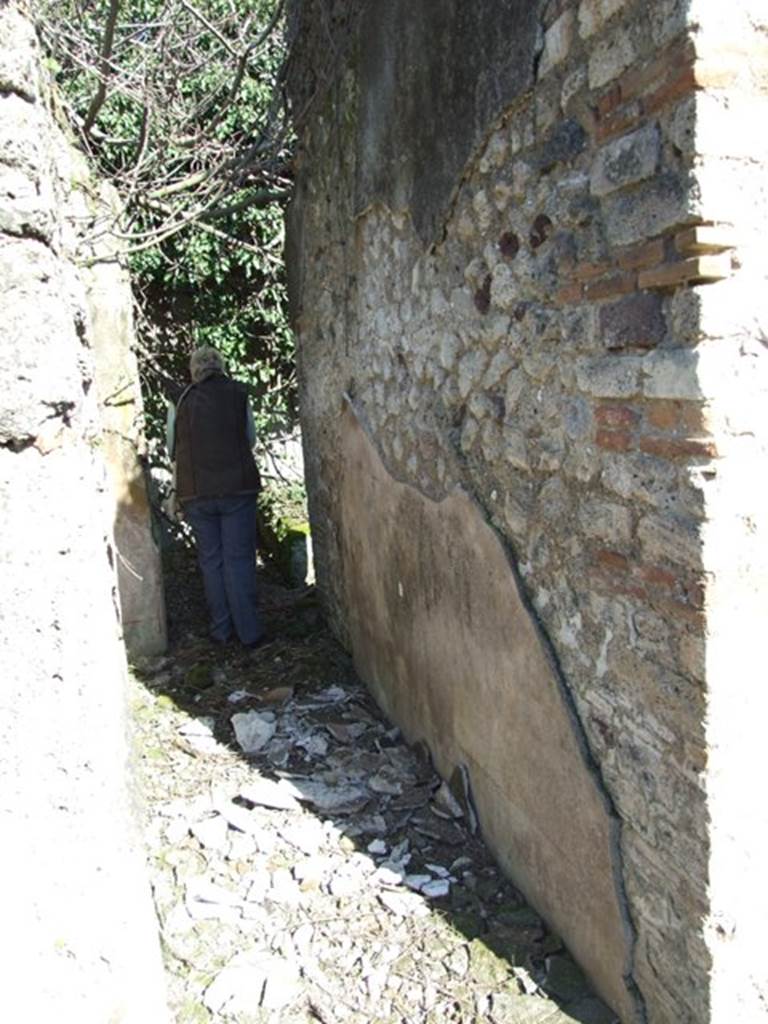
V.4.c Pompeii. March 2009. Room J, andron or corridor to garden area.
The corridor had an opus signinum floor and walls of rough plaster, painted in red and black.
The garden being at a slightly higher level than the corridor, there would have been one step of wood in the eastern end of the corridor.
See Notizie degli Scavi di Antichità, 1905, (p.135).
V.4.c Pompeii. March 2009. Looking east from the end of the andron J, into the garden area, area K.
The entrance to triclinium L is on the left. The north ambulatory of garden K is centre, leading to niche (e).
The north wall of the garden pluteus is right.
V.4.c Pompeii. March 2009. Room L, triclinium on the north side of the garden K, looking north.
On the north side of the garden opened the room L, a wide room with travertine threshold.
Of the two pilasters of the room, the one on the left was covered with rough plaster, while the other had a coating of fine plaster: at the top of the pilaster, three large holes made with the chisel could be seen.
The room, which was probably covered by a barrel vault, with cocciopesto floor.
The walls were decorated with a white background with a red base, which was enlivened by beautiful painted plants.
The white walls were panelled, each panel having a flying figure in the centre, a griffin, panther, or a bird, like a swan.
In the middle of the eastern wall a bricked-up window was found, the masonry of which had already been covered with a layer of rough plaster.
A wooden closet (f) was hung at the south-west corner of the room, as could be seen by an outline made in the floor, and the traces left in the walls.
See Notizie degli Scavi di Antichità, 1905, (p.138).