I.19.3 Pompeii. House of Lucius Satrius Rufus?
Only the street fronts have been excavated, c.1932-34 see CTP IIIA, p.34.
Originally, this Insula was numbered as Reg. I, Insula 11, and then altered to Reg I, Insula 19.
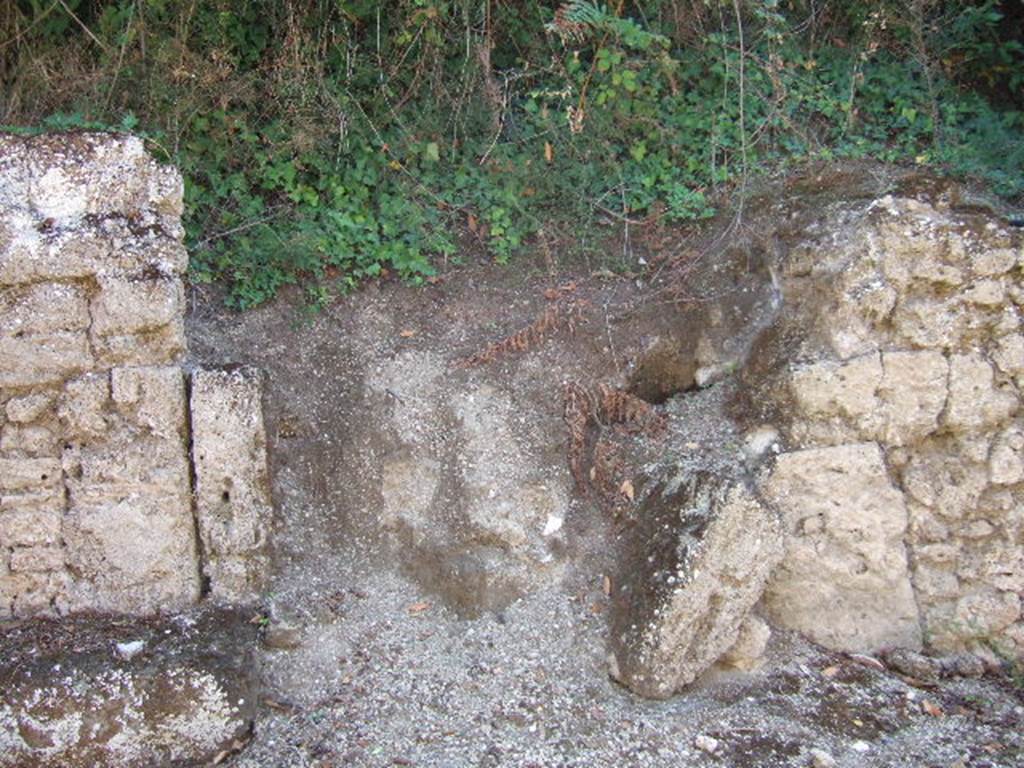
I.19.3 Pompeii. September 2005. Entrance doorway, looking south.
According to Beard, a small bronze plaque was found here.
It read – “Lucius Satrius Rufus, imperial secretary (retired).
If it is the name-plate from the door, then this is the only marker so far found in Pompeii.
See Beard, M. (2008): Pompeii, the life of a roman town. London, Profile Books, (p.115)
According to Della Corte, of the two shutters of the entrance door, one held the door-lock.
The other facing the street, had a bronze tablet incised with the name of the house-owner, fixed by four bronze plates.
It read – L.
Satri Rufi, evocati Aug(usti)
a commentar(is)
See Notizie degli Scavi di Antichità, 1933, p.322, no.358
See Della Corte,
M., 1965. Case ed Abitanti di Pompei.
Napoli: Fausto Fiorentino. (p.305-6).
According to
Pagano,
Another bronze tablet from Pompeii, with the name of one L. Satrius Rufus, evocatus Augusti a commentar(is) was affixed to a wooden element.
It is very uncertain whether they meant to the door of the domus as the excavators assumed.
These are the words of the Giornale di Scavo of 20th June 1933:
“proseguendo la
regolamentazione delle terre alla base della scarpata, nel 3 vano si e
rinvenuto nello strato vergine del lapillo, a destra della serratura di ferro,
a m.0.50 piu in dentro della linea esterna dello stipite ed a m.0.73 di altezza
dalla soglia: targa biansata di bronze (inv. 5646)”.
(translation: “found in the third doorway in the virgin
layer of lapilli, to the right of the iron lock, at more than 0.50 m. inside of
the outer line of the doorpost/jamb and at a height of 0.73m from the
threshold: a two-handled bronze plaque (inv. 5646)”.
See Pagano, M.
(1997): I Diari Di Scavo di Pompei
Ercolano e Stabiae di Francesco e Pietro La Vega (1764-1810): Roma: “L’Erma
di Bretschneider” (p.163, note 144) in Monografie 13.